تقنية التقطير التفاعلي

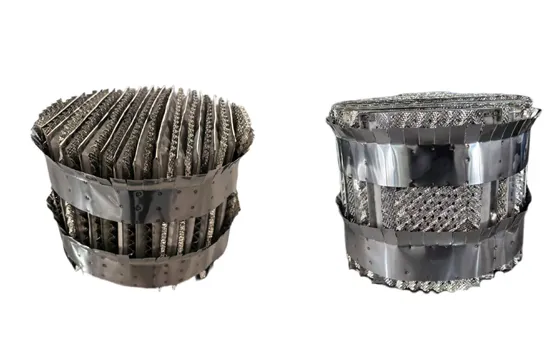
The catalyst support features a narrow sandwich design, which helps improve the separation efficiency of reactive distillation and enables more effective catalyst contact in bubble column applications…

Reactive Distillation Technology Introduction​

Structured catalyst supports are used and applied in gas-liquid reaction systems. These advanced catalyst particles are firmly fixed between two layers of metal wire mesh, forming a unique “sandwich” structure. Each sheet is corrugated, creating flow channels with specific angles and hydraulic diameters. The sandwich layers and flow channels are assembled in opposite directions, resulting in an open cross-flow structural pattern.

Technical Principle Of Reactive Distillation​

Technical Principle Of Reactive Distillation

Structured catalyst supports are used and applied in gas-liquid reaction systems. These advanced catalyst particles are firmly fixed between two layers of metal wire mesh, forming a unique “sandwich” structure. Each sheet is corrugated, creating flow channels with specific angles and hydraulic diameters. The sandwich layers and flow channels are assembled in opposite directions, resulting in an open cross-flow structural pattern.

Why Choose DODGEN Reactive Distillation

Combining Reaction and Distillation

  • Simultaneous product separation through reaction, altering chemical equilibrium and increasing reaction conversion

  • Suppression of side reactions

  • Utilization of reaction heat in mass transfer operations

  • Lower capital investment

  • Reduced energy consumption

  • Higher product yield


Application of Heterogeneous Catalysts

  • Avoidance of catalyst separation and recovery

  • Significant savings in acid treatment

  • Precise definition of the position and height of the reaction zone within the column

  • Easier operation

  • Fewer corrosion issues

  • Lower investment costs

Why Choose DODGEN Reactive Distillation

Esterification: Acetate esters (e.g., methyl acetate, ethyl acetate, butyl acetate), acrylate esters (e.g., methyl acrylate, ethyl acrylate, butyl acrylate), phthalate esters, malonate esters, and other diacid esters; FAME (fatty acid methyl esters, biodiesel).

Etherification: Oxygenates (e.g., MTBE, ETBE, TAME); glycol ethers (e.g., ethylene glycol ethyl ether, diethylene glycol butyl ether).

Hydrogenation: Selective hydrogenation of butadiene; hydrogenation of nitroaromatics; hydrogenation of fatty acids.

Process Water Purification: Removal of organic compounds (e.g., formaldehyde) from process water; removal of nitrates from wastewater.

حلول المعالجة الكيميائية

التطبيق

الاستدامة

أرسل لنا رسالة

متخصص في التفاعل والفصل، شركاء التكنولوجيا منخفضة الكربون

dodgen-chemical-process-company

اتصل بنا

نبذل قصارى جهدنا لتلبية احتياجاتك