Producing battery-grade lithium bis(fluorosulfonyl)imide (LiFSI) requires control beyond final assay. Crude material can contain moisture, acidic species, chloride, fluoride, sulfate-related impurities, metals, insoluble solids, and process solvents that respond differently to purification operations.
Crystallization can contribute to both impurity rejection and particle engineering. A practical LiFSI crystallization purification and particle size control strategy must therefore connect crystallization with upstream impurity removal, mother-liquor separation, washing, drying, closed handling, and scale-up validation.
Why Battery-Grade LiFSI Is a Purification Problem
Different LiFSI synthesis routes generate different impurity profiles. Residual lithiation reagents can contribute insoluble material, while moisture, solvents, and ionic impurities require different separation mechanisms.
No crystallization step should therefore be expected to remove every impurity. Insoluble material can be removed before crystallization by filtration, volatile components and moisture may require concentration or distillation-based operations, and crystallization can separate LiFSI from species that remain preferentially in the liquid phase under the selected solvent and operating conditions.
The process-development question is not simply how to crystallize LiFSI. It is which impurity should be removed at which unit operation and under what conditions.
Choosing the LiFSI Crystallization Route
LiFSI purification can involve solution crystallization, solvent or anti-solvent crystallization, or potentially melt-based separation concepts when LiFSI-specific phase behavior and thermal stability support them.
Selection should follow feed state, impurity behavior, phase or solubility data, thermal constraints, solvent requirements, recovery targets, and downstream solids handling.
Where Melt Crystallization Could Fit
Melt crystallization is an established separation principle in which controlled solidification separates a crystalline product from impurity-enriched liquid. Its performance depends on solid-liquid equilibrium, impurity distribution, crystal formation, and removal of retained liquid.
Applied to LiFSI, however, these general principles do not by themselves establish an industrial melt-crystallization process.
A LiFSI-specific assessment would need reliable phase-equilibrium data, impurity distribution behavior, thermal stability under actual residence times, melt viscosity and transport characteristics, corrosion compatibility, and evidence that impurity-rich liquid can be effectively separated from the crystalline phase.
If those conditions are favorable, melt crystallization could reduce dependence on crystallization solvents. The resulting trade-off would shift toward thermal duty, heat-transfer design, solid transport, fouling, crystal-liquid separation, and temperature control.
Melt crystallization should therefore be treated as a candidate purification route requiring experimental validation, rather than assumed to be inherently superior to solvent-based crystallization.
Solvent and Anti-Solvent Crystallization
Solution crystallization generates supersaturation by changing temperature, concentration, solvent composition, or a combination of these variables.
In anti-solvent crystallization, changing liquid composition reduces LiFSI solubility. Anti-solvent addition and mixing must be coordinated because poor distribution can generate local supersaturation and excessive nucleation before the bulk solution reaches the intended composition.
Published LiFSI patent routes provide direct examples of this broader purification strategy. One disclosed process combines co-distillation, dissolution of solid LiFSI in an anhydrous carbonate solvent, micron filtration of insoluble impurities, concentration, and subsequent crystallization.
This sequence illustrates an important process principle: impurity classes can be assigned to different separation operations rather than forcing crystallization to perform the entire purification duty.
Solution-based routes also provide particle-control variables through solvent composition, cooling, concentration, seeding, and anti-solvent addition. Their trade-offs include solvent recovery, residual solvent control, drying load, product loss, and closed handling.
When a Hybrid Purification Strategy Makes Sense
For demanding battery-grade specifications, process selection does not need to reduce to melt versus solvent crystallization.
Distillation or dehydration, filtration, crystallization, washing, and drying can target different impurity classes. The sequence should be selected according to separation efficiency, product recovery, energy demand, solvent inventory, and operational controllability.
This approach reserves crystallization for separations supported by the relevant phase or solubility behavior.
How Crystallization Couples Purity With Particle Size
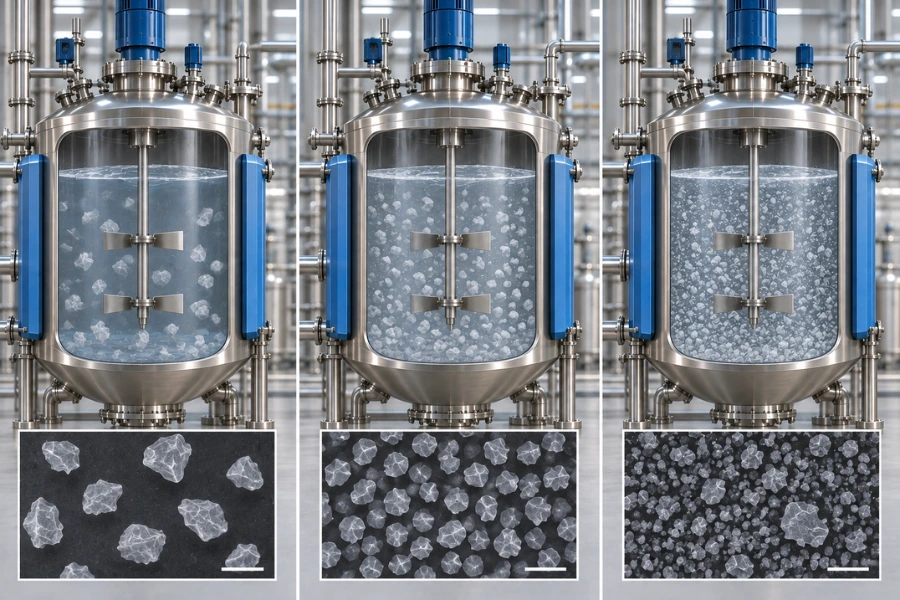
Supersaturation or supercooling provides the driving force for crystallization. Its magnitude and spatial distribution influence how rapidly new nuclei form relative to the growth of existing crystals.
Rapid supersaturation generation can produce a large population of fine crystals. A high fines fraction changes the crystal size distribution and can complicate subsequent solid-liquid separation and mother-liquor removal.
More controlled supersaturation can favor growth on existing crystals, but insufficient driving force increases processing time and may reduce crystallizer productivity.
The operating window must therefore balance nucleation, crystal growth, impurity rejection, yield, cycle or residence time, CSD, and downstream solids handling. Purity and particle size are linked through the same crystallization history.
Engineering LiFSI Particle Size Distribution
Final CSD reflects cooling or anti-solvent addition, seeding, mixing, residence time, agglomeration, and crystal breakage. D50 alone cannot indicate whether the product contains excessive fines, a broad distribution, or agglomerated particles.
Cooling and Anti-Solvent Addition
A cooling profile should manage the rate at which supersaturation develops rather than simply follow a predetermined temperature ramp. Anti-solvent addition similarly needs to limit strong local composition gradients around the feed zone.
At commercial scale, bulk temperature and average composition can conceal conditions near cooling surfaces, addition points, or poorly mixed regions. Local conditions may therefore initiate nucleation before the bulk process reaches its nominal target.
Seeding Strategy
Seeding introduces existing crystal surfaces for growth and can reduce dependence on uncontrolled primary nucleation.
Seed loading, size distribution, addition point, and dispersion determine the initial crystal population available to consume supersaturation. Seed strategy should therefore be linked to the targeted CSD and supersaturation profile rather than specified only as a fixed mass percentage.
Mixing and Crystal Attrition
Mixing distributes heat and solute and maintains solids suspension. Increasing agitation, however, also increases crystal-crystal and crystal-equipment interactions.
If crystals are mechanically susceptible to breakage, attrition can generate smaller fragments and alter the CSD. The appropriate agitation level must balance circulation and suspension against experimentally observed crystal damage.
Why Larger LiFSI Crystals Are Not Automatically Better
For geometrically similar particles, increasing characteristic particle size reduces specific surface area per unit mass. Reducing the fines fraction can therefore reduce exposed surface area and may improve some powder-handling characteristics.
That physical relationship does not establish a universal optimum LiFSI particle size or prove a specific reduction in moisture uptake.
Crystal morphology, distribution width, agglomeration, mechanical robustness, and dissolution behavior also matter. A large agglomerate and a well-formed individual crystal can produce similar particle-size measurements while behaving differently during handling and electrolyte preparation.
LiFSI particle specifications should therefore evaluate D50 together with distribution width, fines fraction, morphology, agglomeration tendency, moisture behavior, and downstream dissolution requirements. The optimum range should be established experimentally for the intended product and process.
Filtration, Washing, and Drying Determine Final Product Quality
Crystallization determines which components enter or remain outside the solid phase. Isolation determines how much impurity-containing liquid remains associated with the recovered crystals.
Mother-Liquor Separation and Washing
A wet crystal cake retains mother liquor within interparticle voids and on particle surfaces. When rejected impurities are concentrated in that liquid, drainage and washing influence final impurity carryover.
Fine-rich cakes can increase resistance to liquid flow, while agglomerated structures may retain liquid internally. Washing performance consequently depends on CSD, morphology, cake permeability, liquid properties, displacement efficiency, and product solubility in the wash medium.
Increasing wash volume may improve impurity displacement but can also increase product dissolution, solvent recovery demand, and drying load. Wash conditions should therefore be evaluated against both impurity removal and product recovery.
Drying and Moisture Protection
Drying must remove retained process liquid while limiting moisture pickup, thermal exposure, caking, and agglomeration.
Specific published LiFSI patent examples use reduced-pressure drying below 50°C following their particular solvent-based isolation sequences. That temperature should be treated as a process-specific example rather than a universal LiFSI drying specification.
Vacuum operation reduces the boiling temperature of volatile components, but drying rate can still be limited by heat and mass transfer through the wet cake or powder bed. Because drying can change agglomeration and apparent PSD, particle characteristics should be checked after drying rather than only at crystallizer discharge.
Dry transfer conditions and packaging should then be validated against the required final moisture specification.
Scaling LiFSI Crystallization From Pilot to Commercial Production
A laboratory LiFSI crystallization process cannot be scaled by multiplying vessel volume while preserving cooling time and agitator speed.
As equipment size increases, heat-transfer area relative to volume, mixing time, solids suspension, and local supersaturation behavior change. The same nominal bulk temperature profile can therefore produce a different crystal population.
Material near a commercial crystallizer’s heat-transfer surface may experience a different thermal history from the bulk. Local supersaturation can promote wall nucleation or deposition, while accumulated deposits can reduce heat transfer and progressively alter the cooling profile.
Mixing introduces another scale-dependent trade-off. Higher agitation may improve suspension but increase attrition if the crystals are mechanically fragile, while inadequate circulation can create local variations in temperature, concentration, and crystal population.
Continuous crystallization introduces residence-time distribution as another design variable. Crystals experiencing different residence times can leave at different stages of growth, broadening CSD and changing downstream filtration and washing behavior.
Pilot validation should therefore evaluate:
- supersaturation and thermal profiles
- heat-removal capability
- nucleation and growth behavior
- mixing and solids suspension
- crystal attrition and agglomeration
- wall deposition and fouling
- particle size distribution
- filtration and washing performance
- drying behavior
- impurity distribution between product and mother liquor
- impurity accumulation where streams are recycled
The purpose of pilot work is to establish whether process behavior remains reproducible as scale changes, not merely whether one pilot batch reaches the target assay.
Integrating the Battery-Grade LiFSI Purification Process
A commercial purification train should be designed backward from the required LiFSI specification and the impurity profile entering purification.
A conceptual sequence may be:
Crude LiFSI → dehydration or pre-purification → insoluble removal → controlled crystallization → mother-liquor separation and washing → vacuum drying → dry closed handling → battery-grade LiFSI
This is a process-development framework, not a universal LiFSI flowsheet. The actual sequence depends on feed chemistry, impurity behavior, solvent system, product specification, recovery targets, and equipment constraints.
Recycle streams require particular validation. If crystallization preferentially rejects an impurity into the mother liquor, recycling that stream without sufficient purge can progressively increase the impurity concentration entering subsequent cycles.
Recycle design should therefore be based on measured impurity partitioning, material balances, purge requirements, and the effect of changing recycle composition on crystallization behavior.
Key Parameters to Validate Before Scale-Up
| Parameter | Process Impact | Evidence Needed for LiFSI Scale-Up |
|---|---|---|
| Feed impurity profile | Determines separation strategy | Analytical characterization across feed lots |
| Phase or solubility behavior | Defines crystallization window | LiFSI-specific equilibrium data |
| Supersaturation | Controls nucleation and growth | Solubility and crystallization experiments |
| Cooling profile | Influences CSD and productivity | Pilot heat-transfer data |
| Seeding | Controls initial crystal population | Seed-response experiments |
| Agitation | Controls mixing and suspension | Mixing and attrition testing |
| Solids loading | Changes slurry behavior | Rheology and suspension data |
| Mother-liquor removal | Controls impurity carryover | Impurity partition and cake data |
| Washing | Removes retained liquid | Wash-efficiency and product-loss data |
| Drying | Controls moisture and residual solvent | Drying kinetics and product stability |
| Atmosphere control | Limits moisture exposure | Moisture pickup testing |
| Recycle strategy | Affects recovery and impurity inventory | Material balance and impurity accumulation data |
The value of these parameters lies in their interaction. Cooling affects CSD, CSD affects cake behavior, and cake behavior affects mother-liquor removal and final impurity carryover.
From LiFSI Crystallization to Battery-Grade Production
Battery-grade LiFSI production requires impurity removal, crystallization, solids separation, drying, and recycle management to operate as an integrated purification system. General crystallization principles can guide process development, but LiFSI-specific phase behavior, impurity partitioning, particle characteristics, and thermal limits must be established experimentally before a route is scaled.
DODGEN applies this process-engineering approach to purification strategy, pilot validation, crystallization scale-up, and process integration when evaluating pathways toward stable battery-grade LiFSI production.