
DODGEN
Polymerization Reactor
DODGEN provides customers high-cost-performance solutions in the production of polymers and high-viscosity substances, including advanced polymer reactors, polymerization equipment, and professional polymerization reactor design.
Polymerization Reactor Introduction
Based on the principles of efficient static differential mixing and heat transfer, DODGEN has created a new composite DSR reactor for continuous controllable polymerization processes, such as bulk polymerization and solution polymerization. Its outstanding feature is the ability to provide very large heat transfer and reaction areas while precisely controlling heat transfer and mixing efficiency to achieve uniform temperature and concentration at the micron scale. This enhances the improvement of conversion rates and the polymer quality, thereby fulfilling various stringent and demanding requirements. DODGEN specializes in advanced polymerization reactors, ensuring efficient, high-quality polymer production for various industrial applications and research purposes.
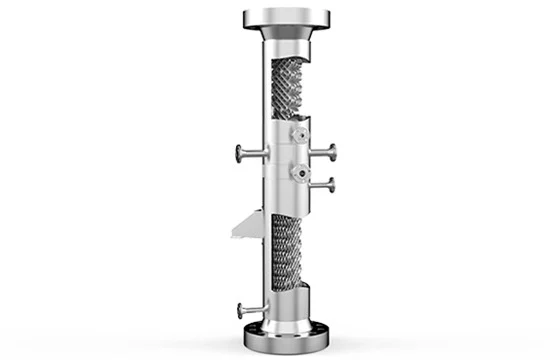
Compact coil structure enhances mixing and heat transfer efficiency.
Academic Recognition
DODGEN’s commercialized millimeter-scale zigzag-tube heat exchange equipment (DSR reactor) is referenced as an industrial scale-up example in the De Gruyter textbook Flow Chemistry, Volume 2: Applications (2nd ed., 2021), Chapter 8 “Scale-up of Flow Chemistry System” (pp. 229–258, authored by Prof. Guangsheng Luo’s group, Tsinghua University), p. 242, Ref. [16]. DOI: 10.1515/9783110693690-008
Technical principle of Polymerization Reactor
Combining the principle and structural characteristics of heat exchange tubes and mixing components, the DODGEN DSR reactor can accurately control the heat transfer and mixing efficiency at the same time, the conversion rate and quality of polymers are improved to meet the needs of different production and final products. Sometimes, in order to further improve the quality and conversion of polymers, we will add mixed units of DSX structure.
Characteristics of DODGEN Polymerization Reactor
Equipment Structure
The DODGEN polymerization reactor adopts a tubular configuration composed of multiple sets of high-density heat-transfer coils arranged to form static mixing units.
Heating or cooling media enter through side nozzles, flow through the jacket, and then flow into the internal coil system.
Reactants are introduced from both ends of the reactor and transported axially along the flow path.
Under plug-flow conditions and without mechanical agitation, the reactor achieves uniform mixing and controlled reaction progression.
The compact structure and optimized internal flow channels reduce temperature gradients and minimize the risk of localized overheating or reaction non-uniformity.
Equipment Manufacturing
The reactor is manufactured using high-specification materials and controlled fabrication processes.
Material selection is based on operating temperature, pressure, viscosity, and corrosion requirements.
Machining, welding, and inspection procedures follow strict quality control protocols to support long-term stable operation under continuous and high-load conditions.
Key components can be custom-designed to align with specific process requirements, supporting different polymer systems and industrial applications.
Chemical Process Solutions
Process Technology
Separation Equipment
Continuous Flow Reactor
Application
Sustainability
Reaction and Separation Professional, Low Carbon Technology Partners

Contact Us
Try Our Best To Meet Your Needs