
DODGEN
Extraction Tower
Advanced liquid-liquid extraction technology, solving separation problems and providing economical solutions.
Extraction Tower Technology Introduction
DODGEN provides liquid-liquid extraction and high-efficiency centrifugal liquid-liquid separation systems based on solubility differences and density gradients between immiscible liquid phases.
The system applies the principle of preferential dissolution, where target components are selectively transferred from a feed phase into an extractant phase.
Appropriate solvent selection and tower configuration are critical to achieving separation efficiency.
Typical performance characteristics include:
Large throughput capacity
Stable phase separation
High solute recovery
Optimized energy consumption
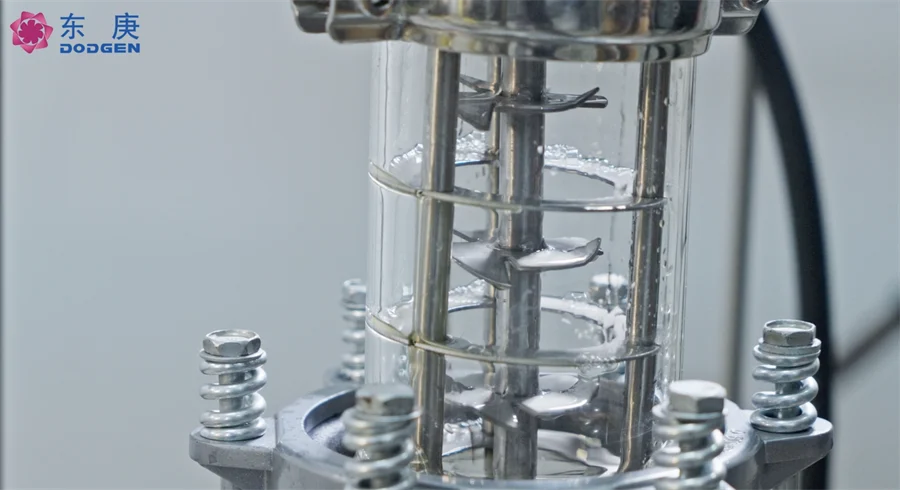

Technical Principle of Liquid-Liquid Extraction Tower
Liquid-liquid extraction is a mass transfer operation that separates components based on differences in solubility or partition coefficient between two immiscible or partially miscible liquid phases.
The process involves:
Contact between feed liquid and extraction solvent
Transfer of solute into the solvent phase
Phase disengagement based on density difference
Separation efficiency depends on:
Partition coefficient of the target component
Interfacial area
Residence time
Hydrodynamic stability
The objective is controlled solute transfer with minimal entrainment and minimal back-mixing.
Extraction Tower Design Characteristics and Engineering Features
1. Integrated Fluid Dynamics Design Validation
The DODGEN high-efficiency rotor extraction tower is designed using computational fluid dynamics modeling combined with experimental validation.
Design validation includes:
Multiphase flow simulation
Rotor-induced shear field modeling
Industrial pilot testing
This approach ensures predictable scale-up and operational stability.
2. High Theoretical Stage Efficiency
The internal rotor structure is configured to maximize effective theoretical stages within a compact height.
Benefits include:
Increased mass transfer per unit height
Reduced column footprint
Stable separation under varying load conditions
3. Optimized Hydraulic Model and Residence Time Control
The tower hydraulic model is engineered to maintain balanced phase dispersion and controlled residence time.
Key outcomes include:
High interfacial contact area
Controlled droplet size distribution
Reduced channeling and flooding risk
Residence time distribution is optimized to improve extraction efficiency without increasing energy demand.
4. Anti-Back-Mixing Structural Configuration
The internal configuration minimizes axial mixing between stages.
This design feature:
Maintains concentration gradient stability
Improves product purity consistency
Reduces solvent contamination
Stable phase disengagement supports downstream purification efficiency.
5. Controlled Dispersion and Re-Contact Mechanism
The rotor system promotes uniform dispersion followed by controlled coalescence.
This results in:
Rapid and homogeneous mass transfer
Reduced emulsion formation
Improved phase separation clarity
The dispersion-recontact sequence is tuned to match solvent properties and target separation requirements.
Chemical Process Solutions
Process Technology
Separation Equipment
Continuous Flow Reactor
Application
Sustainability
Reaction and Separation Professional, Low Carbon Technology Partners
Contact Us
Try Our Best To Meet Your Needs