Melt crystallization scale-up for a 10,000-metric-ton-per-year electronic-grade solvent plant requires more than reproducing laboratory crystallization conditions. Commercial production must maintain impurity rejection, controlled crystal growth, sufficient heat-transfer capacity and acceptable product recovery over repeated operating cycles.
Ethylene carbonate (EC) is a relevant industrial application, but its separation behavior cannot be assumed to represent vinylene carbonate (VC), dimethyl carbonate (DMC) or other electrolyte solvents. Each feed requires its own phase-equilibrium assessment, impurity analysis and process validation.
The 10,000-ton annual production target in this article is an illustrative engineering scenario, not a claim about an individual completed دودجن project.
Why Melt Crystallization Scale-Up Is Not Geometric Scaling
Melt crystallization separates components according to their distribution between solid and liquid phases. When the target compound crystallizes preferentially, impurities may remain concentrated in the mother liquor.
The recovered solid, however, can contain impurities through liquid adhesion, entrapment or incorporation into the crystal structure. Product purity therefore depends on both equilibrium selectivity and the effectiveness of subsequent separation.
Three scale-dependent mechanisms determine whether laboratory performance can be reproduced industrially.
- Heat-transfer resistance. A growing crystal layer increases resistance between the cooling surface and the melt, potentially extending crystallization time.
- Crystal morphology. Cooling rate, local composition and liquid circulation influence crystal structure and the amount of retained mother liquor.
- Operating stability. Fouling, uneven flow distribution and difficult solids handling can reduce usable capacity or create inconsistent product quality.
The commercial design must reproduce the necessary separation behavior, not merely the laboratory cooling temperature or equipment geometry.
Establishing the Design Basis for 10,000-Ton Annual Production
Commercial process design begins with the required quantity of qualified product rather than the nominal capacity of a المبلور الذائب.
For a target of 10,000 metric tons per year and 8,000 operating hours, the average qualified product rate is:
10,000 ÷ 8,000 = 1.25 metric tons/hour
This is the required average output during the assumed operating hours. It does not automatically equal the fresh feed rate or the rated throughput of an individual unit.
Calculating the Required Feed Rate
For a simplified target-component balance:
Fresh feed rate = Target-component product rate ÷ (Target-component mass fraction in fresh feed × Overall target-component recovery)
Consider the following illustrative assumptions.
| Design variable | Assumed value |
|---|---|
| Annual qualified product output | 10,000 metric tons |
| Operating hours | 8,000 hours/year |
| Average qualified product rate | 1.25 metric tons/hour |
| Target-component concentration in fresh feed | 95% by mass |
| Overall target-component recovery | 80% |
| Calculated fresh feed rate | Approximately 1.645 metric tons/hour |
This calculation treats the qualified product mass as approximately equal to its target-component mass. If the final product’s target-component concentration materially affects the balance, that concentration must also be included.
The assumed 80% overall recovery is not a measured single-pass crystallization yield. Overall recovery must account for the target compound leaving in qualified product, rejected fractions, purge streams and other losses, with internal recycle handled consistently.
Translating Production Rate Into Equipment Capacity
For a cyclic layer crystallization process:
Average product capacity = Qualified product recovered per cycle × Number of operating units ÷ Total cycle time
Total cycle time includes crystallization, mother liquor drainage, sweating, product melting and necessary turnaround operations.
For suspension crystallization, capacity depends on crystal production rate, residence time, slurry transport and downstream solid-liquid separation.
A commercial design must also distinguish between installed capacity and achievable annual production. Maintenance, cleaning, feed interruptions and off-specification batches may reduce effective output.
Selecting the Appropriate Melt Crystallization Technology
The choice of معدات الفصل depends on how the target compound crystallizes, how impurities are removed and which operating constraints limit production capacity.
| Selection factor | Suspension crystallization | Static layer crystallization | Dynamic layer crystallization |
|---|---|---|---|
| Crystal formation | Dispersed crystals in liquid | Layer formed on a cooled surface | Layer formed under forced liquid movement |
| Operating approach | Can support continuous operation | Usually cyclic | Usually cyclic, depending on configuration |
| Impurity removal | Crystal separation and washing | Drainage and sweating | Drainage and sweating |
| Principal scale-up concern | Crystal size, slurry handling and washing | Layer uniformity and cycle time | Film distribution, thermal resistance and layer quality |
| Main validation requirement | Reliable crystal transport and separation | Reproducible layer formation and purification | Stable wetting, heat transfer and crystal growth |
This table is a preliminary screening tool. Final equipment selection requires data from the actual solvent and impurity system.
Suspension Melt Crystallization
Suspension crystallization produces discrete crystals within the liquid phase. Its potential for continuous operation can be valuable when industrial throughput and crystal washing are central to the process.
However, crystal size distribution affects pumping, slurry circulation, solid-liquid separation and wash-column performance. Crystals that are too small or mechanically unsuitable may complicate downstream recovery.
A review of suspension melt crystallization discusses equipment development and the challenges associated with industrial separation.
Pilot testing should establish whether representative crystals can be transported, separated and washed while maintaining the required product purity and recovery.
Static and Dynamic Layer Crystallization
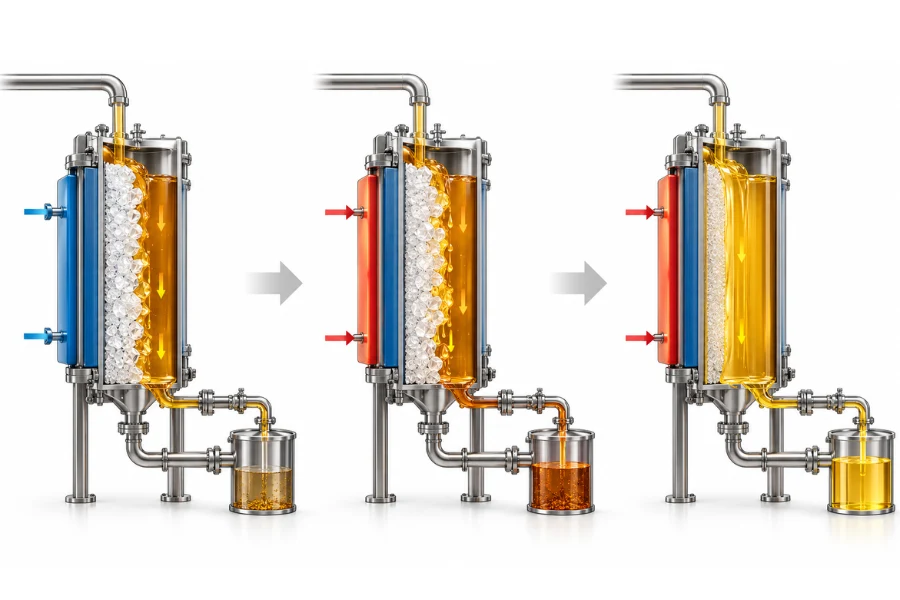
Layer crystallization forms a solid deposit on a cooled surface. After crystallization, residual mother liquor is drained, and the crystal layer may undergo sweating before the remaining product is melted and recovered.
Static systems rely primarily on natural convection, while dynamic systems use forced liquid movement. Falling-film crystallization is a dynamic configuration in which surface wetting and liquid distribution affect crystal growth.
As the layer becomes thicker, thermal resistance increases and crystal growth may slow. This can extend cycle time and reduce average production capacity.
A published falling-film melt crystallization model examined crystal-layer growth and impurity distribution in a phosphoric acid system. It identified feed rate and cooling rate as important operating variables for that system.
The study illustrates how experiments and dynamic models can support scale-up decisions. Its numerical results should not be transferred directly to EC or other electrolyte solvents.
When Should Distillation Be Integrated?
Distillation and melt crystallization use different phase-equilibrium relationships. Distillation exploits volatility differences, while crystallization depends on solid-liquid behavior.
Distillation may be appropriate for removing volatile impurities or conditioning feed before crystallization. Melt crystallization may be useful when the target compound forms a sufficiently selective crystal phase.
A combined process should be evaluated when no single separation step can meet the product specification at acceptable recovery and energy consumption.
Critical Parameters That Change During Scale-Up
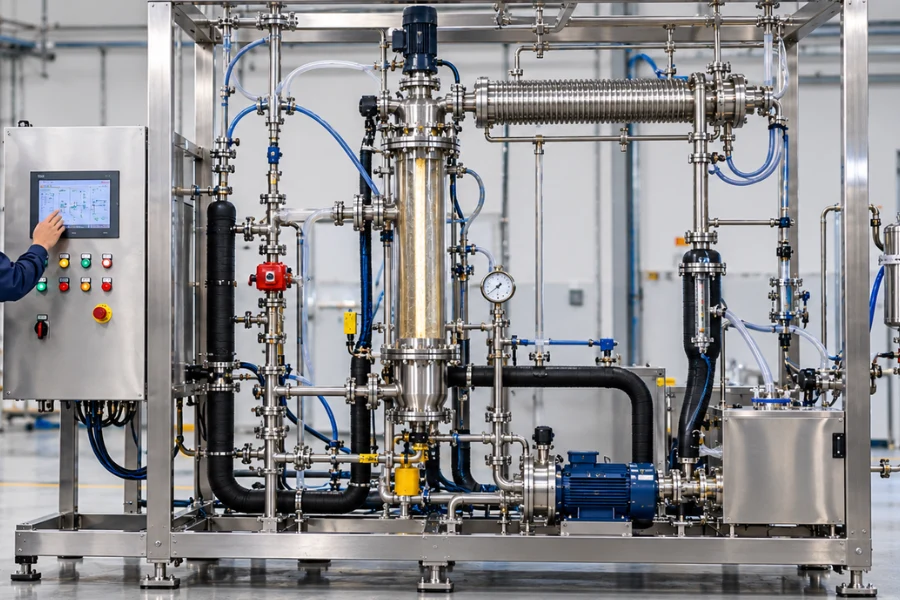
Cooling Rate and Heat Transfer
Cooling conditions affect nucleation, crystal growth and impurity inclusion. Increasing cooling intensity may accelerate crystal formation but can also produce less favorable crystal morphology.
In layer crystallization, the growing solid adds thermal resistance. The design must therefore account for changing heat-transfer performance throughout the operating cycle.
Where the process uses separate المبادلات الحرارية, their heating and cooling duties must be included in the system balance. In an integrated crystallizer, the crystallization surfaces themselves perform the relevant heat-transfer function.
Critical measurements include melt temperature, cooling-medium temperature, heat duty, crystal growth rate and cycle duration.
A fixed temperature difference, such as 1–3°C, should not be treated as a universal design condition. Appropriate cooling profiles depend on phase behavior, equipment configuration and validated operating results.
Crystal Growth and Impurity Inclusion
Impurities associated with crystals may originate from surface-adhering liquid, trapped mother liquor or incorporation into the solid phase.
These mechanisms require different engineering responses. Improved drainage or washing may address surface-associated liquid, while sweating or modified growth conditions may be needed when impurities remain within a crystal layer.
Increasing cooling intensity is not automatically an effective response to poor purity. Experiments should connect crystal growth conditions with the compositions of the recovered solid, mother liquor and intermediate fractions.
Flow Distribution and Fouling
Uneven wetting in falling-film systems can create nonuniform crystal layers and local differences in heat transfer.
In suspension systems, changes in crystal concentration or particle size may affect circulation and solid-liquid separation.
Repeated-cycle or extended pilot testing should measure changes in heat-transfer duty, circulation behavior, cleaning requirements and product quality. Initial performance alone cannot establish operating stability.
Electronic-Grade Solvent Purification and Impurity Control
Electronic-grade solvent specifications may include limits on water, metallic impurities and residual organic compounds. The applicable limits depend on the solvent grade and intended application.
A high overall assay does not establish compliance with every impurity specification. The analytical program must therefore address individual contaminants.
Establishing an Impurity-Specific Testing Plan
| Impurity category | Analytical method to consider | Purpose |
|---|---|---|
| المياه | Karl Fischer titration | Verify moisture limits and detect moisture introduced during handling |
| Trace metals | Validated ICP-MS or another suitable elemental method | Measure specified metallic impurities |
| Organic impurities | Validated GC, HPLC or another appropriate method | Determine residual organics and their distribution |
| Overall composition | Validated quantitative assay | Support product qualification and material balances |
Method selection must account for the solvent matrix, detection limits and analytical interference.
Sampling procedures also require validation. Moisture ingress, contaminated containers and unsuitable transfer materials can affect trace-impurity measurements independently of crystallization performance.
Washing, Sweating and Recovery
Crystal washing can remove liquid associated with separated crystals when a suitable washing system is available. Sweating uses controlled warming to melt part of a crystal layer and remove impurity-rich fractions.
Both operations can improve purity while reducing directly recovered product mass.
The appropriate purification endpoint should therefore be selected using measured impurity removal and target-component recovery, rather than purity alone.
Mother liquor may contain valuable target compound. Recycling can improve overall recovery, but it can also increase circulating loads, concentrate impurities and create additional separation duty.
A Conditional Engineering Decision Example
Consider an EC-rich feed in which the principal impurities preferentially remain in the liquid phase.
If experiments confirm selective EC crystal formation, the next question is whether the recovered product meets its impurity limits after drainage and any necessary sweating.
If retained liquid causes off-specification purity, crystal morphology and purification conditions should be investigated before increasing cooling intensity.
If the mother liquor contains substantial recoverable EC, recycling should be assessed against additional energy use, impurity accumulation and equipment requirements.
This is an illustrative decision sequence, not a reported industrial project.
From Laboratory Experiments to Pilot Plant Validation
Pilot testing must establish which laboratory findings remain valid under representative equipment and operating conditions.
| Development stage | Technical work | Required output |
|---|---|---|
| Phase-equilibrium characterization | Feed analysis, phase behavior and impurity distribution | Separation feasibility and theoretical limits |
| Parameter screening | Cooling, circulation, growth and purification tests | Relationships between operating variables, purity and yield |
| Material and energy balances | Quantify feed, product, mother liquor, recycle and utilities | Recovery basis and energy requirements |
| Pilot operation | Test representative equipment and operating cycles | Operating window, stability evidence and equipment limitations |
| Commercial design assessment | Convert validated results into design requirements | Design basis, equipment loads, controls and unresolved risks |
Phase-Equilibrium Characterization
The first stage determines whether the target compound can form a sufficiently selective crystal phase over the expected feed-composition range.
Eutectic behavior, solid-solution formation and impurity distribution may impose practical limits on achievable purity and recovery.
The output should establish whether melt crystallization is feasible and whether additional separation stages are likely to be required.
Parameter Screening and Modeling
Experiments should determine how cooling rate, temperature profile, circulation and residence time affect purity and yield.
For layer crystallization, crystal thickness, thermal resistance and cycle duration are important. For suspension crystallization, crystal size distribution and separation performance require comparable attention.
Models should be calibrated against representative measurements. Predictions outside validated operating ranges should remain identified as assumptions.
Material and Energy Balance Validation
Material balances must account for the target compound and relevant impurities across product, mother liquor, sweating fractions, recycle and purge streams.
Energy calculations should include crystallization, refrigeration, circulation, melting and downstream recovery where applicable.
The output should provide a consistent basis for equipment duty, recovery and utility consumption per unit of qualified product.
Pilot Operating Stability
Pilot operation should evaluate repeated cycles or sustained running according to the selected process configuration.
Relevant observations include changes in heat-transfer performance, flow distribution, fouling, cleaning requirements and product quality under realistic feed variation.
A validated operating window should describe conditions that can be maintained reliably, not merely those that produced the highest purity in a single experiment.
Commercial Design Acceptance Criteria
Pilot completion does not automatically demonstrate commercial readiness. The design team must assess whether the evidence supports the intended product quality, throughput and operating conditions.
| Acceptance area | Evidence required |
|---|---|
| جودة المنتج | Specified purity and individual impurity limits verified using appropriate analytical methods |
| Material balance | Major streams and target-component recovery reconciled within justified measurement uncertainty |
| Heat and equipment capacity | Heat duties, cycle times or continuous throughput supported by experiments or validated models |
| Operating limits | Defined temperature, circulation, recovery and equipment operating windows |
| Reliability | Relevant fouling, cleaning, feed variation and stability risks assessed |
| Remaining uncertainty | Unresolved risks documented with mitigation or further testing requirements |
Acceptance criteria must be adapted to the actual solvent, product specification, process risks and project design basis.
Commercial design may proceed with some remaining uncertainty when it is explicitly assessed and managed. Unverified assumptions should not be represented as demonstrated operating performance.
Evaluating Energy Consumption and Commercial Feasibility
Melt crystallization may offer energy advantages in suitable systems because the heat of fusion of many compounds is lower than their heat of vaporization. However, this thermodynamic difference does not determine total plant energy consumption.
A commercial comparison must include heating, cooling, refrigeration, circulation, sweating, product melting and mother liquor recovery.
Alternative purification routes should be evaluated using the same feed composition, qualified product specification, recovery basis and annual production target.
Industrial EC Purification Example
DODGEN reports an electronic-grade EC purification project using a melt crystallization separation system.
According to the company’s project page, product purity can reach 99.999%. The page also reports a reduction in steam consumption from approximately 1.3 to 0.3 metric tons per metric ton of product compared with a conventional light-ends removal and refining-column arrangement.
The company describes the steam reduction as approximately 70%. These are project-specific, company-reported figures, not independently verified performance guarantees for other solvents or facilities.
The 220,000-metric-ton annual capacity identified on the project page refers to the broader lithium battery materials production and research project, not the individual EC crystallization unit.
The same page reports a process-package capacity range of 1,000–50,000 metric tons per year per line. This stated capability range does not replace project-specific validation of heat transfer, separation performance and equipment capacity.
The EC project demonstrates a reported industrial application, but its purity and energy figures cannot be directly applied to VC, DMC or other solvents without relevant experimental and process data.
Integrating Melt Crystallization Into an Industrial Purification System
صناعي حلول تكنولوجيا العمليات must account for the interaction between crystallization, feed preparation, impurity removal, product recovery and quality control.
Feed variability can change crystallization behavior, mother liquor composition and the duty required from downstream purification.
For electronic-grade solvents, process design should also address compatible contact materials, contamination during transfer, moisture control where required and representative sampling arrangements.
DODGEN’s electrolyte solvent purification technology describes its broader separation and purification approach. The appropriate configuration must still be established from the target solvent, impurity profile and commercial operating requirements.
Engineering Checklist for Commercial Scale-Up
Before approving the design for a 10,000-ton annual production target, the engineering team should confirm that:
- Solid-liquid equilibrium supports the proposed separation.
- Individual impurity limits and analytical methods are defined.
- Technology selection is supported by material-specific experiments.
- Single-pass yield and overall recovery are calculated separately.
- Mother liquor, sweating fractions, recycle and purge streams are accounted for.
- Heat-transfer and throughput estimates reflect realistic operating conditions.
- Pilot tests establish an operating window and identify reliability risks.
- Equipment capacity accounts for cycle time, cleaning and availability.
- Remaining technical uncertainties are documented with appropriate mitigation measures.
The resulting design basis should explain how qualified annual output will be achieved, which operating conditions must be maintained and how product compliance will be demonstrated.
For projects evaluating melt crystallization scale-up, دودجن can support discussions around separation feasibility, pilot validation and the integration of purification technologies.