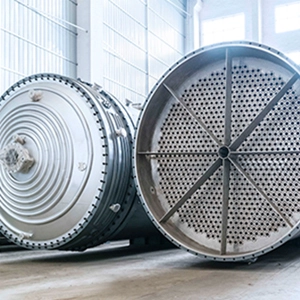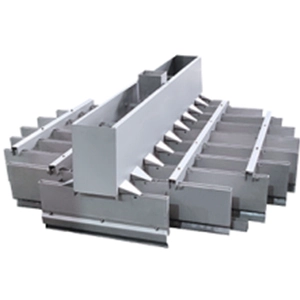
Producing high-purity ثنائي (فلورو سلفونيل) إيميد الليثيوم (LiFSI) is not simply a matter of maximizing reaction conversion. Reactor conditions influence hydrolysis, side reactions, impurity formation, thermal exposure, corrosion risk, and the purification burden that follows synthesis.
This makes reactor design part of the purity strategy. For commercial production of this battery electrolyte salt, the practical question is not which reactor reacts fastest, but which reaction environment can maintain stable heat transfer, mixing, residence time, moisture control, and impurity behavior from pilot validation to industrial production.
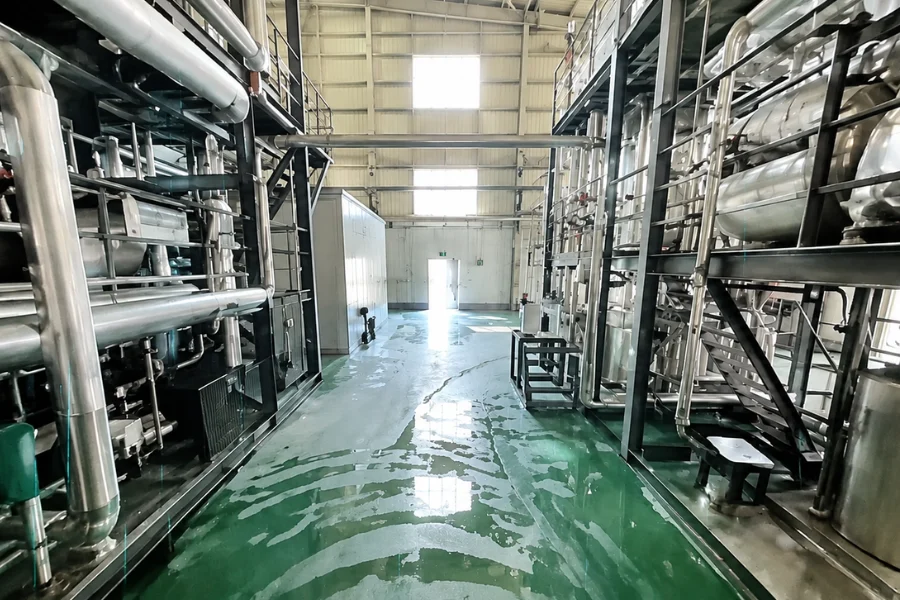
Why LiFSI Reactor Design Is a Purity-Control Problem
عالية النقاء LiFSI synthesis connects reaction engineering directly with impurity management:
Feed Quality → Mixing → Reaction Environment → Temperature and Residence Time → Side Reactions → Impurity Profile → Purification Load → Final Purity
This relationship becomes particularly important during lithiation. Research on an HFSI·NEt3/LiOH system found reversible reaction behavior and showed that higher temperature can favor LiFSI formation, while excessive heat and strongly alkaline conditions can also accelerate FSI⁻ hydrolysis.
This creates an industrial trade-off. Conditions that improve conversion do not necessarily produce the easiest material to purify.
A reactor achieving high conversion while generating a difficult impurity profile may ultimately require more separation equipment, energy, solvent, and waste treatment. High-purity lithium salt process engineering should therefore optimize total process performance rather than isolated reaction yield.
Core Reactor Design Variables for High-Purity LiFSI
Reactor selection should begin with the process environment that must remain controlled. Temperature uniformity, mixing, feed distribution, residence time, and moisture exposure can be more important than nominal reactor volume.
Heat Removal and Temperature Uniformity
Heat removal becomes increasingly important during scale-up because reactor volume and heat-transfer area do not increase proportionally.
A laboratory reaction that appears thermally manageable can develop larger temperature gradients at industrial scale. Local hot spots can increase impurity formation and, under unfavorable conditions, contribute to thermal runaway risk even when the measured bulk temperature remains within its intended range.
Important design factors include reaction heat generation, heat-transfer area, coolant capacity, circulation behavior, mixing intensity, and cooling-system response.
Increasing agitation alone may not reproduce laboratory thermal behavior. Heat-transfer geometry, fluid circulation, and cooling dynamics change simultaneously during scale-up, so thermal performance has to be validated under representative operating conditions.
Mixing and Feed Distribution
Average reactor conditions can hide unfavorable local chemistry.
If a lithiation agent enters faster than it disperses, localized regions of high alkalinity may form. Feed location, dosing rate, mixing time, reactor geometry, and staged addition therefore need to be considered as one system.
For impurity-sensitive chemistry, the relevant question is not only whether the reactor is well mixed on average, but whether mixing occurs faster than undesirable local reactions can develop.
Residence-Time Control
Residence time creates another conversion-versus-stability trade-off.
Insufficient exposure may leave unreacted precursor, while excessive exposure can increase secondary reactions or degradation. In continuous processing, residence-time distribution (RTD) therefore becomes more meaningful than average residence time alone.
A broad RTD can simultaneously create under-reacted and overexposed material, increasing the burden on downstream purification.
Batch vs. Continuous Reactors for LiFSI Production
Batch reactors offer flexibility during process development and make it relatively easy to modify feed sequences, reaction times, and operating recipes. Their behavior, however, can become harder to reproduce as vessel size increases and heat transfer, mixing time, and reactive inventory change.
Continuous flow systems can provide tighter control of heat transfer, mixing, and residence time while reducing the amount of reactive material present in the reaction zone.
| العامل الهندسي | المفاعل الدفعي | مفاعل التدفق المستمر |
|---|---|---|
| Reactive inventory | أعلى | Lower in reaction zone |
| Thermal control | Scale-dependent | Potentially tighter |
| وقت الإقامة | Batch-sequence dependent | Flow-defined |
| Mixing | Agitation-dependent | Geometry/flow-dependent |
| Flexibility | عالية | معتدل |
| Capacity increase | Larger vessels | Scale-up or scale-out |
| Fouling management | Usually easier | Can become critical |
| تكامل العمليات | Sequential | Strong continuous potential |
Continuous processing is not automatically superior. Pressure drop, solids or precipitation, fouling, corrosion, flow distribution, feed stability, and startup/shutdown behavior can become new constraints.
Industrial Insight: The right reactor is determined by the dominant process limitation, not by whether batch or continuous technology appears more advanced.
When Microreactors Become Relevant
Microreactors and small-channel continuous reactors become attractive when a reaction requires rapid heat removal, fast mixing, precise residence time, or reduced hazardous inventory.
Patent literature covering fluorinated conductive salt synthesis describes continuous flow and microreactor configurations, including silicon carbide construction and series or parallel reactor arrangements.
Their engineering advantage can be summarized as:
Small Reactive Volume + High Heat-Transfer Area + Controlled Flow + Defined Residence Time
But small channels also increase sensitivity to precipitation, solids, pressure drop, plugging, and feed inconsistency. Commercial deployment therefore requires evaluating channel geometry, materials compatibility, required residence time, cleaning strategy, and throughput together.
Scale-up may involve larger flow paths, parallel reactor modules, or numbering-up. The objective is not miniaturization itself, but preserving the reaction environment that controls safety, selectivity, and impurity formation.
Process Monitoring and Control for Stable LiFSI Production
Reactor hardware alone cannot maintain a narrow operating window. High-purity production also requires instrumentation and control capable of detecting process deviation before it becomes a quality or safety problem.
Depending on the reaction step, critical measurements may include:
- temperature and temperature deviation
- pressure and differential pressure
- reactant flow rates and feed ratios
- coolant conditions
- moisture-sensitive process indicators
These measurements can support interlocks and closed-loop control of dosing, cooling, and flow.
For continuous systems, an abnormal pressure increase combined with declining flow may indicate developing blockage. In a temperature-sensitive reaction, a rising temperature trend can trigger feed reduction or shutdown before the process moves toward an unsafe condition.
The objective is not automation for its own sake. It is maintaining the process state within the validated purity and safety envelope while improving production reproducibility.
Process Safety Should Be Designed Around Failure Scenarios
Safe reactor design requires understanding what happens when the process leaves normal operating conditions.
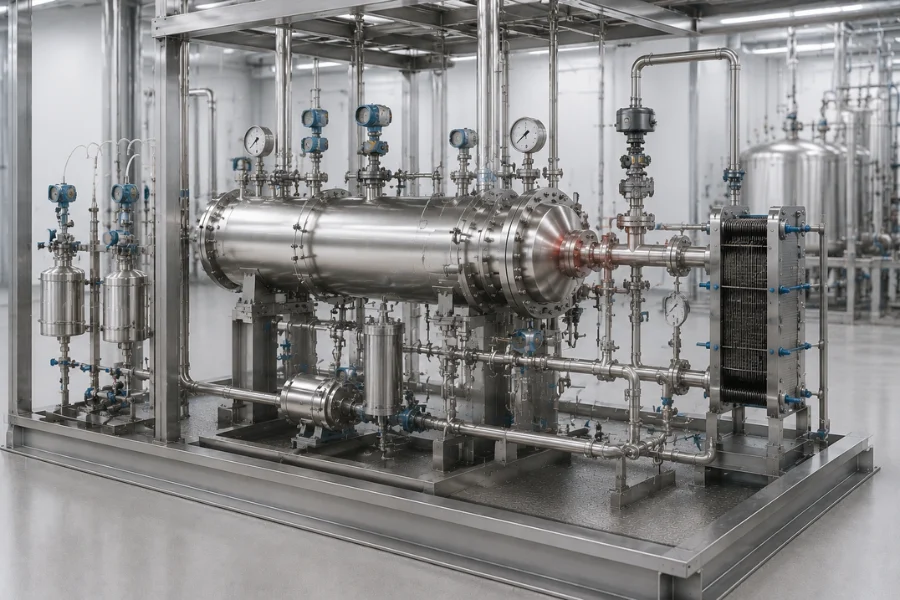
Loss of Cooling
Cooling failure can allow heat generation to exceed heat removal. Temperature rise may then accelerate reaction or decomposition rates, potentially increasing both heat release and pressure.
Reaction calorimetry, thermal stability testing, and appropriate adiabatic evaluation can help determine whether the system remains controllable following cooling loss.
Feed or Dosing Failure
Incorrect feed ratios or excessive dosing can create abnormal reactant concentrations. For chemistry sensitive to strongly alkaline conditions, this can affect reaction pathways and impurity formation.
Feed control should therefore be linked to critical temperature, pressure, and flow measurements.
Moisture Intrusion
Water management is particularly important because LiFSI hydrolysis can affect yield, impurity formation, and process stability.
Moisture control should extend from raw-material storage and transfer lines through reaction, separation, equipment drying, sampling, and final product handling.
Flow Interruption or Blockage
In continuous reactors, blockage can simultaneously increase upstream pressure and extend material residence time inside a heated reaction zone.
Differential-pressure monitoring, flow alarms, temperature protection, and appropriate interlocks should therefore form part of the safety architecture.
Defining a Safe Operating Window
The fastest reaction condition is not necessarily the best operating point.
A practical operating window for high-purity LiFSI synthesis can be considered across several interacting variables:
Temperature × Residence Time × Reactant Ratio × Water Content × Pressure
A temperature acceptable for short exposure may become undesirable at extended residence time. A feed ratio that works under rapid mixing may create local degradation risk when mixing deteriorates.
The operating point should therefore maintain engineering margin from thermal decomposition, hydrolysis-sensitive conditions, equipment pressure limits, material compatibility limits, and impurity specification boundaries.
Reaction calorimetry, process hazard analysis, thermal stability testing, upset-scenario evaluation, and pilot validation help define this envelope. The purpose is not only to establish where the chemistry works, but where it remains controllable under realistic disturbances.
Reactor Materials Are Part of Purity Control
Materials of construction influence both equipment integrity and battery-grade LiFSI purity.
Depending on the selected synthesis route, equipment may encounter fluorinated intermediates, acidic or alkaline environments, moisture-sensitive chemistry, and corrosive species. Material selection should therefore consider corrosion behavior, metal-ion contamination, gasket and seal compatibility, surface condition, cleaning requirements, and long-term exposure.
For a high-purity battery electrolyte salt, even small contamination sources can matter. Corrosion resistance and contamination control should consequently be evaluated together rather than treated as separate engineering issues.
Integrating Reaction and Separation Through Process Intensification
High-purity process engineering becomes more effective when reaction and purification are not designed independently.
The conventional sequence is:
Reaction → Separation → Purification
An integrated process asks whether separation can improve the reaction environment itself. This is a practical form of process intensification: instead of compensating for unfavorable reaction conditions with increasingly demanding downstream purification, reaction and separation are optimized as an interconnected system.
Research into LiFSI lithiation demonstrated this principle through reaction-extraction coupling. Removing triethylamine through extraction shifted the reaction equilibrium while reducing dependence on the higher-temperature conditions associated with reaction distillation.
In that specific experimental system, multistage continuous membrane extraction achieved conversion above 99.7% while limiting LiFSI hydrolysis to below 0.05%. These results should not be treated as universal industrial performance values, but they demonstrate the potential value of coupling reaction equilibrium management with separation engineering.
Industrial LiFSI process development may therefore need to evaluate reaction together with extraction, solvent management, water removal, filtration, crystallization, drying, and final purification.
Industrial Insight: The strongest reactor configuration is often the one that reduces total purification difficulty while maintaining safe and reproducible production, rather than the one delivering the highest isolated reaction performance.
From Pilot Validation to Commercial LiFSI Production
Scale-up should preserve the critical process environment, not simply reproduce laboratory equipment at a larger size.
Pilot operation can validate heat-transfer behavior, mixing sensitivity, impurity evolution, residence-time effects, material compatibility, moisture sensitivity, and control-system response before commercial deployment.
At industrial scale, reactor configuration must also match downstream separation capacity, automation architecture, utility availability, intended throughput, startup and shutdown requirements, and long-term production continuity.
A process that produces excellent material in several laboratory batches has not yet demonstrated industrial reproducibility. Battery-grade LiFSI production requires maintaining the same quality window across extended production campaigns.
A Practical Reactor Selection Framework
There is no universally ideal reactor for every LiFSI route. Selection should start with the dominant process constraint.
| Process Characteristic | Reactor Design Priority |
|---|---|
| Fast or exothermic reaction | Heat transfer and rapid mixing |
| Hydrolysis-sensitive chemistry | Moisture and exposure control |
| Tight impurity limits | Precise feed and mixing |
| Hazardous intermediate | Low inventory and containment |
| Long reaction time | Residence-time strategy |
| Corrosive environment | Materials compatibility |
| إنتاجية عالية | Scale-up or scale-out |
| Battery-grade specification | Reaction-purification integration |
Instead of asking, “Which reactor should be used for LiFSI?”, process engineers should first determine which reaction environment must remain stable from pilot validation through commercial production.
That requirement ultimately determines whether a stirred reactor, tubular flow reactor, microstructured system, staged reactor train, or hybrid configuration provides the most appropriate industrial pathway.
Engineering High-Purity LiFSI Beyond the Reactor
عالية النقاء LiFSI manufacturing depends on coordinated control across reaction, separation, purification, drying, and material handling. Optimizing one unit operation while transferring additional complexity downstream rarely produces the strongest commercial process.
دودجن approaches LiFSI industrialization through integrated lithium salt process engineering. Its three-step process covers bis(chlorosulfonyl)imide synthesis, fluorination to bis(fluorosulfonyl)imide, and lithiation to LiFSI, while modular continuous processing supports the transition toward stable commercial production.
The engineering objective is broader than completing the reaction. It is to establish an integrated process package capable of maintaining purity, safety, controllability, and production continuity from pilot validation through industrial deployment.
For LiFSI projects involving reactor configuration, process safety, process intensification, continuous manufacturing, purification integration, or scale-up, دودجن can support the evaluation of process engineering and commercialization requirements.