Producing high-purity hydrogen cyanide requires coordinated control of gas conditioning, HCN recovery, water and impurity removal, condensation, and stabilization. Performance at one stage directly changes the operating burden of the next.
This coupling is particularly important because HCN boils at about 25.9°C and is highly volatile near ambient conditions. Residual alkaline contaminants, water content, temperature, and stabilization conditions can also affect the behavior of the purified product.
An industrial HCN purification and stabilizer system must therefore maintain four outcomes simultaneously: recovery, product purity, chemical stability, and controllability during continuous operation.
Why Reaction Gas Composition Determines the Purification Strategy
HCN purification begins with the reaction-gas composition rather than the distillation column.
Depending on the synthesis route and operating conditions, crude gas may contain HCN together with water vapor, unreacted ammonia, carbon oxides, and other reaction-derived components. Their concentrations determine the duty imposed on cooling, absorption, stripping, and final purification.
The engineering sequence can be represented as:
Reaction route → impurity profile → gas conditioning → recovery load → purification architecture
Unreacted ammonia is particularly important because alkaline contamination can work against the acidic conditions used to suppress HCN polymerization. Feed variability also matters: changes in gas flow, temperature, water loading, or HCN concentration can shift absorber performance and propagate into the downstream separation system.
A commercial design should therefore account for the expected feed envelope rather than only a nominal reaction-gas composition.
Front-End Gas Conditioning Before HCN Recovery
Cooling the Reaction Gas
Hot reaction gas must be cooled before absorption and downstream purification.
Gas temperature affects vapor-liquid behavior, HCN absorption, cooling demand, and the thermal conditions presented to subsequent equipment. Because HCN remains highly volatile near ambient temperature, front-end cooling should be evaluated together with later condensation and refrigeration requirements rather than as an isolated heat-exchange duty.
Why Ammonia Removal Matters
Residual ammonia should be controlled before the main HCN recovery stages. An acid-wash or comparable conditioning step can remove unreacted NH₃ from the gas.
The consequence of ammonia breakthrough extends beyond gas purity:
NH₃ breakthrough → alkaline contamination → greater HCN stability risk → increased downstream stabilization burden
Ammonia removal is therefore part of the overall stability strategy for high-purity HCN production, not simply a gas-cleaning operation.
Recovering HCN From the Conditioned Reaction Gas
Low-Temperature HCN Absorption
HCN is highly soluble in water, making absorption a practical recovery route. Equilibrium behavior can be described using Henry’s law, while actual tower performance also depends on gas-liquid mass transfer, liquid circulation, gas loading, temperature, and packing or tray behavior.
Lower absorption temperatures can favor HCN transfer into the liquid phase and reduce HCN losses to the tail gas. The benefit comes with higher refrigeration demand, so minimum absorber temperature is not necessarily the optimum operating target.
A practical operating window balances:
- HCN recovery
- tail-gas losses
- gas-liquid mass transfer
- cooling demand
- downstream separation load
- operating stability
Absorption and Stripping Work as a Coupled System
Water used to improve HCN recovery becomes part of the downstream separation load. Higher liquid circulation or more aggressive low-temperature absorption may capture additional HCN while increasing the amount of aqueous material that must later be processed.
The resulting HCN-rich liquid can pass through stripping or preliminary distillation before deeper purification.
This creates an important process trade-off:
Higher HCN recovery through absorption ↔ greater downstream dewatering and separation duty
The absorber should therefore be optimized against overall HCN recovery and purification performance rather than maximum absorption efficiency alone.
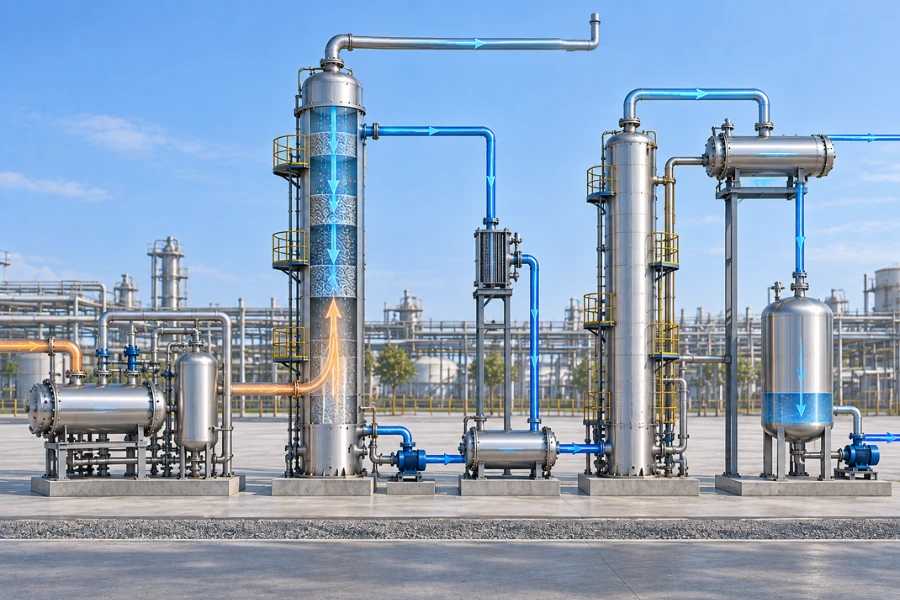
From Recovered HCN to High-Purity Hydrocyanic Acid
Distillation and Impurity Rejection
Once HCN has been recovered, the process objective shifts from gas capture to impurity rejection and product specification control.
Distillation separates HCN from water and other components according to their vapor-liquid behavior. Relevant design variables include:
- feed composition
- operating pressure
- relative volatility
- reflux ratio
- effective separation stages
- feed location
- heat input
- condenser duty
These variables interact. Increasing reflux may strengthen separation while increasing reboiler and condenser duties, while changing column pressure can alter both vapor-liquid equilibrium and the temperature required for HCN condensation.
The appropriate design target is therefore a separation window that delivers the required purity while maintaining manageable hydraulic and thermal loads.
Why Water Removal Becomes a Critical Purification Target
Water creates a specific integration challenge because it can support HCN recovery upstream while becoming an impurity that must be removed downstream.
The relationship is direct:
Water-assisted HCN recovery → higher aqueous load → deeper dewatering requirement → greater separation duty
A referenced high-purity HCN process using low-temperature water absorption, three-stage distillation, and gas-liquid separation reports final product water content below 50 ppm. This is a result for that specific process rather than a universal HCN specification.
The appropriate residual-water target depends on downstream use, product specification, stability requirements, and the incremental cost of deeper separation.
Condensing Purified HCN
Purified HCN vapor must be condensed under conditions that account for its normal boiling point of approximately 25.9°C.
Condenser temperature, operating pressure, refrigeration duty, vapor loading, and recovery efficiency are therefore coupled. Insufficient cooling can increase uncondensed HCN load, while more aggressive refrigeration increases utility demand.
The relevant trade-off is:
HCN recovery ↔ refrigeration duty ↔ operating pressure ↔ vapor containment
For this reason, condensation conditions should be established as part of the high-purity HCN production system rather than after the distillation design has been fixed.
Integrating HCN Purification With Product Stabilization
High purity at the distillation outlet does not by itself ensure stable product behavior during transfer or storage.
Purified liquid HCN can polymerize under unfavorable chemical and thermal conditions, particularly when alkaline contamination or elevated temperature disturbs the required chemical environment. Stabilization therefore begins upstream with impurity control and continues through condensation, stabilizer addition, temperature management, and product handling.
This means the relevant process boundary is:
Purification → condensation → stabilization → transfer or downstream use
HCN Stabilizer System Design
Stabilizer Selection Is a Process Decision
Acidic stabilizers such as sulfuric acid, phosphoric acid, or acetic acid are associated with maintaining conditions that suppress HCN polymerization. Selection should not be based on stabilizer identity alone.
وتشمل المتغيرات ذات الصلة ما يلي:
- residual impurity profile
- alkaline contamination
- HCN temperature
- required product specification
- downstream chemistry
- stabilizer concentration
- materials compatibility
- residence and storage conditions
A stabilizer suitable for one downstream process may introduce an undesirable impurity into another. The selection sequence is therefore better expressed as:
Stability requirement → product specification → stabilizer chemistry → materials compatibility → dosing strategy
Temperature control remains part of the same decision. Lower-temperature handling and chemical stabilization address different parts of the stability problem and should not automatically be treated as substitutes.
Stabilizer Dosing and Distribution
Stabilizer performance also depends on how consistently it reaches the HCN product.
Injection location, metering accuracy, mixing, product flow, and residence time determine whether the required chemical environment can be maintained during changing production conditions. For continuous HCN purification and stabilization, stabilizer concentration is therefore a process-control variable rather than simply an additive specification.
This distinction becomes more important during scale-up. Changes in product flow, line dimensions, mixing behavior, and storage volume can alter stabilizer distribution even when the nominal dosing ratio remains unchanged.
Process Signals That Reveal HCN Purification and Stability Problems
A deviation observed in one section of the plant may originate elsewhere in the HCN purification train. Troubleshooting should therefore connect process signals to mechanisms rather than evaluate individual equipment in isolation.
| إشارة العملية | الآلية المحتملة | ما الذي يجب التحقق منه | الرد الهندسي |
|---|---|---|---|
| HCN loss increases in tail gas | Absorption limitation | Absorption temperature, liquid circulation, gas-liquid contact | Reassess absorber operating window |
| Product water content increases | Separation limitation | Feed water load, reflux, stages, thermal balance | Rebalance dewatering and distillation |
| Condenser recovery decreases | Thermal or pressure limitation | Cooling duty, pressure, vapor load | Review condensation conditions |
| Purity fluctuates with feed rate | Process integration limitation | Column hydraulics, feed condition, control response | Evaluate turndown and control strategy |
| Stabilizer concentration varies | Dosing or mixing limitation | Metering, injection location, product flow | Improve dosing control and distribution |
| Product stability deteriorates | Chemical or thermal disturbance | NH₃ breakthrough, temperature, stabilizer condition | Trace upstream and downstream stability variables |
For example, fluctuating product purity can originate from changing absorber conditions rather than the distillation column itself. Product-stability problems can similarly trace back to upstream ammonia breakthrough instead of stabilizer dosing alone.
This diagnostic approach is particularly useful in a commercial HCN purification process because recovery, dewatering, condensation, and stabilization respond to different but interconnected process variables.
Materials, Containment, and Process Safety
HCN toxicity and volatility make closed processing and vapor containment part of the process architecture. Detection, controlled vent handling, instrumentation, and abnormal-condition response should therefore be considered together with the separation system.
Materials must be evaluated against the actual process stream rather than pure HCN alone. Water, acidic stabilizers, other acidic components, seals, gaskets, valve internals, temperature, and exposure duration can all affect compatibility.
Relevant process deviations include cooling loss, abnormal pressure, ammonia breakthrough, stabilizer dosing failure, and loss of containment. Instrumentation and safeguards should be selected around these credible deviations and their consequences.
Scaling HCN Purification From Process Design to Continuous Operation
Equilibrium calculations can define separation feasibility, but commercial operation introduces hydraulic, thermal, control, and mixing effects that do not necessarily scale proportionally.
For an industrial HCN purification and stabilization system, engineering or pilot validation should examine:
- reaction-gas variability
- ammonia-removal performance
- absorber mass transfer
- stripping and distillation behavior
- water-removal consistency
- condenser capacity
- stabilizer dosing reproducibility
- temperature and pressure control
- startup, shutdown, and turndown conditions
These variables should be tested across an operating envelope rather than at a single design point.
For example, increasing production rate can simultaneously raise absorber loading, column vapor traffic, condenser duty, and stabilizer demand. A system may meet its purity target at nominal throughput yet lose recovery, dewatering consistency, or control margin as these loads move together.
The industrialization pathway therefore progresses from:
Process characterization → separation design → process integration → pilot validation → control strategy → commercial deployment
This approach connects high-purity HCN process design with reproducible continuous production rather than treating scale-up as an equipment-sizing exercise.
Engineering Perspective: HCN Purification Is an Integrated Process
HCN recovery, dewatering, distillation, condensation, and stabilization impose constraints on one another. Optimizing one operation without considering those interactions can shift rather than eliminate the process bottleneck.
A commercial system should therefore be evaluated against five connected outcomes:
Purity + Recovery + Stability + Controllability + Continuous Operating Consistency
دودجن applies process characterization, separation engineering, thermal integration, stabilization strategy, pilot validation, and scale-up engineering to high-purity chemical processes. For HCN projects, the objective is to establish a controllable and reproducible process window from reaction-gas conditioning through purified-product stabilization rather than optimize individual equipment in isolation.