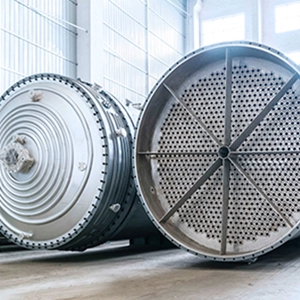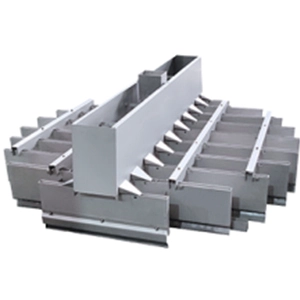
Distillation column energy-saving retrofits can reduce external utility demand by recovering heat, upgrading its temperature, or redistributing it between separation operations. Three approaches deserve particular attention in existing plants: heat pump-assisted distillation, multi-effect distillation, and internal heat integration.
Each approach has different thermodynamic requirements, equipment needs, and operating costs. The appropriate choice depends on the mixture, relative volatility, operating pressure, available temperature differences, utility prices, and constraints of the existing plant.
A retrofit must be evaluated against a validated operating baseline. Lower reboiler duty alone does not prove that a project saves energy or money if the modification increases compressor power or shifts utility demand to other process units.
Why Existing Distillation Columns Need Energy-Saving Retrofits
A conventional distillation column receives heat through a reboiler and rejects heat through a condenser. This arrangement creates a potential recovery opportunity when one process stream releases heat that another stream could use, provided their temperatures are compatible.
Before modifying the separation process, engineers should determine whether excessive energy consumption results from operating inefficiencies or structural limitations.
Identify the Main Sources of Energy Consumption
- Excessive reflux: Higher-than-necessary reflux increases internal vapor and liquid traffic, raising reboiler and condenser duties.
- Unsuitable operating pressure: Pressure changes affect boiling temperatures, relative volatility, separation requirements, and utility selection.
- Limited heat recovery: Hot process streams may be cooled while other streams require external heating.
- Heat exchanger degradation: Fouling, insufficient heat-transfer area, or excessive pressure drop can reduce thermal performance.
- Control limitations: Unstable control or conservative operating margins may prevent the column from meeting its intended performance targets efficiently.
Operational optimization should be assessed before major equipment changes. If the column already operates efficiently, additional savings may require process-to-process heat recovery or a different separation configuration.
Compare Three Distillation Energy-Saving Retrofit Routes
The three approaches reduce external utility demand through different mechanisms.
| Evaluation factor | Heat pump-assisted distillation | Multi-effect distillation | Internal heat integration |
|---|---|---|---|
| Energy-saving mechanism | Upgrades recovered heat to a higher temperature using work | Transfers heat between effects operating at different pressure levels | Transfers heat between regions of a separation system |
| Main energy trade-off | Electricity consumption versus displaced heating and cooling utilities | Heat recovery versus exchanger area and additional equipment | Reduced external duties versus compression power and integration complexity |
| Typical retrofit requirements | Compressor or heat pump, piping, and controls | Additional effect or column, heat exchangers, and piping | Modified column configuration, internal heat-transfer surfaces, or associated equipment |
| Main technical constraint | Required temperature lift and compressor operating envelope | Inter-effect temperature difference and pressure-dependent separation | Heat-transfer feasibility, mass transfer, and controllability |
| Key economic test | Net utility cost after compression power | Net utility cost after additional capital and operating costs | Whole-system utility consumption and installed cost |
This comparison supports preliminary screening rather than a universal ranking. Each candidate must satisfy the separation requirements and fit the existing plant’s mechanical, hydraulic, and utility constraints.
DODGEN’s حلول تكنولوجيا العمليات و معدات الفصل are relevant starting points for reviewing industrial process and separation equipment categories.
Heat Pump-Assisted Distillation
Heat pump-assisted distillation recovers heat from a relatively low-temperature source and raises its temperature so it can supply a process heating duty. This can reduce external steam or fuel consumption, but it introduces an electrical load that must be included in the economic assessment.
Mechanical Vapor Recompression and Other Heat Pump Configurations
Mechanical vapor recompression (MVR) compresses process vapor to increase its pressure and condensation temperature. The resulting vapor can transfer heat to a reboiler or another suitable process heat sink.
A refrigerant-based heat pump instead circulates a working fluid that absorbs heat at a lower temperature and releases it at a higher temperature through a vapor-compression cycle.
MVR is a vapor-recompression approach within the broader family of heat pump-based heat recovery. The appropriate configuration depends on vapor composition, condensation behavior, pressure limits, material compatibility, and the required temperature lift.

Evaluate Temperature Lift and Compressor Power
Temperature lift is the difference between the heat-source temperature and the temperature required by the heat sink. A larger lift generally requires more compression work and can reduce the economic benefit.
A preliminary assessment should establish:
- Overhead vapor condensation temperature and available heat duty.
- Required reboiler or process heating temperature.
- Compressor pressure ratio, capacity, and operating envelope.
- Feed and vapor composition changes across normal operating conditions.
- Electricity prices relative to steam, fuel, and cooling costs.
Larger temperature lifts may require multistage compression, intercooling, or heat recovery from intermediate stages. These choices affect compressor power, equipment complexity, and the amount of heat available for reuse.
A heat balance can estimate recoverable thermal energy, but compressor performance must be evaluated separately. The heat source, compression system, and heat sink must be assessed together.
Cui et al. (2016) compared heat pump-assisted distillation with multi-effect distillation using five binary systems with different relative volatilities. Their study supports using mixture properties and utility prices for preliminary screening, followed by rigorous simulation to validate promising configurations.
When a Heat Pump Retrofit Is Worth Screening
A heat pump is a candidate when recoverable heat can reach the required temperature at an acceptable electrical cost.
It may be less attractive when the temperature lift is large, compressor capacity is difficult to accommodate, or the plant already has inexpensive usable heat. The decision should use actual process data and utility prices rather than a generic efficiency estimate.
Multi-Effect and Double-Effect Distillation
Multi-effect distillation reduces external heating demand by transferring heat between separation operations at different pressure levels. Vapor generated in a higher-pressure effect condenses at a temperature that can supply heat to a lower-pressure effect.
In a double-effect arrangement, the first effect provides heat to the second. Additional effects can extend heat recovery, but they also introduce more equipment and operating constraints.
Evaluate Inter-Effect Temperature Differences
The higher-pressure effect must provide a sufficient temperature driving force for heat transfer to the lower-pressure effect. If the temperature difference is too small, the required exchanger area and installed cost may outweigh the expected utility savings.
Pressure selection also affects vapor-liquid equilibrium and relative volatility. Changes in relative volatility can alter reflux requirements, separation performance, and the heat duty needed to meet product specifications.
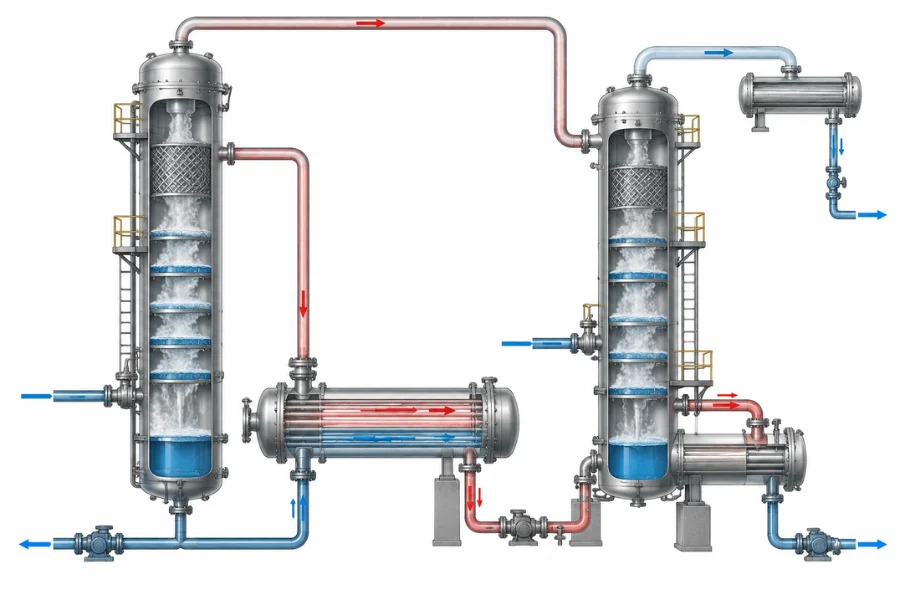
Screen each additional effect against three conditions:
- Separation feasibility: Can each effect achieve the required product purity and recovery at its selected pressure?
- Thermal feasibility: Is the temperature difference sufficient for practical heat transfer?
- Economic feasibility: Do the utility savings justify the additional exchangers, columns, piping, controls, and installation costs?
Why More Effects Do Not Guarantee Lower Costs
Each additional effect changes the pressure profile and heat-transfer requirements. Although more effects can increase heat reuse, the benefit may diminish as temperature differences become smaller and equipment requirements increase.
The economic assessment should include heat duties across all effects, required exchanger area, pressure-dependent separation performance, maintenance, installation space, and utility prices.
Multi-effect distillation deserves screening when suitable pressure levels are available and the plant can accommodate the required equipment. It may be less practical when pressure changes adversely affect separation or when extensive modifications are needed to existing columns.
The number of effects should be selected through process simulation and economic analysis rather than assuming that each additional effect produces a proportional reduction in energy costs.
Internal Heat Integration and HIDiC
Internal heat integration transfers heat between regions of a separation system to reduce external heating and cooling requirements. The internally heat-integrated distillation column (HIDiC) is one configuration designed to enhance heat transfer between the rectifying and stripping sections.
How HIDiC Transfers Heat
In a typical HIDiC arrangement, the rectifying section operates at a higher pressure than the stripping section. The pressure difference creates a temperature difference that enables heat transfer from the rectifying section to the stripping section.
This transfer can reduce external reboiler and condenser duties. Depending on the configuration, compression equipment may be required to establish the pressure difference and support internal heat transfer.
The achievable benefit depends on the temperature profile, available heat-transfer area, local heat duties, and the ability to maintain effective vapor-liquid contact.
Distinguish Heat Integration From Thermal Coupling
These configurations share an energy-saving objective but use different mechanisms.
- Indirect heat integration: Heat passes through a heat exchanger without mixing process streams.
- Thermally coupled distillation: Separation sections exchange vapor or liquid directly through connecting streams.
- Dividing wall columns: An internal partition combines separation regions within one column shell.
- HIDiC: A pressure difference between sections supports internal heat transfer.
These configurations are not interchangeable. Their equipment layouts, mass-transfer behavior, pressure requirements, and control strategies must be evaluated separately.
DODGEN’s أجزاء العمود الداخلية are relevant when evaluating internal equipment and column configuration. Actual suitability depends on the process design, hydraulic performance, and mechanical requirements.
Evaluate Whole-Plant Energy Consumption
A reduction in one column’s heat duty does not necessarily reduce total plant energy consumption. Compression power, upstream and downstream heat demands, cooling requirements, and interactions with other process units can change the overall result.
Kagioulis et al. (2021) examined HIDiC retrofit configurations for an ethylene fractionator and a deethanizer. The study reported increases in overall plant energy consumption of 16% and 50%, respectively, despite potential reductions in the energy demand of individual separation operations.
These results apply to the specific configurations studied and should not be treated as general predictions for HIDiC projects. They demonstrate why a retrofit must be evaluated across the full plant energy boundary rather than judged by column-level heat-duty reductions.
Consider Newer HIDiC Configurations Carefully
A 2025 study investigated discretely heat-integrated distillation columns (D-HIDiC) using liquid injection to improve heat recovery. For methanol-water separation, the simulated configuration achieved up to 50% primary energy savings compared with conventional distillation.
The study also examined multistage compression, intercooling, and the balance between heat recovery and electricity consumption. Its reported savings apply to the studied configuration and simulation conditions, not to HIDiC retrofits generally.
The practical implication is that compression design and heat-recovery arrangements can materially affect performance. Any proposed configuration must be assessed using its own process model and operating constraints.
How to Select the Right Retrofit Strategy
Compare candidate configurations using the same feed rate, product specifications, and operating conditions. Otherwise, differences in calculated energy consumption may reflect changes in production or separation targets rather than the retrofit itself.
Screen Candidates Against Process Conditions
| Screening question | Candidate approach | Decision criterion |
|---|---|---|
| Is recoverable overhead heat available at a manageable temperature lift? | Heat pump-assisted distillation | Compressor power and net utility cost |
| Can a higher-pressure effect supply heat to a lower-pressure effect? | Multi-effect distillation | Temperature driving force, separation performance, and installed cost |
| Can the rectifying and stripping sections exchange heat effectively? | Internal heat integration | Internal heat-transfer feasibility and whole-plant energy use |
| Is recoverable heat available elsewhere in the plant? | Process-to-process heat recovery | Temperature compatibility and integration opportunities |
| Are space, equipment, or control limitations severe? | Operating optimization or simpler heat recovery | Savings achievable without disproportionate implementation risk |
The options are not mutually exclusive. A plant may combine a heat pump with process-to-process heat recovery or integrate side heat exchangers into a broader process modification.
Account for Relative Volatility and Operating Pressure
Relative volatility affects separation difficulty and the internal vapor and liquid traffic required to achieve the target purity. Operating pressure can change relative volatility and boiling temperatures, so a configuration that performs well at one pressure may require substantially different duties at another.
Cui et al. (2016) used five binary systems to compare heat pump-assisted distillation with double-effect distillation. Their results show that mixture properties influence the relative performance of these options. Shortcut methods can help identify promising candidates, but rigorous thermodynamic simulation is needed when pressure changes materially affect vapor-liquid equilibrium, product recovery, or reflux requirements.
Include Utility Prices and Operating Hours
A heat pump may reduce steam consumption while increasing electricity demand. Multi-effect distillation may reduce external heating while increasing capital requirements. Internal heat integration may reduce external duties but introduce compression, mechanical, or control costs.
The preferred configuration therefore depends on utility prices, annual operating hours, maintenance requirements, equipment availability, and production constraints—not just thermal efficiency.
Evaluate Retrofit Feasibility in an Existing Plant
A feasibility study must determine whether the proposed configuration can deliver the required separation while fitting the existing plant’s equipment, hydraulic, and control constraints.
Establish a Validated Energy Baseline
Collect actual operating data rather than relying solely on original design values.
- Feed flow rate, composition, temperature, and pressure.
- Product flow rates, purity, and recovery targets.
- Reflux ratio, column pressure, and temperature profiles.
- Reboiler and condenser duties.
- Steam pressure levels, electricity consumption, and cooling requirements.
- Heat exchanger performance, pressure drop, and fouling condition.
- Production variability and operating constraints.
Reconcile the material and energy balances against plant data. This baseline provides the common reference for evaluating the conventional process and each retrofit candidate.
Check Equipment and Hydraulic Constraints
The existing plant may not have sufficient capacity or space for the required modifications. Engineering checks should cover:
- Heat exchanger area and achievable temperature differences.
- Pressure drop through existing and proposed exchangers.
- Compressor capacity, discharge conditions, and turndown.
- Column hydraulic capacity, including flooding and entrainment.
- Existing pressure ratings and mechanical design limits.
- Piping routes, foundations, and maintenance access.
- Available capacity in steam, electrical, and cooling systems.
Side heat exchangers can alter local temperature profiles and mass-transfer driving forces. Depending on their position and duty, changes to column internals, reflux ratio, or effective stages may be necessary to maintain product specifications.
DODGEN’s structured packings may be relevant when evaluating packing options, but final selection requires process-specific hydraulic, mass-transfer, and mechanical checks.
Assess Control and Product-Quality Risks
Heat-integrated systems couple temperature, pressure, vapor flow, and separation performance. A change in one section can alter heat availability or product composition elsewhere.
The assessment should cover feed and throughput changes, startup and shutdown, compressor or exchanger outages, product purity under varying loads, control-loop interactions, and the ability to maintain stable operation when the energy-saving equipment is unavailable.
Dynamic simulation or pilot validation may be appropriate when steady-state models cannot adequately characterize these risks. The validation scope should reflect the configuration’s complexity and the consequences of operating outside the expected envelope.
Calculate Energy Savings and Project Economics
A retrofit must be evaluated through net utility savings rather than changes in reboiler duty alone. Electricity, steam, fuel, cooling, and changes in upstream or downstream utility requirements all affect the result.
Compare Baseline and Retrofit Energy Use
Use consistent feed conditions, production rates, product purity, recovery targets, and operating schedules. Quantify:
- Reboiler and condenser duties across the entire separation system.
- Compressor power and other incremental electrical loads.
- Steam, fuel, cooling water, and refrigeration requirements.
- Heat recovered between the column and other process streams.
- Changes in upstream and downstream utility demand.
Purchased utility cost, primary energy consumption, and carbon emissions are different performance measures. If energy use is converted into primary energy or emissions, document the conversion factors and system boundary.
Calculate Net Utility Costs
For a simplified case involving steam, electricity, and cooling services, the utility cost over a defined accounting period can be expressed as:
[C_{\text{utilities}} =m_{\text{steam}}P_{\text{steam}}
- E_{\text{electric}}P_{\text{electric}}
- Q_{\text{cooling}}P_{\text{cooling}}]
المكان:
- (m_{\text{steam}}) is the total steam consumed during the accounting period.
- (E_{\text{electric}}) is the total electricity consumed during that period, measured in kWh.
- (Q_{\text{cooling}}) is the cooling-service quantity used for billing, such as cooling energy when charged per unit of heat removed.
- Each (P) is the corresponding unit price, expressed in units consistent with the quantity it multiplies.
If steam consumption is recorded in kg/h or electricity demand in kW, convert these rates into total consumption over the accounting period using the applicable operating hours. If cooling water is billed by volume, use the total water volume and its volumetric price instead of a cooling-energy quantity.
Additional utilities, fuel, and other relevant operating costs should be included where applicable.
Annual net operating cost savings are:
[S_{\text{net}} =C_{\text{baseline}} – C_{\text{retrofit}}]
Both costs must use the same accounting period, production basis, utility prices, and system boundary. The retrofit cost must include all relevant post-modification utility consumption, including compressor power and changes in heating or cooling demand.
If annual net savings are zero or negative, the project does not deliver operating cost savings under those assumptions.
Estimate Capital Cost and Payback
Capital costs may include compressors, additional columns, heat exchangers, piping, instrumentation, control-system upgrades, installation, and commissioning. Operating costs should include utilities, maintenance, reliability effects, and production losses associated with installation or shutdowns.
A simple payback estimate is:
[\text{Payback period} =\frac{\text{Installed capital cost}}{\text{Annual net operating cost savings}}]
This calculation is meaningful only when annual net savings are positive and the capital cost and savings use consistent currency and annual accounting assumptions.
For larger investments, net present value (NPV), internal rate of return (IRR), and sensitivity analysis provide a more complete basis for decision-making.
Test Economic Sensitivity
Test the variables most likely to change the outcome:
- Electricity, steam, and fuel prices.
- Annual operating hours and production rate.
- Achievable heat recovery and compressor efficiency.
- Installed capital cost and construction duration.
- Maintenance, equipment availability, and project lifetime.
A refinery heat exchanger network study using Pinch Analysis reported approximately 10.4 MW in energy savings, annual operating cost savings of about $2 million, and a projected payback period of less than one year. These figures describe that specific refinery case and are not general performance expectations for distillation retrofits.
Use project-specific simulations and cost estimates for the final investment decision. Generic savings percentages cannot establish the financial viability of an individual retrofit.
From Process Simulation to Industrial Implementation
A retrofit should progress from operating data to validated process models, equipment checks, and investment evaluation before major modifications are approved.
Recommended Engineering Workflow
- Collect operating data. Establish the current energy balance, separation performance, utility consumption, and equipment condition.
- Screen candidate configurations. Compare heat pumps, multi-effect distillation, internal heat integration, and simpler heat-recovery opportunities.
- Validate process simulations. Check phase equilibrium, material and energy balances, product specifications, and operating conditions.
- Verify equipment and controls. Confirm exchanger performance, pressure drop, column hydraulics, compressor requirements, and control-system compatibility.
- Evaluate project economics. Calculate net utility savings, installed cost, operating cost, and sensitivity to uncertain assumptions.
- Implement and verify performance. Compare actual operating results with the approved baseline after commissioning.
Not every retrofit requires a pilot plant or major column reconstruction. The validation scope should reflect process uncertainty, configuration complexity, and the consequences of a failed modification.
DODGEN’s حلول تكنولوجيا العمليات provide a starting point for reviewing relevant industrial process applications. The appropriate solution should be determined from the separation requirements, utility conditions, equipment constraints, and implementation objectives.
الخاتمة
Heat pump-assisted distillation, multi-effect distillation, and internal heat integration reduce external utility demand through different mechanisms. Their suitability depends on temperature levels, pressure-dependent separation behavior, equipment constraints, utility prices, and implementation costs.
The most reliable retrofit decision combines a validated energy baseline, process-specific simulation, equipment and control checks, and whole-plant economic evaluation. The objective is to reduce total purchased utility cost while maintaining separation performance and operating reliability—not simply to minimize reboiler duty.
DODGEN’s حلول تكنولوجيا العمليات provide a relevant starting point for reviewing industrial process options.
الأسئلة الشائعة
تُعد المضخة الحرارية خيارًا مناسبًا عندما يمكن ترقية الحرارة المستردة بتكلفة كهربائية مقبولة. ويستحق التقطير متعدد التأثيرات الدراسة عندما توفر مستويات الضغط المناسبة قوة دافعة كافية لنقل الحرارة. أما التكامل الحراري الداخلي فيتطلب منحنى درجات حرارة قابل للتطبيق، ويجب أن يُثبت تحقيق وفورات على مستوى المنشأة بأكملها.
قد تكون المضخة الحرارية هي الخيار الأفضل عندما تتوفر حرارة من الأعلى ويكون الفارق المطلوب في درجة الحرارة في حدود المعقول. أما التقطير ذو التأثير المزدوج فقد يكون خيارًا أكثر جاذبية عندما تسمح مستويات الضغط المناسبة بنقل الحرارة دون الحاجة إلى استهلاك كهربائي إضافي لعملية الضغط. وكلا الخيارين يتطلبان إجراء تحليل اقتصادي خاص بكل عملية على حدة.
لا. يمكن أن تؤدي المراحل الإضافية إلى زيادة إعادة استخدام الحرارة، ولكنها قد تتطلب أيضًا مبادلات حرارية أكبر حجمًا، ومزيدًا من المعدات، وتغيرات في الضغط تؤثر على أداء الفصل. ويعتمد العدد الأمثل للمراحل على العوامل الدافعة المتعلقة بدرجة الحرارة، وأسعار المرافق، والتكلفة الرأسمالية، ومواصفات المنتج.
ينقل التكامل الحراري الداخلي الحرارة بين مناطق المعالجة، وعادةً ما يتم ذلك عبر سطح لنقل الحرارة. أما التقطير المقترن حرارياً فيربط بين أقسام الفصل من خلال تدفقات مباشرة للبخار أو السائل. وتختلف تخطيطات معدات هذه العمليات، وسلوك نقل الكتلة فيها، ومتطلبات التحكم فيها.
احسب الوفورات السنوية الصافية في تكاليف التشغيل انطلاقًا من خط أساس ثابت ونموذج للتحديث، بما في ذلك التغييرات المتعلقة بالكهرباء والبخار والتبريد والمرافق الأخرى ذات الصلة. اقسم تكلفة رأس المال المركب على الوفورات السنوية الصافية الإيجابية للحصول على تقدير بسيط لفترة الاسترداد. كما ينبغي تقييم المشاريع الأكبر حجمًا باستخدام القيمة الحالية الصافية (NPV) ومعدل العائد الداخلي (IRR) وتحليل الحساسية.
It can be designed to meet these requirements, but the result must be verified. Engineers should check vapor-liquid equilibrium, separation stages, column hydraulics, heat-transfer performance, and control behavior across the intended operating range.