مقدمة
Recovering L-methionine from fermentation broth requires coordinated control of product solubility, biomass separation, dissolved impurities and crystallization. When methionine crystallizes during fermentation, the downstream process must distinguish product crystals from microbial solids to avoid unnecessary recovery losses.
A solubility-based route can dissolve methionine before biomass removal, followed by concentration and cooling crystallization. Resin-assisted purification offers another option when soluble impurities require additional separation. The appropriate route depends on the broth composition, product specifications and performance of the complete recovery system.
Understanding the Methionine Fermentation Broth
Soluble and Crystalline Methionine
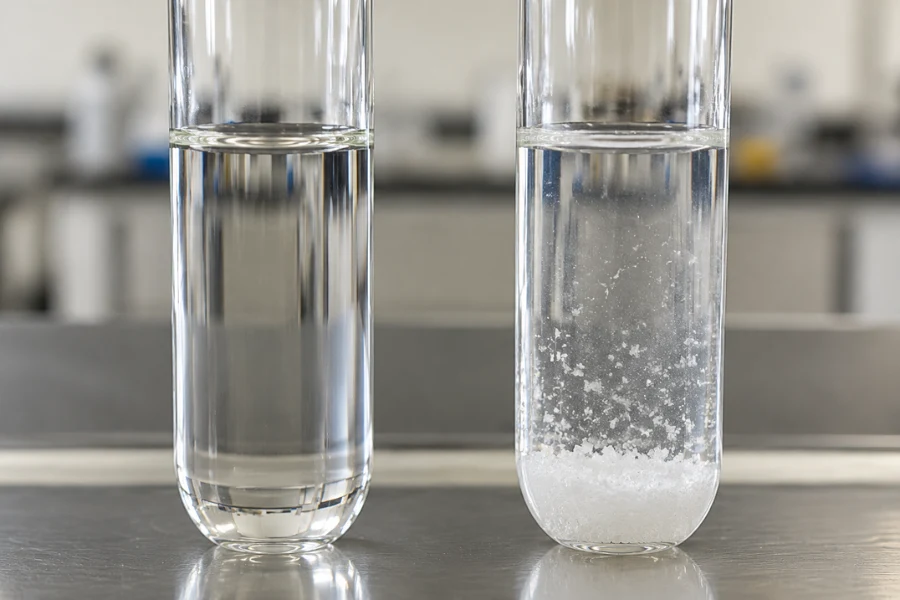
L-methionine may exist in both dissolved and crystalline forms in fermentation broth. Patent US7785846B2 reports a water solubility of approximately 30 g/L at 20°C and more than 90 g/L at 70°C. The actual solubility in fermentation broth also depends on its composition.
This temperature dependence affects the separation sequence. If methionine crystals are present, removing suspended solids without distinguishing biomass from product crystals may cause significant product loss.
Feed characterization should establish total and dissolved methionine concentrations, suspended-solids content and operating temperature. These measurements indicate whether direct clarification is feasible or thermal solubilization is needed.
Biomass and Soluble Impurities
Fermentation broth may contain microbial cells, cell debris, residual nutrients, inorganic salts and soluble metabolic byproducts. Centrifugation and filtration primarily remove suspended solids, while most dissolved impurities remain in the liquid.
A clarified broth may therefore require further treatment before crystallization. The decision depends on which impurities affect product specifications, crystallization behavior or crystal separation.
Fermentation Broth Pretreatment and Solid-Liquid Separation
Thermal Solubilization Before Biomass Removal
Heating can transfer crystalline methionine into the liquid phase before biomass removal. US7785846B2 describes this approach, followed by elevated-temperature biomass separation, concentration and cooling crystallization.
The patent discloses heating temperatures of approximately 60–120°C, with preferred conditions depending on the amount of product requiring dissolution. These are patent-specific operating conditions rather than universal recommendations. Temperatures above the liquid’s boiling point at the selected pressure may require pressurized operation.
Temperature control must extend beyond the heater. Cooling in transfer lines or separation equipment can cause methionine to reprecipitate, increasing solids loading and potentially transferring product into the biomass residue.
Where indirect heating is used, equipment selection should account for fouling, pressure drop, residence time and cleaning requirements. These factors are particularly important when the feed contains microbial solids or components that may deposit on heat-transfer surfaces.
Selecting a Solid-Liquid Separation Method
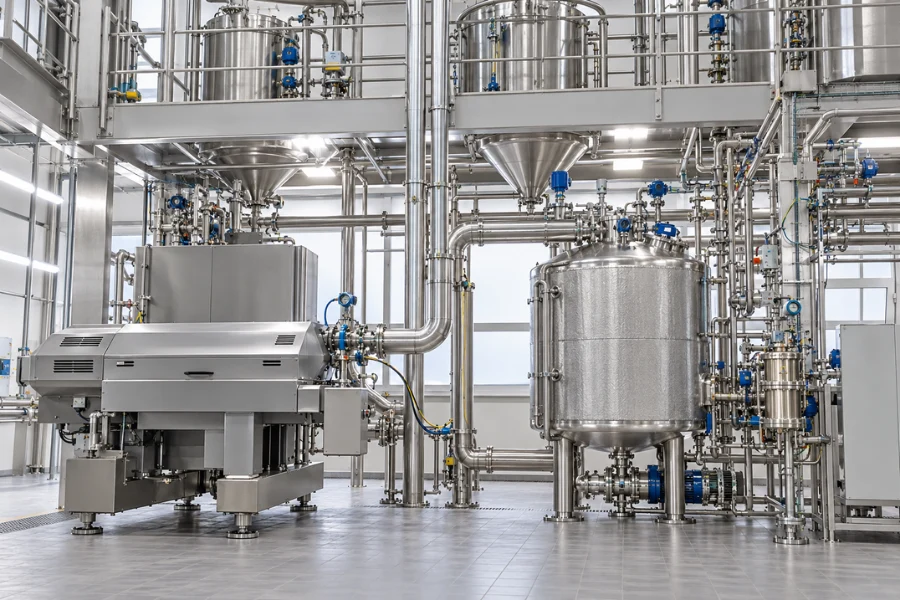
The separation method should be selected according to biomass characteristics, methionine phase distribution and required throughput.
| الطريقة | Primary function | Critical evaluation |
|---|---|---|
| Centrifugation | Remove biomass and suspended solids | Particle properties, solids loading and liquid recovery |
| الترشيح | Retain solids while recovering liquid | Cake resistance, pressure drop and filter-aid demand |
| Microfiltration | Retain suspended particles using a membrane | Flux, fouling, cleaning and methionine passage |
| Ultrafiltration | Retain selected macromolecules and larger species | Membrane selectivity and product retention |
If methionine is predominantly dissolved, the main objective is to remove biomass while retaining the product in the clarified liquid. If crystals are present, the process must either separate product and biomass selectively or dissolve the product before clarification.
Laboratory trials should measure both solids-removal efficiency and methionine distribution across the separated streams. These measurements establish the performance requirements for biomass clarification.
Broader معدات الفصل selection becomes relevant when evaluating the subsequent concentration and purification stages. However, equipment intended for gas-liquid separation, extraction or melt crystallization should not be assumed suitable for microbial biomass removal.
Recovering Methionine From Biomass Residues
The separated biomass can retain methionine in entrained liquid or as undissolved crystals. A disclosed example in US7785846B2 reports a biomass residue containing approximately 6% methionine.
Washing may recover some of this product, but the decision depends on the recoverable methionine mass, added wash-liquid volume and downstream concentration requirements.
Residue analysis should therefore precede equipment selection for secondary recovery. A low product concentration or high dilution requirement may make additional washing less attractive than other recovery options.
Impurity Removal and Crystallization Feed Conditioning
Resin Adsorption and Ion-Exchange Options
Resin adsorption or ion exchange may be considered when soluble impurities cannot be adequately controlled through clarification and crystallization.
A 2019 study investigated D72 macroporous cation resin for L-methionine recovery from إشريكية القولونية fermentation broth. The study reported the following results.
| المعلمة | Reported result |
|---|---|
| Adsorption capacity | 52.37 mg/g |
| Desorption rate | 99.12% |
| Methionine recovery | 82.37% |
| نقاء المنتج | 85.69% |
| Feed pH | 2 |
| Loading flow rate | 2 bed volumes per hour |
| Loading volume | 55 mL |
| Eluent | 1 mol/L ammonia solution |
| Elution flow rate | 2 bed volumes per hour |
| Column height-to-diameter ratio | 14:1 |
These values describe the reported experimental configuration. They should not be transferred directly to a different fermentation broth or industrial adsorption column without validation.
The study supports the feasibility of resin-based methionine separation under its investigated conditions. It does not establish that resin treatment is superior to direct crystallization or that a complete resin-to-crystallization flowsheet has been validated by those results.
Resin selection must also account for breakthrough behavior, adsorption capacity under actual feed conditions, elution volume, regeneration and treatment of secondary liquid streams.
Conditioning the Feed for Crystallization
Crystallizer feed quality depends on methionine concentration, temperature, pH, residual particles and dissolved impurities.
Conditions optimized for resin adsorption should not automatically be applied to crystallization. For example, the pH of 2 used in the D72 study was part of its adsorption process, not a universal methionine crystallization specification.
Feed conditioning should target impurities that materially affect product quality or crystal recovery. Additional purification is justified when its benefit exceeds the associated product losses, processing requirements and waste-treatment burden.
Concentration and Crystallization Purification
Evaporation and Supersaturation Control
Evaporation increases methionine concentration by removing water. Atmospheric or vacuum operation may be considered according to thermal requirements, liquid properties and equipment design.
A المبخر الغشائي المتساقط may be evaluated for a suitably clarified, low-fouling feed. Its suitability depends on liquid distribution, viscosity, heat-transfer conditions and the risk of premature crystallization inside the evaporator.
The purpose of concentration is to establish a reproducible feed for crystallization. Excessive concentration may cause deposition on heating surfaces or produce a slurry that is difficult to transfer.
The concentration target should therefore be selected together with the crystallization temperature profile and the allowable solids content entering downstream equipment.
Cooling Crystallization and Antisolvent Crystallization
Cooling crystallization lowers methionine solubility by reducing temperature. Antisolvent crystallization changes the solvent composition to reduce the amount of methionine that can remain dissolved.
| Selection factor | Cooling crystallization | Antisolvent crystallization |
|---|---|---|
| Main driving force | Temperature-dependent solubility | Solvent-composition change |
| Main controls | Cooling profile, mixing and supersaturation | Antisolvent addition, mixing and local composition |
| Additional requirements | Cooling capacity and temperature control | Solvent supply, recovery and handling |
| Validation focus | Crystal size, purity and slurry behavior | Solvent compatibility, crystal properties and recovery |
US7785846B2 describes an experimental cooling-crystallization procedure in which concentrated methionine solution was cooled to 5°C at 5 K/h. These conditions illustrate a disclosed method, not a universal commercial cooling program.
Antisolvent crystallization requires separate evaluation of solvent compatibility, impurity behavior, product recovery and residual-solvent requirements. The cost of solvent recovery must also be included when comparing routes.
Crystal Formation and Downstream Performance
Supersaturation drives nucleation and crystal growth. Its distribution within the crystallizer depends on the concentration or cooling strategy, mixing and heat transfer.
Excessive local supersaturation can increase nucleation and the proportion of fine crystals. Fine particles may raise filtration resistance and increase the difficulty of removing mother liquor from the crystal cake.
Crystallization trials should therefore measure crystal-size distribution, product purity and recovery alongside filtration performance. A high crystallization yield is not sufficient if the resulting slurry cannot be separated reliably.
Crystal Separation, Washing and Drying
Separating the Crystal Slurry
Filtration or centrifugation separates methionine crystals from the mother liquor. The choice depends on particle-size distribution, slurry solids content, throughput and acceptable residual moisture.
Small crystals may form a high-resistance filter cake, while retained mother liquor can carry dissolved impurities into the recovered product.
The crystallizer and separator should be evaluated together because the upstream crystallization conditions determine much of the downstream separation load.
Washing and Drying
Washing removes mother liquor retained within the crystal cake. Its effectiveness depends on wash-liquid distribution, liquid composition, temperature and methionine solubility.
Additional washing may improve purity but can dissolve product and increase the volume of liquid requiring recovery or treatment. The selected washing strategy should therefore be evaluated through both purity and net methionine recovery.
Drying conditions must meet the required residual-moisture specification without compromising product quality. Temperature, residence time and drying-gas conditions should be validated using representative wet crystals.
Mother Liquor Recycling and Overall Product Recovery
Establishing the Material Balance
Recovered dry-crystal mass alone does not establish downstream methionine recovery. Product may remain in biomass residues, mother liquor and wash streams.
For a defined process boundary, overall recovery can be expressed as:
Overall methionine recovery (%) = Methionine mass in the designated recovered product stream ÷ Methionine mass entering the defined process boundary × 100
Crystallization-stage recovery uses methionine entering crystallization as its denominator. Downstream overall recovery instead measures product recovered relative to the methionine entering the complete downstream process.
Internal recycle streams must not be counted repeatedly as new feed. The material balance should distinguish fresh methionine input, recovered product, purge streams and other net losses.
Measuring methionine in the major outlet streams identifies where additional recovery measures may have the greatest effect.
Recycling Benefits and Impurity Accumulation
Mother liquor and wash-liquid recycling can recover residual methionine, but these streams may also contain impurities that remain dissolved during crystallization.
Repeated recycling can increase impurity concentrations and change subsequent crystallization behavior. Stable operation may require a controlled purge, selective impurity removal or an alternative recovery step.
The economic value of recycling should be evaluated using net recovery, impurity accumulation, additional evaporation duty and waste-stream treatment requirements rather than recovered methionine alone.
Scaling Up Methionine Separation and Crystallization
Heat and Mass Transfer During Scale-Up
Equipment scale affects heat-transfer area relative to working volume, mixing time and solids circulation. These changes may alter temperature uniformity, supersaturation and crystal-size distribution.
A laboratory cooling rate cannot be transferred directly to a larger crystallizer without evaluating heat-removal capacity and mixing. Likewise, a successful laboratory filtration test does not establish commercial separator throughput if the crystal properties change during scale-up.
The scale-up basis should therefore include heat-transfer requirements, mixing behavior, solids suspension, residence time and the response to representative feed variations.
Pilot Validation and Commercial Process Integration
Pilot trials should assess the complete recovery process because the conditions established upstream determine the performance requirements downstream.
Key validation items include:
- Total and dissolved methionine concentrations in representative feeds.
- Methionine distribution after biomass separation.
- Concentration duty and premature-crystallization risk.
- Crystal-size distribution and filtration behavior.
- Product purity and recovery after washing and drying.
- Methionine losses in biomass, mother liquor and wash streams.
- Impurity accumulation during recycle operation.
- Repeatability and process-control requirements at the intended throughput.
Continuous or semi-continuous configurations require additional assessment of residence-time distribution, throughput matching and solids accumulation.
These measurements help identify the limiting operation and establish whether the proposed process can maintain stable performance at commercial scale.
Selecting an Integrated Purification Process
Comparing Process Routes
Two broad process configurations illustrate the main selection decisions.
| Evaluation factor | Solubility-based recovery and crystallization | Resin-assisted purification route |
|---|---|---|
| Main approach | Dissolve methionine where necessary, remove biomass, concentrate and crystallize | Clarify the broth and use selective resin separation where justified |
| Main prerequisite | Suitable solubility behavior and manageable impurity levels | Suitable resin selectivity and practical adsorption and elution conditions |
| Potential advantage | Fewer separation stages when crystallization meets specifications | Additional separation of selected dissolved components |
| القيد الرئيسي | Some impurities may remain in or with the crystal product | Additional equipment, regeneration and liquid-stream handling |
| Critical validation | Product loss, crystal quality and mother-liquor recovery | Resin performance, impurity rejection and overall recovery |
The resin-assisted route may require further concentration or crystallization depending on the product specification. The cited D72 study does not independently validate every possible downstream configuration.
Developing suitable حلول تكنولوجيا العمليات requires comparing these alternatives against the actual feed composition, product requirements, material balance and operating constraints.
Engineering Questions Before Industrial Deployment
Before finalizing the process, project teams should establish:
- What fraction of the methionine is dissolved or crystalline at the recovery temperature?
- Can biomass be removed without unacceptable product loss?
- Which dissolved impurities require removal before product recovery?
- What concentration and crystallization conditions produce manageable crystals?
- Can the selected equipment separate, wash and dry the crystals at the required throughput?
- How much methionine remains in the biomass, mother liquor and wash streams?
- Will recycling improve net recovery without excessive impurity accumulation?
- Can the process maintain product quality under representative operating variations?
These questions should be answered using feed characterization, laboratory testing, material balances and pilot validation where appropriate.
الخاتمة
Methionine fermentation broth separation and purification must account for the product’s temperature-dependent solubility, the distribution of methionine between liquid and solids, and the effect of dissolved impurities on crystallization.
Thermal solubilization can reduce product loss during biomass removal when methionine crystals are present. Resin-assisted separation may provide additional impurity control when justified by the feed composition and product requirements.
The preferred process should be selected using net methionine recovery, product purity, energy demand, crystal separation performance and recycle stability. Pilot validation is needed to establish whether laboratory results can be reproduced at the intended industrial scale.
دودجن focuses on process technology, separation and purification engineering, and industrial process integration. For methionine recovery applications, equipment and process selection should begin with the actual broth characteristics and required product specifications.