When conducting laboratory-scale melt crystallization studies, one question frequently arises: customers want to know as early as possible whether a material is worth scaling up.
This is where laboratory-scale data becomes critical.
The purpose of a lab-scale study is not to establish final industrial operating conditions. Instead, it is intended to answer several fundamental questions at an early stage:
Can melt crystallization create a meaningful purity difference between the target component and impurities? Can impurities be effectively removed through the mother liquor or sweating fraction? Does the product color improve during purification? Can purity be further increased through additional crystallization stages?
When these questions are clearly answered during the laboratory phase, subsequent process development can proceed with significantly less uncertainty and fewer detours.
When evaluating experimental results, we do not focus solely on final product purity. Instead, we analyze the feed material, mother liquor, sweating fraction, and purified product as a complete system.
Take cyanophenol as an example. The feed purity was approximately 89%. After the first crystallization stage, product purity increased to above 97%, and after the second stage, it exceeded 99%. These results indicate that melt crystallization not only recovered the target component in crystalline form but also effectively transferred impurities into the mother liquor and sweating fraction. The gradual improvement in product color further confirms successful impurity removal.
The results obtained with nitrotoluene provide another representative example. Starting from a feed purity of approximately 75%, the first crystallization stage increased purity to around 93%, the second stage to approximately 98%, and the third stage to 99.85%. Such stepwise purification data are highly valuable because they demonstrate the continuous purification capability of multistage melt crystallization.
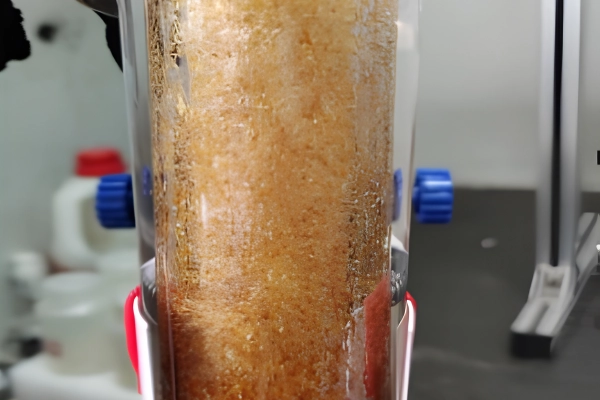
Raspberry ketone presents a different scenario. The feed purity was approximately 91%, while the first-stage product reached over 97% purity and the second-stage product exceeded 99%. Although this material exhibited challenges such as a large gap between its spontaneous crystallization temperature and melting point, a tendency toward rapid crystallization, and increased viscosity during processing, effective purification was still achieved through optimization of seed crystal addition and cooling profiles.
These case studies highlight an important principle: during laboratory evaluation, the objective is not only to determine whether high purity can be achieved, but also whether the path toward high purity is technically clear and scalable.
A significant purity increase after the first stage suggests favorable separation behavior between the target compound and impurities.
Further improvement during the second stage indicates additional development potential for multistage crystallization.
Simultaneous color improvement may suggest effective removal of colored impurities.
When impurity concentrations in the mother liquor and sweating fraction are substantially lower than those in the purified product, the impurity rejection mechanism can be considered validated.
However, not all laboratory results are equally promising.
In some cases, product purity improves only marginally after the first crystallization stage, and the compositions of the product, mother liquor, and sweating fraction remain similar. Such results require careful evaluation. The underlying causes may include similar crystallization behavior between impurities and the target compound, severe crystal entrainment, or batch-to-batch variations that reduce separation efficiency.
Even under these circumstances, laboratory-scale data remain valuable. At a minimum, they indicate that scale-up should not proceed blindly and that simply increasing the number of crystallization stages is unlikely to solve the problem. Instead, the material characteristics and separation strategy should be reassessed.
Ultimately, laboratory-scale studies provide far more than a single purity value.
They provide process direction.
A successful laboratory-scale evaluation should answer three critical questions:
Can the material crystallize?
Can crystallization achieve effective separation?
Can the separation performance be reproduced and scaled up?
When the answer to all three questions is yes, melt crystallization becomes more than an interesting laboratory observation—it becomes a purification technology with genuine industrial development potential.