For many fine chemicals and advanced material products, achieving higher purity is far from straightforward.
Some materials have high boiling points that make distillation impractical. Others are highly sensitive to solvent systems, making recrystallization screening both costly and time-consuming. In some cases, products must meet strict requirements for color, odor, and impurity content, creating the need for a more suitable purification technology.
Melt crystallization is one such option that deserves serious consideration.
The principle is relatively simple. The material is first melted, and controlled cooling is then applied to promote preferential crystallization of the target component while impurities remain concentrated in the liquid phase. After the mother liquor is removed, a controlled sweating step is performed by gradually increasing the temperature, allowing impurities trapped within the crystal layer to be further expelled and resulting in a higher-purity product.
However, whether melt crystallization is effective for a specific material can only be determined through laboratory-scale testing.
The greatest value of a lab study is its ability to transform a theoretical possibility into a data-supported conclusion.
A complete laboratory-scale evaluation typically includes analysis of the feed material, mother liquor, sweating fraction, and purified product. The feed defines the starting point. The mother liquor and sweating fraction reveal whether impurities have been successfully rejected. The product demonstrates the final purification performance.
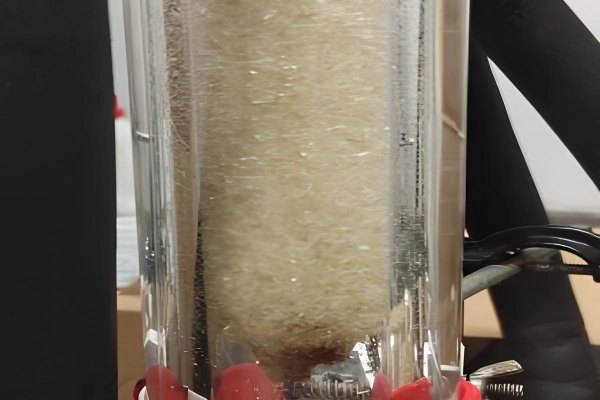
When product purity is significantly higher than that of the feed, while impurity-rich fractions such as the mother liquor and sweating fraction show lower target-component concentrations, the separation mechanism can be considered effective.
When product purity continues to increase through successive crystallization stages, it indicates additional purification potential.
When product color becomes lighter as purity increases, impurity removal is reflected not only in analytical results but also in visual appearance.
For some materials, these improvements are remarkably clear. A feed material with an initial purity of approximately 89% may exceed 97% after a single melt crystallization stage and surpass 99% after a second stage. In other cases, purity can be progressively increased from around 75% to as high as 99.85%. Such results demonstrate the strong purification capability that melt crystallization can provide for suitable systems.
At the same time, laboratory studies also identify materials that may not be good candidates for the technology.
Some materials crystallize but form poor crystal structures that hinder mother liquor drainage. Others experience crystal layer collapse during the sweating stage. Certain materials show significant batch-to-batch variation, while others exhibit only minor composition differences among the product, mother liquor, and sweating fraction, indicating limited impurity separation.
These less favorable outcomes should not be viewed as failures. Rather, they represent one of the most valuable functions of laboratory-scale testing: identifying limitations before significant development resources are invested.
Melt crystallization is particularly well suited to materials that exhibit relatively stable molten behavior, a well-defined crystallization window, the ability to form robust crystal structures, effective mother liquor drainage, efficient sweating performance, and simultaneous improvements in both purity and color.
When these characteristics are present, further optimization can focus on parameters such as cooling rate, seed crystal addition temperature, holding time, final sweating temperature, and the number of crystallization stages.
Therefore, a melt crystallization laboratory study is much more than a simple sample preparation exercise.
It establishes a systematic framework for process evaluation.
Using a relatively small quantity of material and a short experimental cycle, it answers one critical question:
Is this material a viable candidate for further development using melt crystallization?
For products that require high purity, reduced solvent consumption, and a scalable purification route, obtaining that answer is often well worth the effort.