In industrial vinylene carbonate synthesis, dehydrochlorination determines more than CEC conversion. It also determines salt loading, residual precursor concentration, secondary impurities, and the crude composition that filtration and purification must process.
Reactor temperature, feed strategy, mixing, solids formation, filtration, vacuum purification, and melt crystallization therefore form one process chain. Optimizing any one stage without considering its downstream consequences can shift rather than remove the production bottleneck.
How Industrial Vinylene Carbonate Synthesis Works
A widely documented industrial route chlorinates ethylene carbonate (EC) to chloroethylene carbonate (CEC), followed by dehydrochlorination with an acid acceptor to produce vinylene carbonate and a corresponding salt.
The crude mixture can contain residual CEC, solvent, salt, unreacted reagents, light components, heavy byproducts, and other reaction-derived impurities. A representative process sequence is:
EC → Chlorination → CEC → Dehydrochlorination → Solid-Liquid Separation → Desolvation → Vacuum Purification → Melt Crystallization → High-Purity VC
This sequence creates an important process dependency: reaction conditions establish the impurity and solids load entering purification. The industrial target is therefore stable production of specification-grade VC across the complete process, not maximum conversion in the reactor alone.
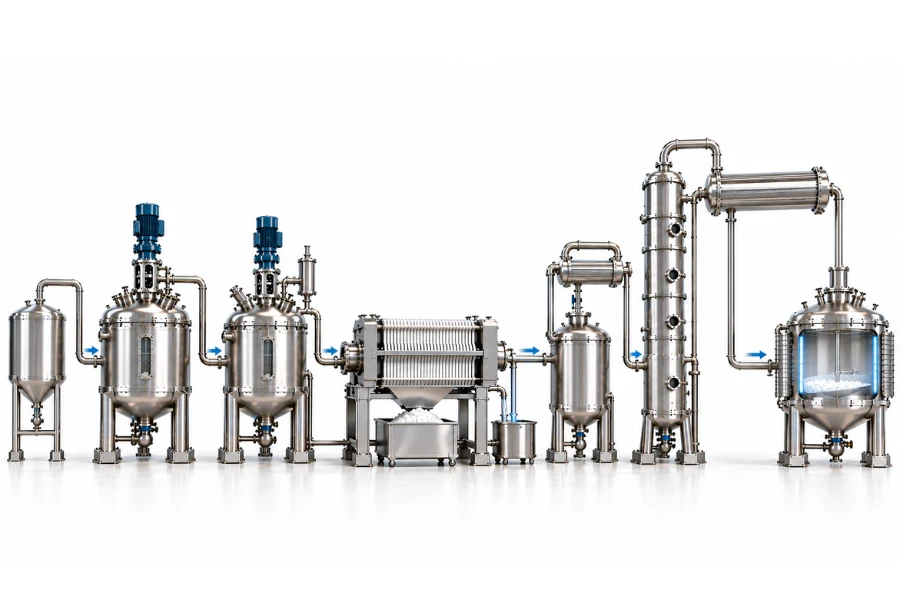
Why CEC Dehydrochlorination Becomes a VC Reactor Problem
At production scale, CEC conversion must be balanced against selectivity, reagent distribution, heat removal, and progressive salt formation.
Reaction Rate vs. Selectivity
Higher temperature, greater base exposure, or longer residence time may accelerate CEC conversion without necessarily increasing recoverable VC yield. More severe conditions can change secondary reaction behavior and the impurity profile that downstream separation must handle.
Feed ratio and addition strategy also affect local reaction conditions. Even when the overall batch composition is within target, poor mixing around a feed point can temporarily expose material to reagent concentrations different from the bulk average.
The operating window should therefore consider:
- Reaction temperature and temperature profile
- CEC and acid-acceptor feed rates
- Reagent concentration and distribution
- Mixing intensity
- Residence or hold time
- Conversion and selectivity
- Crude-product impurity profile
These variables should be validated as a coupled operating window rather than optimized individually or transferred from unrelated carbonate chemistry.
Salt Formation Changes Mixing and Heat Transfer
When a tertiary amine serves as the acid acceptor, dehydrochlorination generates the corresponding hydrochloride salt. Increasing conversion can therefore change the reactor from a predominantly liquid system into a progressively more concentrated slurry.
CEC Dehydrochlorination → Salt Formation → Higher Solids Loading → Changed Mixing → Changed Heat Transfer → Changed Temperature Response
As solids loading changes, suspension quality and circulation patterns can change with it. Poor suspension can increase local composition differences, while changes near heat-transfer surfaces can affect the reactor’s ability to remove heat under the same nominal jacket or coil conditions.
The same slurry properties determine whether the reactor can discharge consistently and how the downstream filter handles solids loading, cake formation, washing, and liquid recovery.
For vinylene carbonate synthesis, the reactor is therefore a reaction-plus-solids-generation system. Reactor sizing based only on liquid residence time does not capture the mixing, heat-transfer, and downstream separation consequences of salt formation.
Reactor Safety Is an Operating-Window Problem
VC reactor safety depends on whether feed addition, reaction rate, heat generation, cooling, mixing, and changing slurry properties remain inside a controllable operating envelope.
General reactor-engineering principles described in Perry’s Chemical Engineers’ Handbook show that interactions among kinetics, fluid flow, transport resistance, and heat effects can create dynamic behavior and, in some systems, runaway conditions. VC-specific safety limits, however, require process-specific reaction and thermal data rather than generic temperature limits.
Heat Generation vs. Heat Removal
Feed addition simultaneously changes reaction rate and, as conversion proceeds, solids loading. Heat-removal performance therefore cannot be evaluated independently of reaction progress and slurry behavior.
A useful causal chain is:
Feed Rate → Reaction Rate → Heat Generation → Salt/Slurry Development → Mixing and Heat Transfer → Reactor Temperature
This matters during scale-up because reactor volume and available heat-transfer area do not increase proportionally. Agitation performance and slurry circulation can also change with vessel geometry and scale.
Scale-up validation should therefore test cooling duty, feed-control response, agitation performance, temperature response, and credible cooling or mixing deviations under representative reaction progress—not only at initial liquid conditions.
Managing VC Stability in the Reactor
VC’s vinyl functionality makes cumulative thermal exposure a product-stability variable.
Temperature must be considered together with hold time, inhibitor strategy, oxygen conditions, impurity composition, stagnant regions, and local hot surfaces. A moderate temperature maintained for excessive time may impose a different product history from a short controlled exposure.
The reactor objective is therefore to complete the required chemistry without adding unnecessary thermal history or creating operating conditions that become difficult to control as solids develop.
Why Reaction Control Determines Purification Load
Dehydrochlorination determines the composition presented to the downstream separation train.
Changes in reaction severity can alter residual CEC, salt loading, solvent composition, and secondary impurities. Those changes propagate into filtration behavior, desolvation duty, rectification load, crystallization performance, and product recovery.
Reaction Severity → Conversion and Selectivity → Crude VC Composition → Filtration Load → Purification Duty → VC Recovery
This leads to an important plant-wide optimization principle:
Maximum reactor conversion does not necessarily equal maximum plant-wide VC yield.
If additional conversion is obtained by conditions that increase difficult-to-remove impurities, the resulting purification losses, energy demand, or product-stability constraints can outweigh the reactor-level gain. Reaction optimization should therefore include downstream impurity behavior and recoverable VC yield as performance criteria.
Solid-Liquid Separation Before VC Purification
Hydrochloride salt must be removed while retaining as much VC-containing liquid as practical.
Filter performance depends on solids loading, particle behavior, solvent composition, and the slurry delivered by the reactor. Cake washing can reduce retained soluble contaminants, but additional washing also increases solvent handling and transfers recoverable VC into secondary liquid streams.
The decision is therefore not simply whether to wash more. Washing intensity should be balanced against contaminant removal, VC recovery, solvent-recovery duty, and the impurity tolerance of downstream purification.
Poor solids removal can transfer suspended material or soluble contaminants into heated purification equipment. Reaction and filtration conditions should consequently be validated as an interface rather than as independent operations.
Why Vinylene Carbonate Purification Needs Controlled Thermal History
After solids removal and desolvation, crude VC still contains reaction-derived impurities. Purification must achieve the required separation without imposing unnecessary temperature and residence time on VC.
Vacuum Distillation and Rectification
Reduced pressure lowers the temperature required for vaporization, reducing one component of thermal exposure during VC purification. It does not, however, eliminate the effects of liquid residence time or heated equipment holdup.
Relevant variables include:
- Operating pressure
- Bottom and reboiler temperature
- Liquid residence time
- Column separation efficiency
- Feed impurity composition
- Condensation conditions
- VC recovery
- Polymerization-control strategy
A lower boiling temperature provides limited benefit if VC remains for excessive periods in a reboiler, column bottom, or other heated inventory. Pressure, column configuration, liquid holdup, and reboiler operation should therefore be evaluated together.
Distillation Cannot Solve Every Purity Problem
Increasing reflux, theoretical separation duty, or thermal input is useful only while the remaining impurities respond sufficiently to vapor-liquid equilibrium.
When volatility differences provide limited separation, additional rectification can produce diminishing purity gains while increasing residence time and energy demand. At that point, the engineering question is whether another phase-equilibrium mechanism can perform the polishing duty more efficiently.
This creates a functional division between bulk purification by vacuum rectification and final polishing by melt crystallization.
Why Melt Crystallization Complements VC Distillation
Melt crystallization uses solid-liquid equilibrium rather than the vapor-liquid equilibrium governing rectification.
A VC-rich stream is cooled under controlled conditions so that VC preferentially enters the crystal phase while a greater fraction of impurities remains in the liquid. Sweating then removes impurity-rich liquid retained on or within the crystal mass.
Crude VC → Desolvation → Vacuum Rectification → VC-Rich Stream → Melt Crystallization → Sweating → High-Purity VC
Rectification and crystallization therefore address different separation constraints. Rectification is suited to bulk impurity removal when volatility differences are usable, while melt crystallization provides a polishing route when further vaporization offers diminishing separation value.
Technology selection should consequently follow impurity behavior rather than an assumption that either distillation or crystallization is universally superior.
Purity vs. Yield: Managing Recycle Streams
Increasing crystal purity can reduce single-pass recovery because some VC remains in the mother liquor. More intensive sweating can further improve crystal purity while transferring additional recoverable VC into secondary fractions.
Recycling those streams can recover VC, but it also returns the impurities rejected by crystallization. If those impurities are only weakly removed elsewhere in the process, repeated recycle can increase their steady-state concentration.
The process therefore has to balance:
Product Purity ↔ VC Recovery ↔ Energy Consumption
Recycle ratio should be evaluated together with impurity accumulation, purge requirement, crystallization yield, and available upstream separation capacity. A higher recycle ratio improves recovery only while the additional impurity and separation load remains manageable.
From Process Signals to Engineering Responses
Because reaction and separation are coupled, the location where a process problem appears may not be where it originates.
| Process Signal | Likely Mechanism | What to Verify | Engineering Response |
|---|---|---|---|
| Reactor temperature rises faster than expected | Heat generation exceeds available removal or mixing has changed | Feed rate, agitation, cooling duty, slurry development | Reduce addition severity and verify heat-removal margin |
| Residual CEC remains high | Incomplete dehydrochlorination or poor reagent distribution | Temperature, residence time, feed distribution, mixing | Verify reaction behavior before increasing overall severity |
| Filtration becomes unstable | Salt or slurry properties have shifted | Solids loading, particle behavior, solvent composition, upstream mixing | Optimize reaction and filtration conditions together |
| Purification duty increases | Crude VC carries a higher impurity burden | Conversion, residual CEC, solvent and byproduct profile | Identify the upstream source before increasing separation severity |
| Purity plateaus after rectification | Remaining impurities respond poorly to vapor-liquid separation | Impurity composition and column performance | Evaluate whether remaining impurity behavior favors crystallization-based polishing |
| Crystallization purity rises while recovery falls | More VC remains in mother liquor or sweat streams | Crystal yield, sweating conditions, recycle composition | Optimize recovery and recycle rather than maximizing single-pass purity |
This diagnostic sequence prevents a downstream symptom from automatically triggering more severe reaction, distillation, or crystallization conditions.
Scale-Up Requires Reaction and Purification to Be Validated Together
Pilot development should use representative material to test the interfaces that become important at commercial scale.
Reactor validation should examine heat removal, feed strategy, mixing, reaction time, salt formation, and reproducibility. Filtration trials should determine how those reaction conditions change slurry behavior, cake washing, and liquid recovery.
Purification testing should use representative crude VC rather than an idealized feed so residual precursor, solvent, reaction byproducts, and other impurities can be tracked through vacuum rectification and melt crystallization. Recycle should also be tested over repeated operation because an impurity rejected in one pass may accumulate when mother liquor returns upstream.
A publicly disclosed DODGEN project provides an industrial reference point. Its design basis includes 11,000 t/a of CEC and 4,000 t/a of VC, with distillation coupled to falling-film melt crystallization and a target VC purity of ≥99.995%. The disclosed process also integrates filtration and drying, triethylamine recovery, solvent recovery, rough distillation, rectification, and crystallization.
The engineering significance of this configuration is not the capacity number alone. It shows that reaction throughput, solids handling, reagent and solvent recovery, rectification, crystallization, and final purity have to be reconciled within one material and separation system.
The meaningful scale-up target is therefore stable specification-grade VC production at acceptable recovery, energy demand, thermal exposure, and operating consistency—not reactor conversion in isolation.
Integrating VC Reaction, Safety, and High-Purity Separation
The key design boundary in VC production is not between the reactor and the purification section, but between conditions that merely increase local performance and conditions that improve the complete process.
Dehydrochlorination should therefore be evaluated by the solids and impurity load it creates, while purification should be evaluated by both product specification and recoverable VC yield. For VC industrialization, DODGEN integrates reaction development, impurity control, purification, crystallization, and scale-up validation around these plant-wide performance criteria.