Melt crystallization appears straightforward in terms of its process flow: melting the material via heating, crystallizing via cooling, draining the mother liquor, sweating via controlled heating, and finally, melting the purified product. However, the ultimate purification efficiency is dictated not merely by the execution of these steps, but rather by whether the physical state achieved at each stage is optimal.
Melt crystallization can be conceptualized as four consecutive mechanisms: nucleation/growth, wall adhesion, drainage, and sweating.
The first mechanism is crystal nucleation and growth. Once the material is completely molten, it must enter the crystallization zone through controlled cooling. If crystallization occurs too early, too rapidly, or too abruptly, it can induce spontaneous flash crystallization. Conversely, if it occurs too late, the system’s viscosity may escalate, severely impeding crystal growth. The ideal scenario involves the initiation of crystal nuclei at an appropriate temperature, followed by a gradual temperature ramp-down to allow steady crystal growth.
If spontaneous crystallization is unfavorable, seeding can be implemented. However, the introduction of seed crystals requires strict parameter control. Seeding too late, when the system is heavily supercooled, triggers a sudden mass crystallization. Seeding too early may cause the seeds to prematurely dissolve, failing to induce crystallization. Experimental data on raspberry ketone demonstrates that both the seeding temperature and the cooling rate are paramount to the resulting crystalline state.
The second mechanism is wall adhesion. In tubular crystallizers, crystal adhesion to the wall serves as a critical process indicator. The growth of crystals along the wall surface indicates the opportunity to form a stable, continuous crystal layer. A stable crystal layer is highly conducive to subsequent mother liquor drainage and effective sweating.
If the crystals fail to adhere to the wall and instead remain largely suspended or form a slurry-like mass, the separation efficacy typically degrades. Under such conditions, impurities and mother liquor become easily entrapped within the crystalline matrix, resisting subsequent discharge.
The third mechanism is drainage. Draining the mother liquor is a pivotal operation in melt crystallization. The mother liquor is typically enriched with impurities; thus, a successful and thorough drainage is a prerequisite for a pronounced increase in product purity.
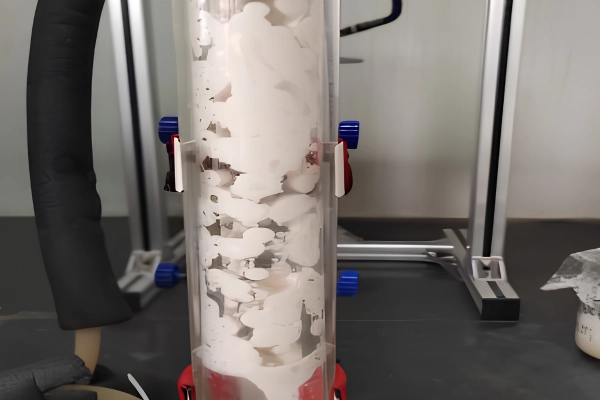
The poor performance observed in certain experiments is often attributed not to a failure to crystallize, but to the undrainable nature of the mother liquor. Factors such as overly fine crystals, excessive system viscosity, or a loosely packed crystal layer structure can all obstruct drainage. In such instances, even if the product appears solid, effective separation has not necessarily been achieved.
The fourth mechanism is sweating. Sweating represents an indispensable refining step in many melt crystallization processes. Following mother liquor drainage, the temperature is raised at a controlled, gradual rate, causing the entrapped impurities and low-melting fractions within the crystal layer to preferentially melt out. Once these sweating fractions are collected, the purity of the remaining crystal skeleton is further enhanced.
An effective sweating process must be mild, continuous, and highly selective. An excessively rapid temperature rise can cause the entire crystal layer to prematurely collapse or melt; conversely, an overly slow ramp reduces process efficiency. Furthermore, an inappropriate final sweating temperature can lead to an unfavorable trade-off between product yield and purity.
Consequently, the success of a melt crystallization experiment cannot be evaluated solely by whether a final solid product is obtained.
Instead, it must be judged by the synergy of these four core mechanisms: whether the crystals grow at an optimal temperature, whether they form a stable and adherent crystal layer, whether the mother liquor drains cleanly, and whether sweating effectively expels residual impurities.
In the case of p-cyanophenol, the product purity increased substantially after primary crystallization, advanced further during secondary crystallization, and was accompanied by a distinct lightening of product color. This underscores the effective synergy between crystal growth, drainage, and sweating.
Similarly, experiments with p-nitrotoluene demonstrated a stepwise increase in purity across primary, secondary, and tertiary stages, proving that multi-stage melt crystallization can deliver sustained separation efficiency.
For materials characterized by slow crystallization kinetics, high viscosity, poor drainage, or a propensity to collapse during sweating, process troubleshooting must focus intensely on these four distinct mechanisms.
Melt crystallization is neither a simple cooling process nor a rudimentary solidification.
It is a sophisticated process control system centered on crystal growth mechanics and impurity rejection. While phenomena such as crystal morphology, wall adhesion, drainage, and sweating behavior appear fundamental, they dictate whether the target purity can be achieved and ultimately determine the viability of commercial process scale-up.