Polymer-grade monomer purification is not simply about increasing an assay from 99% to 99.9% or higher. Two monomer streams with the same headline purity can behave very differently in polymerization if the remaining impurities differ in chemical identity or reactivity.
Trace water, structural isomers, residual solvents, reaction byproducts, monofunctional species, and thermally generated impurities can influence stoichiometry, molecular weight, catalyst performance, color, and process stability. The more useful engineering question is therefore: What remains in the monomer, and what will those impurities do during polymerization?
Melt crystallization and extraction address different parts of this problem. Their value becomes clearer when purification is designed around impurity behavior, downstream polymerization requirements, and commercial-scale process integration rather than a purity number alone.
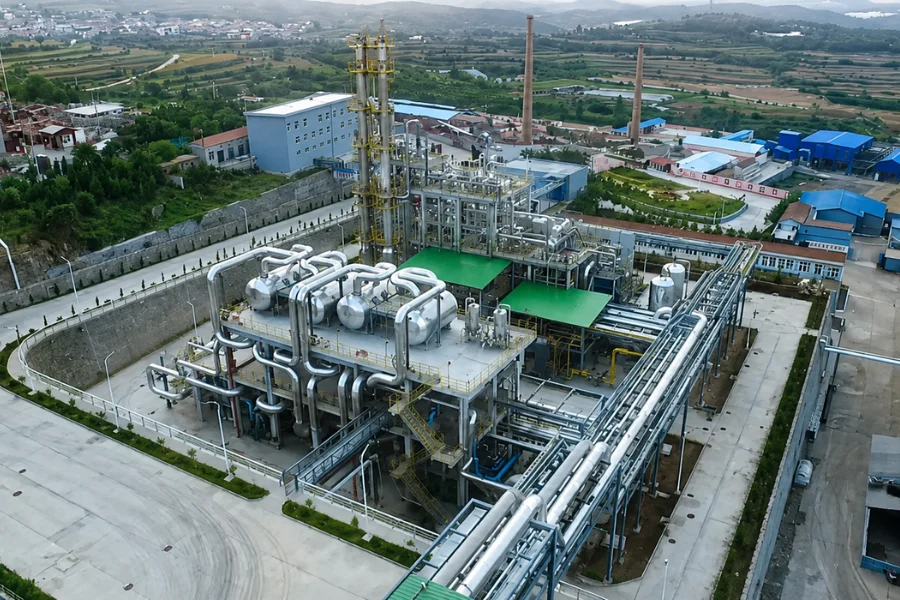
Why Polymer-Grade Monomer Purity Is a Polymerization Issue
Monomer specifications ultimately need to support the downstream reaction. This is especially visible in step-growth polymerization, where high molecular weight requires very high functional-group conversion and tight stoichiometric control.
For an ideal balanced system at a functional-group conversion of 0.99:
[DP_n=\frac{1}{1-p}=100]
If the functional-group ratio falls to 0.99 while conversion remains 0.99, the theoretical number-average degree of polymerization falls to approximately 66.8.
In this idealized case, a 1% stoichiometric deviation reduces (DP_n) by roughly one-third. Monofunctional contaminants can create a similar problem by terminating growing chains rather than merely appearing as an analytical impurity.
This distinction matters for polyester monomers, polyamide intermediates, and other high-purity monomer feedstocks where downstream molecular weight depends strongly on feed composition. A nominal 99.9% assay does not reveal whether the remaining 0.1% is relatively inert or capable of disrupting polymerization.
For that reason, impurity identity + concentration + polymerization sensitivity is often more informative than total purity alone.
Start With the Impurity Profile, Not the Separation Equipment
A purification train should begin with the impurity map.
Distillation remains highly effective when components have sufficient volatility differences. As purity requirements rise, however, close-boiling compounds, structural isomers, thermally sensitive species, or reactive monomers can make additional thermal separation increasingly difficult.
Extraction and melt crystallization provide alternative separation mechanisms.
| Impurity or Process Signal | Separation Challenge | Engineering Direction |
|---|---|---|
| Close-boiling impurity | Low relative volatility | Crystallization or hybrid separation |
| Structural isomer | Similar volatility | Evaluate solid-liquid phase behavior |
| Selectively soluble impurity | Different chemical affinity | Extraction |
| Trace polar impurity | Strong partition difference | Selective extraction |
| Heat-sensitive monomer | Degradation or polymerization risk | Lower-temperature separation |
| Residual extractant | Additional purification duty | Solvent recovery and polishing |
| Persistent trace impurity | Bulk purification already complete | High-purity polishing |
The goal is separation-duty allocation. Bulk removal, selective impurity rejection, concentration, solvent recovery, and final polishing may be better handled by different unit operations.
Where Melt Crystallization Fits in Monomer Purification
Melt crystallization relies on solid-liquid equilibrium rather than vapor-liquid equilibrium. Controlled cooling allows the desired component to crystallize while impurities are preferentially rejected into the remaining melt.
This mechanism can be useful for aromatic monomers, isomer-rich streams, and specialty polymer intermediates where volatility-based separation becomes inefficient or high-temperature residence time creates degradation or unwanted polymerization risk. Because the process generally does not require an added solvent, it can also avoid creating another solvent-removal duty.
Yet a favorable melting point is only the beginning of process development.
Crystal purity depends on subcooling, nucleation, growth rate, crystal size distribution, impurity inclusion, and mother-liquor retention. Cooling too aggressively may raise apparent productivity while generating smaller crystals or trapping more impurities.
Post-crystallization operations matter as well. Washing removes adhering mother liquor, while controlled sweating can preferentially melt impurity-rich regions and further increase product purity.
The operating target is therefore not maximum crystallization rate. It is a reproducible balance among purity, recovery, crystal handling, heat transfer, and throughput.
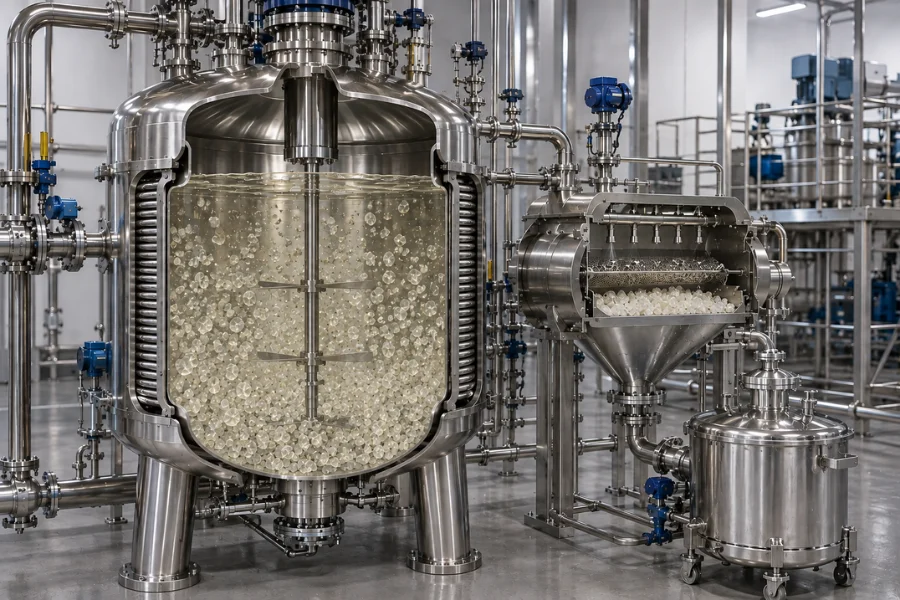
Layer or Suspension Crystallization?
Layer crystallization grows a solid layer on cooled surfaces and is commonly associated with batch or semi-continuous operation. Its process arrangement can be relatively straightforward, but available growth area and cycle behavior constrain productivity.
Suspension melt crystallization distributes crystals through the melt, providing substantially more growth surface and greater potential for continuous processing. The trade-off is more demanding hydrodynamics, crystal size control, slurry transport, solid-liquid separation, and fouling management.
For scale-up, these operating characteristics matter as much as equilibrium selectivity.
Where Extraction Adds Value
Extraction is attractive when an impurity differs from the target monomer more strongly in chemical affinity or solubility than in volatility.
A properly selected extractant can transfer unwanted species into another liquid phase or selectively recover a valuable component from a complex feed. This makes extraction useful for upstream cleanup, selective impurity rejection, and concentration before final high-purity separation.
Commercial performance depends on distribution coefficients, solvent selectivity, phase ratio, interfacial area, mass transfer, temperature, stage efficiency, and phase disengagement. Equilibrium data alone cannot describe how an industrial extraction system will perform.
There is also a process penalty to consider. Adding an extractant can create requirements for solvent recovery, residual-solvent control, recycle management, and solvent-loss reduction; slow phase disengagement or emulsification may further limit throughput.
Extraction therefore creates the most value when its selectivity removes a difficult downstream separation duty rather than simply adding another unit operation.
Why Hybrid Purification Can Outperform a Single Separation Step
High-purity processing rarely requires every separation operation to perform the same job.
A conceptual route might be:
Crude Monomer → Extraction → Solvent Recovery / Concentration → Melt Crystallization → Washing / Sweating → Polymer-Grade Monomer
Extraction can reject impurity families with favorable partition behavior. Crystallization can then address residual species whose solid-liquid equilibrium permits stronger discrimination at higher product concentration.
Distillation may remain valuable for initial fractionation, light-component removal, or solvent recovery. The point of hybrid purification is not to replace conventional separation, but to stop asking one mechanism to solve every impurity problem.
This approach is especially relevant near polymer-grade specifications. Once bulk contaminants have been removed, the final impurities are often the most difficult and expensive to separate.
Melt Crystallization vs. Extraction: Engineering Decision Matrix
Neither route is inherently superior. Selection depends on impurity chemistry, phase behavior, purity requirements, recovery targets, and downstream polymerization sensitivity.
| Engineering Factor | Melt Crystallization | Extraction |
|---|---|---|
| Separation basis | Solid-liquid equilibrium | Liquid-liquid equilibrium |
| Typical duty | High-purity separation or polishing | Selective impurity removal or concentration |
| Added solvent | Generally not required | Usually required |
| Thermal exposure | Relatively low | Often relatively low |
| Main variables | Cooling, nucleation, growth, washing | Selectivity, phase ratio, mass transfer |
| Recovery concern | Product retained in mother liquor | Product partitioning and solvent losses |
| Equipment challenge | Crystal handling and solid-liquid separation | Contacting and phase disengagement |
| Scale-up focus | Heat transfer, hydrodynamics, fouling | Interfacial area, stage efficiency, solvent recycle |
| Hybrid role | Final polishing | Pretreatment or selective rejection |
One trade-off deserves particular attention: purity versus recovery.
In crystallization, stronger impurity rejection or additional purification stages may leave more target product in the mother liquor. In extraction, changing solvent ratio or operating conditions to improve impurity removal can increase target-product partition losses.
Commercial optimization therefore cannot pursue purity independently. Product recovery, recycle load, energy use, and waste generation need to be evaluated at the same time.
Scale-Up Is Where Laboratory Purification Routes Often Change
A successful laboratory separation proves that a mechanism can work. It does not prove that the process will remain stable and economical at commercial scale.
For melt crystallization, scale changes heat-transfer behavior, local subcooling, mixing, residence-time distribution, crystal growth, and slurry circulation. Fouling can progressively reduce heat-transfer performance, while changes in crystal size affect washing and solid-liquid separation.
Extraction presents a different challenge. Laboratory equilibrium data must be converted into real mass-transfer performance through sufficient interfacial area, residence time, stage efficiency, and reliable phase disengagement. Feed variability and solvent recycle can further change steady-state impurity behavior.
A practical industrialization path therefore progresses through:
Laboratory Feasibility → Pilot Validation → Operating Window → Mass and Energy Balance → Equipment Integration → Commercial Validation
Pilot work should evaluate more than peak purity. Recovery, long-duration stability, impurity rejection, fouling tendency, solvent consumption, recycle accumulation, and response to feed variability often determine whether the proposed process can actually be commercialized.
A Practical Route-Selection Framework
A polymer-grade monomer purification project can be screened through six steps.
1. Define the Critical Impurities
Determine which species affect polymerization through chain termination, stoichiometric imbalance, catalyst interference, side reactions, color formation, or other quality mechanisms.
2. Evaluate Separation-Relevant Properties
Compare volatility, solubility, melting behavior, phase equilibria, thermal stability, and chemical affinity rather than relying on boiling point alone.
3. Assign the Separation Duties
Separate bulk removal from selective impurity rejection and final polishing. Each operation should perform the duty where it has a meaningful selectivity advantage.
4. Compare Candidate Process Routes
Evaluate distillation, extraction, melt crystallization, and hybrid configurations against purity, recovery, energy demand, solvent requirements, controllability, and process complexity.
5. Pilot-Test the Critical Step
Establish a practical operating window rather than one successful laboratory condition. Test feed variability and sustained operation where possible.
6. Validate the Integrated Process
Review solvent and mother-liquor recycle, energy integration, impurity accumulation, production continuity, and compatibility with downstream polymerization.
The resulting question is no longer “Which purification technology is better?” It becomes “Which separation mechanism should perform each purification duty?”
From Purification Target to Polymerization Performance
Polymer-grade monomer purification should be designed backward from the requirements of polymerization.
The highest achievable assay is not automatically the best industrial target. A successful purification system delivers a feed composition that consistently supports molecular weight, reaction behavior, polymer properties, and production stability while maintaining acceptable recovery and operating economics.
Melt crystallization can provide high-selectivity, relatively low-temperature purification when solid-liquid phase behavior is favorable. Extraction can remove contaminants that respond more strongly to liquid-liquid partitioning, while distillation and solvent recovery continue to support duties for which volatility remains useful.
The strongest process architecture may therefore combine several separation mechanisms rather than maximize a single unit operation.
DODGEN approaches high-purity monomer purification as an integrated process engineering problem—from impurity analysis and separation-route evaluation to pilot validation, scale-up, and commercial process integration. The objective is not purity as an isolated laboratory number, but a purification process capable of supporting stable, reproducible polymer production at industrial scale.