Definition
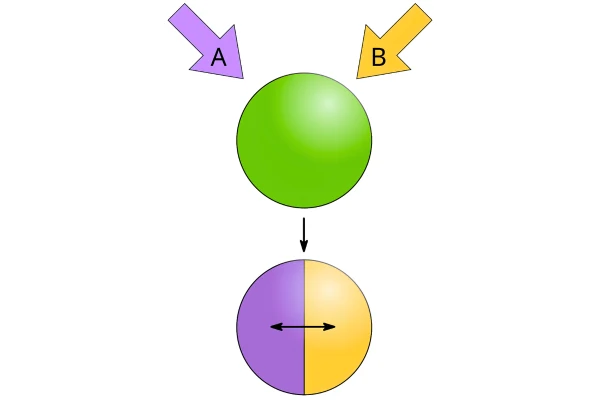
Phase separation is the process by which a homogeneous mixture separates into two or more physically distinct phases because the components are no longer stable as a single phase under the prevailing conditions.
The resulting phases may be liquid-liquid, gas-liquid, solid-liquid, or other multiphase systems. Phase separation can occur naturally when temperature, pressure, composition, or chemical reactions change the thermodynamic equilibrium of a system, or it can be deliberately induced as part of an industrial separation process.
For chemical engineers, understanding phase separation is important because phase behavior directly affects product recovery, purification, equipment design, and process stability.
Why Does Phase Separation Occur?
A mixture remains homogeneous only when its components are thermodynamically stable under specific operating conditions. Changes in temperature, pressure, or composition can reduce mutual solubility and cause the system to divide into distinct phases.
For example, a polymer dissolved at elevated temperature may separate from the solvent when the solution is cooled. In phase separation spinning, this principle is used to induce polymer-rich and solvent-rich phases, allowing the polymer phase to precipitate and solidify into fibers.
The driving force for phase separation is therefore the reduction of the system’s free energy, while the actual separation rate depends on nucleation, phase growth, mass transfer, viscosity, and mixing conditions.
Industrial Applications
Phase separation is widely used in chemical processing, polymer manufacturing, extraction, crystallization, reaction systems, and product purification.
In liquid-liquid extraction, two immiscible liquid phases are formed so that a target component can preferentially transfer into one phase before mechanical separation.
In polymer processing, temperature-induced or composition-induced phase separation can be used to produce fibers, membranes, porous materials, and other structured polymer products.
Phase separation also occurs downstream of chemical reactors. A reaction mixture may separate into organic and aqueous phases, allowing valuable products, solvents, catalysts, or by-products to be recovered before further purification.
A typical process sequence may be:
Reaction or Extraction → Phase Formation → Phase Separation → Purification
Engineering Considerations
Successful phase separation requires both favorable thermodynamic conditions and sufficient separation kinetics.
Process engineers must evaluate phase equilibrium, density difference, interfacial tension, viscosity, droplet or particle size, residence time, temperature, mixing intensity, and the tendency to form stable emulsions.
Creating two phases does not guarantee efficient physical separation. Fine droplets, high viscosity, or low density differences can significantly increase settling time and reduce separation efficiency.
Equipment selection therefore depends on the phase system and process objective. Gravity settlers, decanters, gas-liquid separators, extraction towers, centrifuges, and other separation equipment may be used to promote phase disengagement.
Temperature control is especially important in systems where phase separation is induced by changes in solubility. Poor control may cause incomplete separation, unstable product quality, or fouling and solids accumulation inside downstream equipment.
Phase Separation vs. Mechanical Separation
Phase separation describes the formation and coexistence of distinct phases, while mechanical separation refers to the physical removal of those phases after they have formed.
For example, an organic and aqueous phase may first develop because of thermodynamic phase behavior and then be separated in a decanter or centrifuge.
This distinction is important in process design because engineers must first create suitable conditions for phase formation before selecting equipment to achieve efficient phase disengagement and recovery.
Related Terms
- Phase Equilibrium
- Liquid-Liquid Extraction
- Solubility
- Interfacial Tension
- Crystallization
- Gas-Liquid Separation
- Decanter
- Extraction Tower