Definition
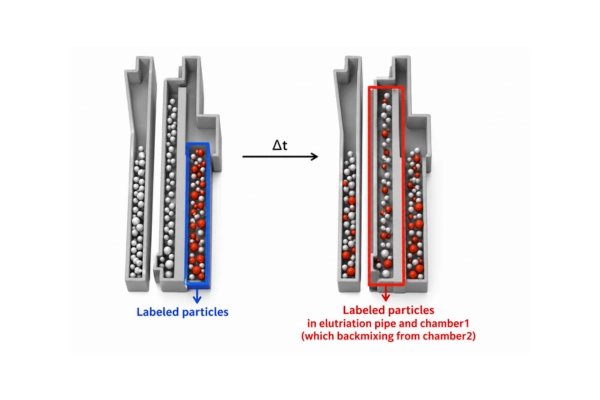
Back mixing refers to the reverse movement of part of a fluid against the main flow direction inside continuous process equipment. It can occur in reactors, extraction towers, separation columns, and other systems because of turbulence, internal circulation, equipment geometry, or the influence of internals.
Instead of moving progressively from the inlet toward the outlet, some material mixes with upstream fluid. This increases axial mixing and causes the actual flow behavior to deviate from ideal plug flow.
Why Does Back Mixing Occur?
Back mixing is closely related to equipment hydrodynamics. Common causes include turbulence, recirculation zones, poor flow distribution, excessive mixing intensity, and the design or arrangement of equipment internals.
Scale-up can also change back-mixing behavior. A reactor or separation unit that approaches plug flow at laboratory or pilot scale may develop stronger circulation, velocity maldistribution, or axial dispersion after equipment diameter and throughput increase.
For this reason, back mixing should be evaluated as part of equipment design and scale-up rather than treated only as a theoretical flow phenomenon.
How Does Back Mixing Affect Process Performance?
The effect of back mixing depends on the process and the desired flow pattern.
In many continuous reactors, excessive back mixing broadens the residence time distribution (RTD). Some material may leave earlier than expected, while another fraction remains in the equipment longer. This can reduce conversion or selectivity when reaction performance depends on maintaining a narrow residence time range.
For consecutive or competing reactions, increased mixing between fluid elements with different reaction histories may increase by-product formation and reduce product consistency.
However, back mixing is not always undesirable. In some strongly exothermic reactions, greater mixing can reduce temperature gradients and improve heat removal. The engineering objective is therefore to control back mixing according to reaction kinetics, heat transfer requirements, and product specifications.
Back Mixing in Reactors and Separation Equipment
In a plug flow reactor (PFR), axial back mixing is ideally absent, while a continuous stirred tank reactor (CSTR) represents the opposite limiting case of complete mixing.
Real industrial reactors usually operate between these ideal models. Axial dispersion, internal circulation, and imperfect flow distribution determine the actual degree of back mixing.
In extraction towers, excessive back mixing can reduce the effective concentration driving force between phases and lower separation efficiency. Poorly designed distributors or internals may also create local circulation and flow maldistribution.
In continuous polymerization reactors, broad residence time distributions caused by back mixing can affect molecular weight distribution, thermal history, and product uniformity.
How Is Back Mixing Evaluated?
Tracer experiments and residence time distribution analysis are commonly used to evaluate non-ideal flow behavior.
An earlier-than-expected tracer breakthrough, a broad RTD curve, or a long concentration tail can indicate short-circuiting, axial dispersion, stagnant regions, or excessive back mixing. Engineers can use these results to evaluate reactor geometry, distributors, internals, mixing intensity, and operating conditions.
Engineering Significance
Back mixing is an important link between fluid flow behavior and actual process performance. It influences residence time distribution, conversion, selectivity, separation efficiency, and scale-up reliability.
For process engineers, the key question is not simply whether back mixing exists, but whether its magnitude is appropriate for the reaction or separation duty. Understanding and controlling back mixing is therefore important in continuous flow reactors, polymerization reactors, extraction towers, and other industrial process equipment.
Related Terms
- Residence Time Distribution (RTD)
- Plug Flow
- Axial Dispersion
- Continuous Stirred Tank Reactor (CSTR)
- Short-Circuiting
- Flow Distribution
- Reactor Scale-Up