
Definition
An electrolyte is a substance that produces electrically conductive ions when dissolved in a solvent, melted, or in solid state. These ions enable the conduction of electric current through the medium.
In chemical and electrochemical engineering, electrolytes are essential components in energy storage systems, electrolysis processes, and industrial chemical reactions involving ion transport.
Electrolytes can exist in three main forms:
- Aqueous electrolyte solutions
- Molten salts
- Solid-state electrolytes
Fundamental Role in Industrial Systems
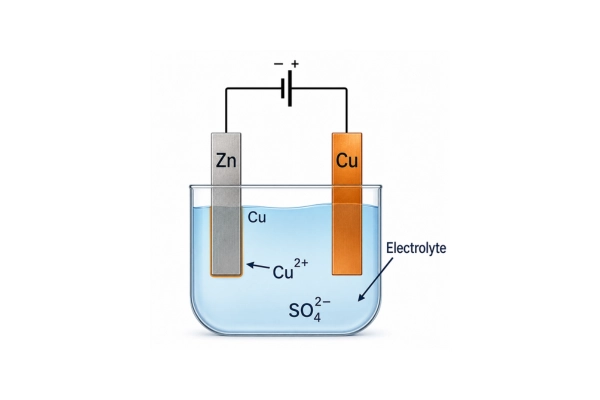
Electrolytes serve as the ion transport medium in electrochemical systems.
Their primary function is to:
- Enable ion movement between electrodes
- Complete the internal electrical circuit
- Maintain charge balance during electrochemical reactions
- Support energy conversion and storage processes
In battery systems, for example, electrolytes are responsible for lithium-ion transport between cathode and anode materials.
Types of Electrolytes
1. Strong Electrolytes
Strong electrolytes fully dissociate into ions in solution.
Examples include:
- NaCl
- KCl
- NH₄Cl
- NaBr
These are commonly used in industrial electrochemical and aqueous systems.
2. Weak Electrolytes
Weak electrolytes only partially dissociate in solution, leading to lower ionic conductivity.
They are typically used in systems where controlled ion release is required.
3. Solid-State Electrolytes
Solid electrolytes conduct ions through a solid matrix instead of a liquid medium.
They are widely used in:
- advanced battery systems
- solid-state energy storage
- high-safety electrochemical devices
Industrial Applications
Electrolytes are widely used in industrial chemical and energy systems, including:
- Lithium-ion battery systems
- Electrochemical energy storage devices
- Electrolysis processes (hydrogen production, chlorine production)
- Metal refining and electroplating
- Industrial water treatment systems
In modern energy industries, electrolyte formulation directly determines:
- ionic conductivity
- electrochemical stability
- energy density
- cycle life performance
Process Engineering Considerations
From a chemical engineering perspective, electrolyte systems must be carefully designed based on:
Ionic Conductivity
Electrolytes must support efficient ion transport with minimal resistance.
Electrochemical Stability Window
Electrolytes must remain stable under operating voltage conditions without decomposition.
Solvent Compatibility
In liquid systems, solvent selection strongly influences viscosity, conductivity, and reaction behavior.
Temperature Performance
Electrolyte behavior changes significantly with temperature, affecting conductivity and stability.
Industrial Significance
Electrolytes are a foundational component in modern electrochemical and energy systems.
They directly affect:
- battery performance
- energy efficiency
- safety characteristics
- operational stability
- system lifetime
In advanced industries such as lithium battery manufacturing, electrolyte formulation is often considered as important as electrode material design.
Industrial Misconception
A common misunderstanding is that electrolytes are simply “salt solutions.”
In reality, industrial electrolytes are highly engineered chemical systems, often composed of:
- solvents (carbonate systems, esters, etc.)
- lithium salts (e.g., LiFSI, LiPF₆)
- additives for stability and safety
Their performance depends on complex interactions between all components, not just ion concentration.
Relationship to Transport Properties
Electrolytes are closely linked to key physical parameters such as:
- conductivity (ionic transport ability)
- viscosity (ion mobility resistance)
- diffusivity (ion movement rate)
These properties determine the overall electrochemical performance of the system.
Related Terms
- Ionic Conductivity
- Conductivity (κ)
- LiFSI Electrolyte Systems
- Battery Electrolyte Solvents
- Electrochemical Stability Window
- New Energy Materials