Definition
A hydrocyclone, also called a hydraulic cyclone, is a separation device that uses a swirling liquid flow to separate suspended solids or immiscible liquid phases according to differences in density and migration behavior within a centrifugal field.
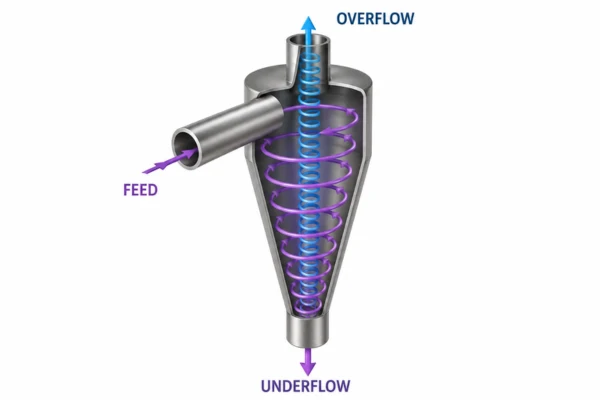
Unlike mechanically driven centrifuges, a hydrocyclone has no rotating bowl or other moving separation components. The feed enters the cylindrical section tangentially at pressure, generating a high-velocity vortex inside the equipment. Denser particles or phases migrate toward the wall and leave through the lower underflow outlet, while the lighter or finer fraction moves toward the center and exits through the overflow.
Hydrocyclones are widely used when continuous operation, compact equipment size, and high processing capacity are required.
How Does a Hydrocyclone Work?
After entering tangentially, the feed forms a rotating flow that becomes more intense as it moves into the conical section. The swirling motion creates a radial pressure gradient and centrifugal effects that influence the movement of particles and droplets.
Coarser or denser particles tend to migrate outward toward the wall and move downward to the underflow. Finer particles and the clarified liquid are more likely to enter the inner vortex and travel upward through the vortex finder to the overflow.
The separation is not determined by density alone. Particle size, particle shape, liquid viscosity, solids concentration, feed pressure, cyclone diameter, cone geometry, and outlet dimensions all influence performance.
For this reason, hydrocyclone performance is commonly described using a cut size, often represented as d₅₀, which indicates the particle size having approximately equal probability of reporting to the overflow or underflow.
Industrial Applications
Hydrocyclones are widely used for classification, thickening, desanding, solid-liquid separation, and preliminary liquid-liquid separation.
In chemical processing, a hydrocyclone may be installed downstream of a reactor, crystallizer, or solids-generating process to remove coarse particles before filtration, centrifugation, washing, or further purification.
A typical process sequence may be:
Reaction or Crystallization → Hydrocyclone Classification → Filtration or Further Separation
Hydrocyclones are also commonly used in starch processing, mineral processing, wastewater treatment, and other industries handling large volumes of liquid suspensions.
Engineering Considerations
The main advantages of hydrocyclones are simple construction, no moving separation parts, small footprint, high throughput, and relatively low maintenance requirements.
However, these advantages come with important engineering trade-offs. Increasing feed pressure can strengthen the centrifugal field, but it also increases pumping energy and equipment wear. Higher solids concentrations may reduce classification accuracy, while changes in feed viscosity or particle size distribution can shift separation performance.
Hydrocyclone selection therefore requires consideration of feed flow rate, pressure drop, density difference, viscosity, solids loading, particle size distribution, required cut size, and allowable pressure loss.
Multiple hydrocyclones may be operated in parallel to handle larger flow rates or in series to improve overall separation performance.
Separation Limits of Hydrocyclones
A hydrocyclone does not provide a sharp separation boundary. Particles smaller than the target cut size may still enter the underflow, while some coarse particles may leave through the overflow because of turbulence, short-circuit flow, or particle interactions.
Performance may also be limited when particles are extremely fine, the density difference is small, the liquid viscosity is high, or the feed conditions fluctuate significantly.
In such cases, hydrocyclones may be combined with centrifuges, filters, settlers, or other separation equipment to achieve the required product specification.
Related Terms
- Centrifugal Separation
- Centrifugal Separator
- Cut Size
- Particle Classification
- Solid-Liquid Separation
- Sedimentation
- Pressure Drop
- Underflow and Overflow