Purifying vinylene carbonate (VC) for battery electrolyte applications is not simply a matter of adding theoretical stages or increasing reflux. VC is thermally sensitive and prone to polymerization, so aggressive separation conditions can improve fractionation while simultaneously reducing yield or operating stability.
Industrial purification must therefore balance purity, impurity rejection, thermal exposure, product recovery, and scalability. Vacuum distillation, low-holdup evaporation, rectification, pretreatment, and crystallization each have different roles within that process.
For battery-grade vinylene carbonate (VC) and high-purity electrolyte solvents, the objective is to reach specification with the lowest practical thermal burden while maintaining a controllable, reproducible process.
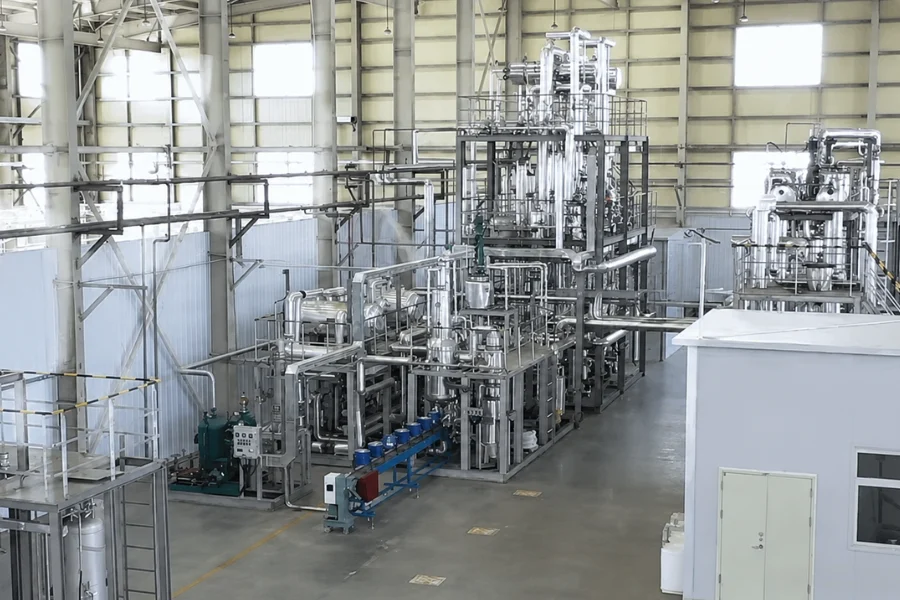
Why VC Requires a Different Distillation Strategy
VC purification is constrained by both separation behavior and chemical stability. Published process work has reported significant temperature sensitivity and emphasized minimizing the time VC remains at evaporation temperature.
This makes temperature and residence time interdependent design variables. Lowering the boiling temperature helps, but reboiler holdup, heated-surface exposure, circulation history, and local temperature also determine the thermal history of the product.
VC’s unsaturated structure also creates a polymerization tendency. If unfavorable conditions promote oligomer or polymer formation, deposits may reduce heat-transfer performance and narrow the operating window during extended production.
A successful purification system must therefore deliver more than a one-time purity result. It must maintain separation performance without progressively increasing fouling, thermal exposure, or product loss.
Start With the VC Impurity Profile
Column configuration should follow the feed composition, not the other way around.
VC synthesis and upstream processing can leave different impurity classes, including residual process solvents, light components, salts, moisture, and heavier reaction byproducts.
| Impurity Class | Main Process Concern | Engineering Direction |
|---|---|---|
| Light volatile components | Product contamination | Stripping or overhead separation |
| Residual process solvents | Purity and recovery | Desolvation and fractionation |
| Heavy byproducts | Accumulation and fouling | Controlled bottoms removal |
| Salts and solids | Heat-transfer deterioration | Upstream filtration |
| Moisture | Electrolyte quality | Dry handling and pretreatment |
| Difficult trace impurities | Final purity limitation | Distillation plus polishing |
This explains why industrial VC purification is better treated as a separation train. A practical sequence may involve filtration, desolvation, crude distillation, rectification, and final crystallization rather than forcing one column to remove every impurity.
This broader approach is also central to high-purity separation engineering, where individual unit operations are selected according to impurity behavior rather than applied as isolated purification steps.
Vacuum Distillation: Balance Temperature and Process Stability
Reducing pressure lowers the temperature required for vaporization, making vacuum distillation particularly valuable for thermally sensitive VC.
However, deeper vacuum is not automatically better. Lower pressure increases vapor volume and can raise requirements for vapor handling, condenser capacity, leak control, and vacuum-system performance.
In practice, the preferred pressure is the one that provides sufficient thermal protection without compromising stable evaporation, condensation, fractionation, or reasonable equipment sizing. The operating window should therefore be established from the actual feed composition and target purity rather than copied from a generic vacuum specification.
Residence Time and Equipment Holdup Matter
For thermally sensitive materials, two systems operating at similar evaporation temperatures can produce different results if their liquid holdup and residence-time distributions differ substantially.
Low-holdup configurations such as thin-film evaporation can reduce the time VC spends on heated surfaces. This can be valuable during initial solvent removal or other thermal separation duties where prolonged heating provides little separation benefit.
Engineers should evaluate residence time alongside wall temperature, heat-transfer area, circulation frequency, vacuum stability, and product recovery.
Published VC Purification Example
A published VC process provides a useful illustration of this principle. Crude VC was purified using a thin-film evaporator operated at approximately 5 mbar, with a reported bath temperature around 100°C and feed rate of approximately 3 mL/min. The reported purified VC yield was 73.3%.
These conditions should not be interpreted as universal design targets. Their significance lies in the combination of vacuum operation and short residence time, which limited prolonged VC exposure at evaporation temperature.
Commercial design still requires validation against the actual impurity profile, equipment geometry, throughput, and product specification.
Fractionation Intensity Has a Thermal Cost
After bulk solvent removal, rectification may be needed to separate VC from remaining volatile impurities.
When relative volatility is favorable, this can be achieved without severe fractionation. Close-boiling components are more difficult: additional theoretical stages or reflux may improve separation, but they can also increase circulation, energy duty, and thermal history.
This creates a fundamental trade-off between purity and thermal exposure.
Light impurities may be removed toward the overhead fraction, while heavier reaction products tend to accumulate in the bottom section. Bottoms management becomes particularly important because prolonged accumulation can increase fouling risk and repeatedly expose retained VC to heat.
Pressure, reflux, cut points, feed location, and withdrawal strategy should therefore be optimized together rather than independently.
Know Where Distillation Should Stop
Distillation is highly effective when useful volatility differences exist. It becomes less attractive when achieving the next increment of purity requires disproportionate reflux, energy, residence time, or product loss.
This is particularly important for battery-grade VC.
Distillation for Bulk Separation
Distillation and rectification are well suited to:
- process solvent removal;
- volatile impurity separation;
- solvent recovery;
- light-component rejection; and
- bulk VC purification.
The objective is to exploit volatility differences where they provide an efficient separation mechanism.
Crystallization for Final Polishing
When difficult trace impurities remain, melt crystallization can complement distillation through a different separation mechanism. Instead of relying on vapor-liquid equilibrium, crystallization can reject impurities through controlled solid-liquid phase behavior.
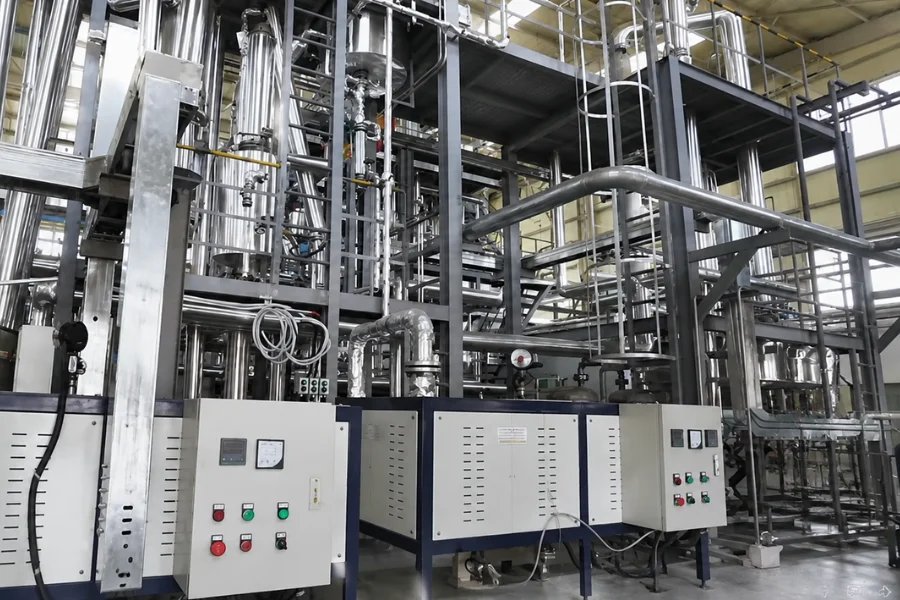
This creates a practical hybrid route:
Desolvation → Distillation → Rectification → Crystallization
Instead of pushing rectification toward increasingly demanding conditions, the distillation section can deliver an appropriate intermediate purity while crystallization performs final polishing.
| Process Objective | Preferred Direction |
|---|---|
| Bulk solvent removal | Distillation |
| Light impurity rejection | Fractionation |
| Minimize VC thermal exposure | Vacuum, low-holdup evaporation |
| Heavy impurity control | Bottoms management |
| Difficult trace impurity removal | Evaluate crystallization |
| High final purity | Integrated distillation-crystallization |
At industrial scale, the better question is often not how much additional separation the column can theoretically deliver, but whether another purification mechanism can achieve the remaining specification with less thermal and operational penalty.
Electrolyte Solvents Need Their Own Purification Windows
The same philosophy applies to battery electrolyte solvents, but one distillation configuration should not be applied uniformly.
Carbonate solvents such as dimethyl carbonate (DMC), ethyl methyl carbonate (EMC), diethyl carbonate (DEC), and ethylene carbonate (EC) differ in volatility and processing behavior. Their purification systems should reflect the physical properties and impurity profile of the actual stream.
For more volatile solvents, condenser capacity, vapor recovery, solvent losses, and pressure control may dominate equipment design. For higher-boiling or thermally sensitive streams, vacuum level, heat-transfer surface, and residence time become more important.
Mixed solvent recovery introduces another constraint: recovered material must satisfy downstream electrolyte requirements, not merely general solvent-reuse specifications.
This is why electrolyte purification must consider trace impurity control and recycle purity alongside recovery rate. A high solvent recovery percentage has limited value if accumulated contaminants make the recovered stream unsuitable for battery electrolyte production.
Pretreatment Protects High-Purity Distillation
Not every contaminant belongs in a distillation system.
Suspended salts and solids can promote fouling and reduce heat-transfer performance, while moisture or reactive contaminants can complicate downstream quality control. Appropriate filtration, drying, and upstream impurity management can therefore improve the stability of the thermal separation section.
Distillation performs best when upstream processing has already removed contaminants that do not benefit from volatility-based separation.
The purification train should determine what is best removed before evaporation, what can be separated efficiently through volatility, and what requires final polishing.
Scale-Up Changes the Purification Problem
Laboratory distillation can demonstrate separation feasibility, but it does not prove commercial operating stability.
Larger systems introduce different liquid holdup, residence-time distributions, vapor loads, heat-transfer behavior, pressure control, and impurity accumulation. A process that reaches specification during a short laboratory run may behave differently after extended industrial operation.
Pilot Validation Should Test More Than Purity
Pilot-scale development should evaluate:
- pressure-temperature operating window;
- impurity rejection and product recovery;
- residence-time behavior;
- vacuum and condenser stability;
- heavy-component accumulation;
- fouling tendency; and
- sustained purification consistency.
The development pathway is therefore:
Laboratory Separation → Pilot Validation → Process Optimization → Process Integration → Commercial Deployment
For high-purity battery materials, this transition is critical. Commercialization requires repeated production at specification, not simply a successful laboratory sample.
Engineering Decision Matrix for VC Purification
| Process Challenge | Engineering Response | Main Trade-Off |
|---|---|---|
| Thermal sensitivity | Vacuum operation | Vacuum complexity |
| Long thermal residence | Low-holdup evaporation | Equipment configuration |
| Close-boiling impurities | More stages or reflux | Energy and thermal exposure |
| Heavy impurity accumulation | Bottoms management | Product recovery |
| Trace impurity limitation | Crystallization polishing | Added process step |
| Solids or salts | Upstream filtration | Pretreatment requirements |
| Commercial scale-up | Pilot validation | Development effort vs. deployment risk |
No single configuration is universally optimal. Feed composition, target specification, thermal stability, recovery objectives, operating scale, and downstream integration should determine the purification strategy.
Design the Purification Train, Not Just the Column
High-purity VC and electrolyte solvent purification should be treated as an integrated separation engineering problem.
Reaction chemistry determines the impurity profile. The impurity profile defines the appropriate pretreatment and separation duties, while thermal stability constrains how aggressively those separations can be performed.
For some streams, vacuum rectification may carry most of the purification load. For others, combining low-holdup evaporation, rectification, and crystallization can provide a better balance between purity, recovery, thermal exposure, and long-term process stability.
DODGEN approaches VC and electrolyte purification from this integrated process perspective, connecting reaction, separation, high-purity processing, pilot validation, and industrial scale-up. For VC or battery electrolyte solvent projects, the appropriate pathway should be established by evaluating the actual impurity profile and process constraints before defining the commercial purification system.