Understanding the Industrial Risks of Silane
Silane (SiH4) Safety is a critical concern in semiconductor fabs. Silane is a colorless, pyrophoric, and highly flammable gas used in silicon deposition and thin-film applications. Even minor leaks can ignite spontaneously, posing immediate fire and explosion hazards. Beyond operational risks, exposure can irritate skin, eyes, and respiratory systems, threatening personnel and production continuity.
In semiconductor fab safety management, SiH4 is delivered through pressurized pipelines, storage tanks, and automated tools. Factors such as pipeline pressure, high flow rates, and short residence times create potential leak points. Effective industrial gas monitoring and SiH4 leak prevention strategies are essential to minimize risks and maintain operational stability.
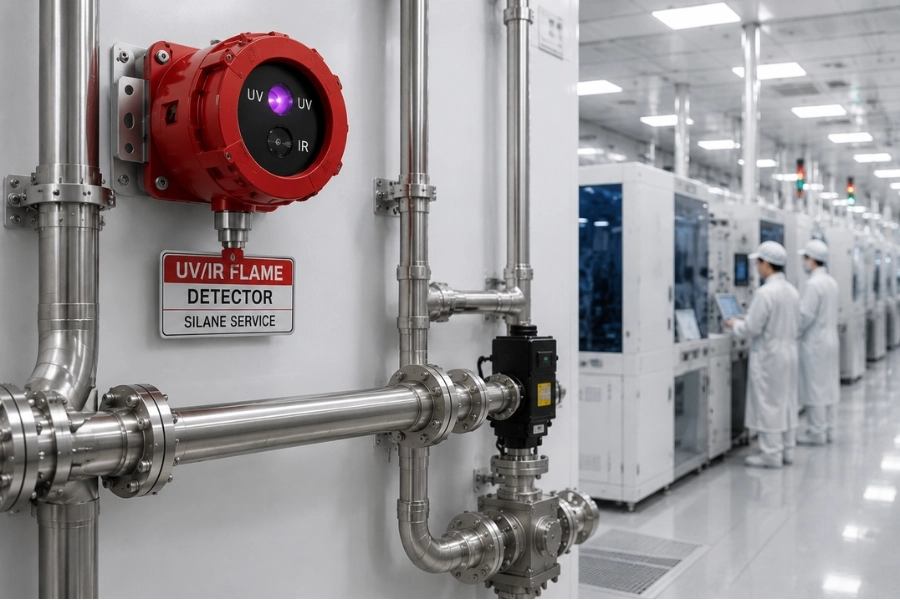
Visual Aid: Simplified pipeline flow diagram showing pressurized SiH4 lines, valves, storage tanks, and potential leak points.
Fire and Explosion Hazards in Fab Environments
Semiconductor fab safety requires careful control of airflow, equipment, and pyrophoric chemicals:
- Airflow and dilution: High ventilation can disperse smoke, complicating early fire detection.
- Electrical hazards: High-voltage tools and plasma systems increase ignition risks.
- Pipe parameters: Flow rates (100–700 LPM), pressures up to several atmospheres, and short residence times influence flame locations.
Mapping these parameters helps engineers determine optimal flame detector placement. Early detection reduces the likelihood of explosions, supporting both personnel safety and operational continuity.
Why Flame Detectors Are Essential
Flame Detectors vs High-Sensitivity Smoke Detectors
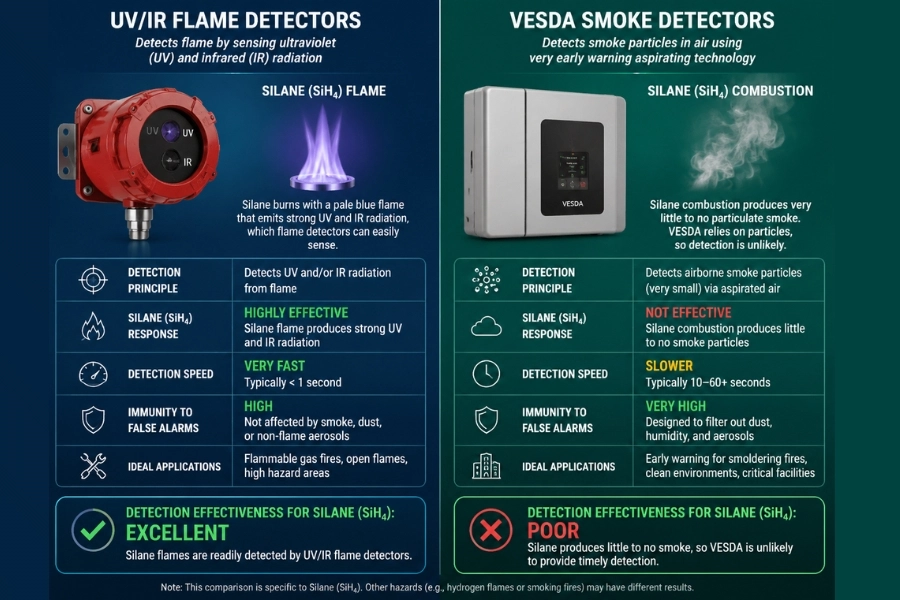
High-sensitivity smoke detectors, such as VESDA systems, provide early warning for many pyrophoric gases. However, silane’s spontaneous ignition requires flame detectors:
- UV/IR, Multi-IR, Triple-IR, and Wideband IR detectors reliably detect combustion in small leaks and delayed ignition scenarios.
- Integration with pipeline layout, flow rates, and storage tank positions ensures coverage at the highest-risk points.
- Pyrophoric gas detection systems complement flame detectors but cannot replace them for immediate ignition events.
Properly deployed flame detectors enhance Silane (SiH4) Safety by reducing delayed ignition risks and enabling rapid emergency response.
Integration with Fab Safety Systems
Flame detectors are most effective when integrated into industrial gas monitoring systems:
- SCADA/HMI integration: Automatic alerts, valve shutdown, and exhaust activation.
- Operator safety: Remote monitoring reduces personnel exposure.
- Redundancy: Multi-point detection ensures a single failure does not compromise safety.
This integration forms a comprehensive SiH4 leak prevention strategy, enhancing overall fab safety.
Compliance and Regulatory Standards
Silane (SiH4) Safety also requires adherence to regulatory standards:
- NFPA 318: Protects semiconductor fabrication facilities.
- ANSI/CGA G-13 & SEMI S2/S18: Gas handling, detection, and operational safety requirements.
Installing flame detectors according to these standards ensures compliance, protects personnel, and maintains production yield.
Best Practices for Implementation
Maximizing safety requires engineering rigor and operational procedures:
- Redundant flame detectors along pipelines and near storage tanks.
- Regular calibration and preventive maintenance to guarantee consistent performance.
- Operator training for alarm interpretation, emergency shutdowns, and maintenance.
- Integration with automation for real-time valve closure, exhaust activation, and alarms.
DODGEN’s expertise in industrial process integration and high-purity engineering supports compliant, scalable, and reliable SiH4 Safety systems.