Detection Challenges of Silane Combustion in Semiconductor Cleanrooms
Silane (SiH₄) is widely used in semiconductor manufacturing, particularly in chemical vapor deposition processes. It is classified as a pyrophoric gas that can ignite upon contact with air.
Silane combustion produces limited visible light and is difficult to identify under high-intensity cleanroom lighting. At the same time, combustion generates particulate contamination that can affect wafer quality and reduce yield.
In semiconductor fabrication environments, contamination events can interrupt production cycles that typically span several days or weeks. Equipment replacement for advanced process tools can exceed USD 3 million to USD 5 million per unit, depending on configuration.

Silane Leak Scenarios in Fabrication Environments
Silane release behavior varies based on pressure, flow rate, and system configuration. These variations directly influence detection strategy.
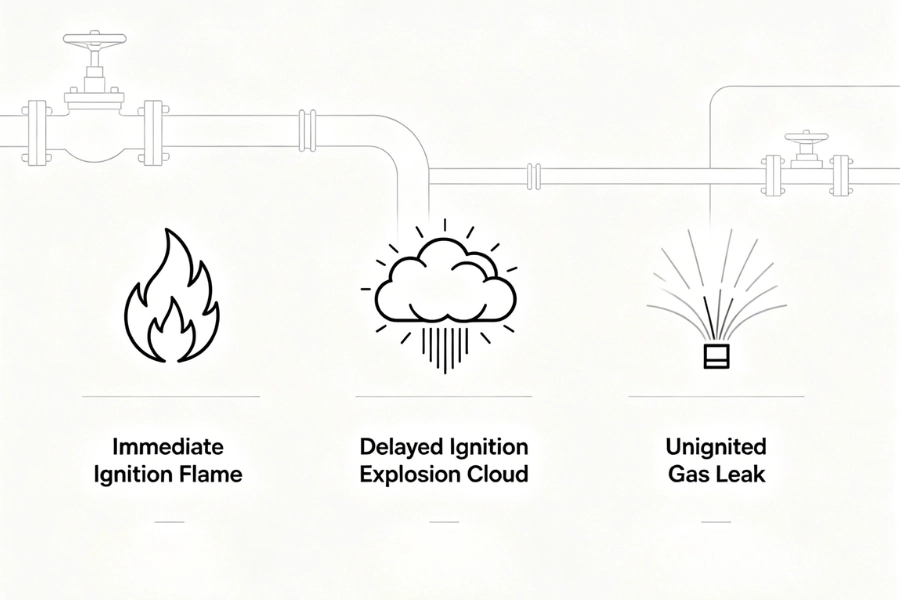
Three conditions are typically considered in safety design:
- Immediate ignition following release
- Delayed ignition after gas accumulation
- Unignited gas release with potential for later ignition
Each condition presents different detection requirements. Systems designed around a single hazard condition may not perform consistently across all scenarios.
Leak Sources in Gas Delivery and Manifold Systems
Silane release events are commonly associated with localized system interfaces.
Typical locations include:
- Gas cabinets, including regulators and valve assemblies
- Valve manifold boxes and connection points
- Process tool interfaces such as CVD chamber inlets
- Exhaust and abatement system entry sections
Cleanroom airflow conditions introduce additional constraints. Air exchange rates exceeding 200 cycles per hour can dilute gas concentrations and disperse particulate, affecting detection response.
Regulatory Framework for Silane Fire Detection
Fire protection requirements for semiconductor facilities are defined by multiple standards.
NFPA 318 specifies fire protection measures for hazardous production materials, including detection and suppression systems. Flame detection has been historically required for silane applications.
CGA G-13 provides guidance for silane handling and requires UV/IR-based fire detection in gas cabinets. SEMI S2 and S14 define equipment-level safety performance criteria, including detection response time.
Recent updates to standards introduce additional detection methods such as high-sensitivity smoke detection. However, flame detection remains a baseline requirement in most installations.
Operating Principles of UV/IR Flame Detection Systems
UV/IR flame detection systems monitor radiation across two spectral ranges.
- Ultraviolet detection captures emissions from reactive combustion species
- Infrared detection identifies thermal radiation associated with combustion
Signal processing requires simultaneous detection across both bands to confirm a fire event. This approach reduces false alarms from non-combustion sources such as electrical discharge.
Response times are typically within milliseconds under direct line-of-sight conditions. Performance is dependent on detector placement, field of view, and maintenance of optical surfaces.
Limitations of Flame Detection in Silane Applications
Performance of optical fire detection systems can be influenced by process conditions.
During silane combustion, particulate generation can accumulate on detector surfaces or obstruct optical paths. In addition, unignited gas release scenarios cannot be identified by flame detection systems.
Gas leak monitoring systems detect concentration levels but may introduce response delays depending on sensor type and sampling distance. In extended piping systems, total detection delay can exceed several seconds.
These factors indicate that no single detection method provides full coverage across all release conditions.
Multi-Layer Detection Architecture for Silane Systems
Silane hazard management typically uses a layered detection approach.
Detection and Response Structure
- Gas leak monitoring – detection of unignited release at ppm levels
- Flame detection systems – confirmation of combustion events
- High-sensitivity smoke detection – early particulate detection and redundancy
- Suppression systems – CO₂, water mist, or clean agent discharge
- Control integration – hardwired connection to emergency shutdown systems
Each layer addresses a specific stage of the hazard sequence. System design focuses on minimizing detection delay and ensuring reliable activation of shutdown mechanisms.
Engineering Design Checklist for Silane Gas Systems
Design and evaluation of silane systems typically follow structured criteria.
For pyrophoric gas handling:
- Install UV/IR-based fire detection as a primary confirmation method
For unignited leak detection:
- Use fast-response gas monitoring systems positioned near potential release points
For redundancy requirements:
- Include high-sensitivity smoke detection systems where airflow conditions affect visibility
For shutdown response:
- Connect detection outputs directly to emergency shutdown or safety instrumented systems
For validation:
- Conduct controlled ignition testing under representative operating conditions
This approach supports consistency between design intent and operational performance.
Integration of Detection Systems into Process Safety Design
Detection technologies function as part of a broader process safety framework.
In pyrophoric gas systems, safety design includes hazard identification, failure scenario analysis, and response system integration. Detector placement, signal routing, and response logic are defined based on these analyses.
DODGEN applies this methodology across semiconductor and chemical process environments. The approach includes detector selection, placement validation, and integration with shutdown systems to meet applicable safety standards.
The objective is to achieve predictable system response under defined failure conditions rather than relying on individual device performance.
Silane Fire Detection Strategy in Semiconductor Facilities
Silane presents multiple hazard conditions due to its ignition characteristics and variability in release behavior.
Flame detection systems provide confirmation of combustion events and are required by industry standards. However, they do not address all release scenarios.
A combined detection strategy typically includes:
- Gas monitoring for early-stage leak identification
- Flame detection for combustion confirmation
- Smoke detection for additional coverage under airflow constraints
- Integrated control systems for rapid shutdown
System performance depends on coordination between detection, control, and suppression layers.
Conclusion
Silane safety in semiconductor fabrication environments requires a structured approach to detection and response.
Variations in release behavior, airflow conditions, and process configuration affect detection performance. Design strategies that rely on a single detection method may not address all failure conditions.
A multi-layer detection architecture supports improved coverage across ignition and non-ignition scenarios. Integration with shutdown and suppression systems determines overall system effectiveness.
In high-value manufacturing environments, detection strategy is directly linked to operational continuity and equipment protection.