In lab-scale trials of melt crystallization, our primary objective is not achieving peak purity initially, but rather determining the technical viability of the material for further process development.
When clients inquire whether a specific substance can be purified via melt crystallization, the answer depends on more than just the melting point or feedstock purity. The progression of the experiment is dictated by several specific physical phenomena: stable melting, spontaneous crystallization, crystal adhesion (scaling), efficient mother liquor discharge, effective sweating during temperature ramp-up, and the synchronized improvement of both product color and purity.
Our standard procedure involves charging the material into a tubular crystallizer and melting it under a nitrogen blanket. Once fully liquefied, the temperature is decreased slowly according to a pre-set program. This process answers a fundamental question: Does the material possess a distinct crystallization window?
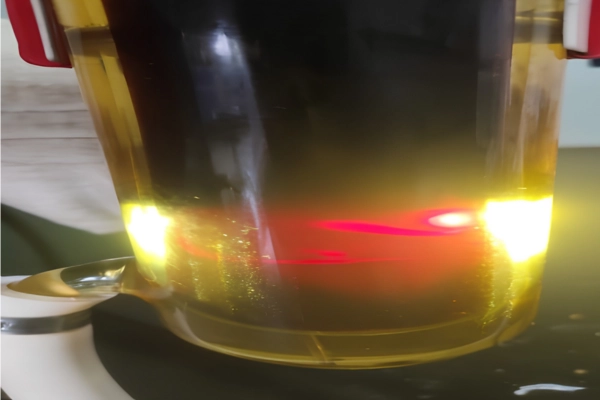
Some materials exhibit immediate positive signals. For instance, p-cyanophenol appears as a deep-red transparent liquid in its molten state. During cooling, it undergoes spontaneous crystallization with good adhesion to the cooling surface, allowing for smooth mother liquor discharge and subsequent sweating. Crucially, the product color lightens significantly after the first stage, becoming even drier and lighter after the second. Such materials are ideal candidates for further development.
p-Nitrotoluene shows similar characteristics. In the first stage, it forms acicular (needle-like) crystals with excellent scaling properties and efficient mother liquor separation. The purity increases significantly after the first stage and continues to rise through the second and third stages. This indicates a favorable separation factor between impurities and the main component, confirming the feasibility of process scale-up through multi-stage crystallization.
However, not all materials perform as seamlessly.
We frequently encounter substances that crystallize but exhibit suboptimal behavior. For example, some materials show a sharp increase in viscosity during cooling, resulting in fine, dispersed crystals that hinder mother liquor discharge. Others may appear to crystallize initially but suffer from structural collapse during the sweating phase. Furthermore, some materials exhibit significant batch-to-batch inconsistency, where purity and color improve in one trial but remain stagnant in another.
In such cases, we do not simply conclude that the material is “unsuitable.” Instead, we perform a root-cause analysis:
- Slow crystallization: Adjust the cooling rate or implement seeding.
- Spontaneous/Flash crystallization (Explosive crystallization): Increase the seeding temperature to allow crystal growth under milder supersaturation conditions.
- Poor mother liquor discharge: Focus on crystal morphology, melt viscosity, and crystal layer structure.
- Collapse during sweating: Evaluate the stability of the crystalline skeleton.
Ultimately, judging the suitability of a material for melt crystallization transcends the final purity percentage.
We prioritize whether the process forms a closed-loop logic: stable melting, robust crystallization, efficient discharge, effective sweating, demonstrable improvement, and reproducibility.
If a material exhibits these traits, it remains a candidate for optimization even if the initial yield is low, as the goal of lab-scale trials is to validate the technical direction, not to finalize the commercial recipe. Conversely, if there is no significant gradient in impurity concentration between the mother liquor, sweating liquor, and the final product—or if the color remains unchanged—it indicates that impurities are not being effectively segregated. In such instances, extending the duration or increasing the number of stages is futile; one must re-evaluate the applicability of melt crystallization or consider a hybrid separation process.
The value of melt crystallization lies in its application to systems with stable molten states, clear crystallization behavior, and impurities that partition effectively into the liquid phase. By meticulously observing these phenomena in the early stages, we provide a definitive direction for subsequent process optimization.
Identify the material behavior first; optimize the parameters second. Only when the direction is correct do the parameters become meaningful.