How Inclined Plates Improve Mixing, Heat Transfer, and Deposit Control
Inclined-plate static mixing elements redirect fluid inside a pipe to strengthen mixing and reorganize the internal flow field. Unlike densely crossed or highly obstructive static mixers, they use relatively open, angled surfaces to generate controlled radial and circumferential flow.
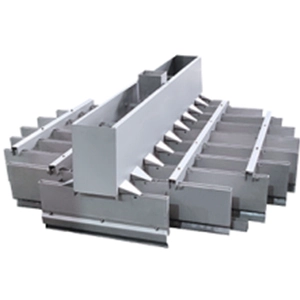
In tubular reactors and other continuous-flow equipment, these elements can be installed at intervals along the axial direction. Available geometries include inclined flat plates, trapezoidal plates, and curved plates.
Adjacent elements may have different circumferential positions or inclination directions. As the fluid passes through each stage, it is redirected along a different path, improving overall cross-sectional mixing.
The final performance depends on plate shape, size, position, angle, spacing, and orientation. These parameters should be selected according to fluid properties, reaction kinetics, throughput, solids content, heat-transfer requirements, and allowable pressure drop.
How Inclined Plates Reorganize the Flow Field
When fluid passes over an inclined plate, the plate deflects the main flow in a controlled direction. Part of the axial momentum is converted into radial and circumferential motion, creating a three-dimensional flow field inside the pipe.
Longitudinal vortices and transverse circulation reduce concentration, temperature, and velocity gradients across the pipe cross-section.
At the same time, the interfaces between different fluid regions are continuously stretched, folded, and thinned. Large nonuniform regions are divided into smaller fluid packets and striations, shortening the characteristic distance required for molecular diffusion and heat conduction.
At higher flow inertia, shear layers and wakes form near the plate edges. These structures generate smaller-scale flow disturbances. Bulk convection, local shear, and turbulence then work together to improve fluid uniformity.
Improving Radial Mixing
The transverse circulation generated by inclined plates continuously renews the contact area between different fluid regions. This accelerates concentration equalization across the pipe.
Longitudinal vortices transport fluid from the pipe core toward the wall while drawing near-wall fluid back into the main flow. Continuous exchange therefore occurs among different radial and circumferential positions.
Strengthening Heat Transfer
Frequent exchange between the pipe core and the near-wall region weakens the formation of a stable thermal boundary layer.
The resulting radial transport can improve heat transfer between the bulk fluid and the pipe wall. This effect is particularly useful when the tubular reactor relies on an external jacket or heat-transfer medium for temperature control.
Redistributing Momentum
Inclined plates convert part of the axial momentum into transverse circulation, vortex motion, and local shear.
The elements do not create mechanical agitation. Instead, they use the energy of the flowing fluid to generate secondary flow and redistribute momentum across the pipe.
Design Parameters Affect Performance
Different plate shapes, dimensions, positions, and orientations produce different flow patterns. They also affect mass transfer, heat transfer, momentum transfer, pressure drop, and solids behavior.
The same design may perform well in one process but poorly in another. A result obtained from one fluid system should not be treated as universal evidence that the element is either inherently effective or ineffective.
The design must be evaluated for the actual operating system, including:
- Fluid viscosity and density
- Reynolds number
- Number and ratio of feed streams
- Reaction rate
- Heat release
- Solids concentration
- Particle size and settling velocity
- Required mixing length
- Allowable pressure drop
- Erosion and corrosion risks
Installation and Distribution of Inclined Plates
1. Circumferentially Staggered Arrangement
Adjacent stages should generally be arranged with different circumferential orientations. This prevents the transverse flow generated by every stage from remaining concentrated in the same direction.
For example, if the first stage contains plates arranged along the vertical and horizontal directions, the next stage may be rotated by 45 degrees. Its plates would then point toward the upper-left, lower-left, upper-right, and lower-right regions.
Subsequent stages can alternate between these arrangements or use another defined rotation angle.
This staggered distribution reorganizes the velocity, concentration, and vortex fields produced by the previous stage. It can therefore improve cross-sectional mixing uniformity.
In solids-containing systems, progressive redirection may also suspend particles at different circumferential positions, reducing localized retention and deposition.
There is no universal stagger angle. A four-plate stage may use a 45-degree rotation, while other arrangements may use 30 or 60 degrees. Computational fluid dynamics and pilot testing can be used to identify a suitable value.
The design objective is to create sufficient spatial variation between stages and prevent the flow field from repeating at the same position and in the same direction.
This variation may be introduced by changing:
- Circumferential orientation
- Plate angle of attack
- Offset direction
- Plate geometry
- Plate length
- Axial spacing
2. Off-Center Plate Installation
An inclined plate does not need to point directly toward the pipe center. Its downstream edge can be offset from the centerline and positioned at an angle to the radial direction.
This arrangement gives the redirected fluid both radial and circumferential velocity components, producing a guide-vane-like swirling effect.
An offset configuration can increase disturbances near the pipe wall. It can be particularly useful in the lower section of a horizontal or slightly inclined pipe, where particles are more likely to settle.
As particles are lifted radially, circumferential flow transports them away from the deposition zone. An offset swirl arrangement may therefore provide better deposit control than a purely inward-facing plate.
Swirl direction and intensity depend on the offset angle. If adjacent stages use different offset directions, the swirl generated by one stage is reorganized by the next.
This approach can prevent a single rotational flow from developing continuously along the reactor. Uninterrupted swirl may otherwise create a low-velocity core or near-wall retention zones.
Alternating the swirl direction can improve cross-sectional uniformity while reducing the risk of stable stagnant regions.
3. Multiple Short Plates Within One Cross-Section
A more flexible arrangement places several short inclined plates within the same cross-section. Each plate can have a slightly different angle and orientation.
The fluid then receives several smaller disturbances in different directions at the same axial position.
For example:
- One plate may direct fluid toward the upper-left region.
- Another may direct it toward the lower-right region.
- One may generate a mainly radial flow component.
- Another may produce a stronger circumferential component.
This arrangement makes it more difficult for a uniform or repetitive flow pattern to develop locally. Cross-sectional exchange becomes more distributed and less dependent on one dominant circulation path.
Axial Variation of Element Geometry
The geometry of the inclined plates can also change along the reactor axis.
Possible variations include:
- A larger plate angle in one stage and a smaller angle in the next
- A longer plate followed by a shorter plate
- Different spacings between adjacent stages
- Alternating flat and curved plates
- Changes in plate width or blockage ratio
- Alternating offset and circumferential direction
These changes may appear small, but they can have a direct effect on flow development.
A velocity, concentration, or temperature profile created by one stage will not continue developing in the same pattern. The next group of elements reorganizes it using a different flow direction and intensity.
This repeated disruption can reduce persistent maldistribution and improve overall mixing.
Suitable Applications
Inclined-plate static mixing elements may be used for:
- Combining multiple feed streams
- Introducing an additional reactant
- Premixing before a reaction zone
- Equalizing concentration and temperature
- Improving radial transport
- Reducing local concentration peaks
- Suppressing hot spots in fast reactions
- Supporting heat transfer through the pipe wall
- Maintaining moderate solids suspension
- Reducing localized particle deposition
For fast or concentration-sensitive reactions, improved radial transport can reduce local reactant accumulation and temperature excursions.
In solids-containing systems, upward-directed flow generated by plates near the bottom of the pipe can lift deposited particles and return them to the main stream.
Because this design relies mainly on cross-sectional bulk convection, it can provide relatively low shear and limited wear compared with more restrictive mixing elements.
Potential applications include:
- Moderate-solids suspensions
- Suspension homogenization
- Crystallization processes
- Slurry reactions
- Continuous precipitation
- Temperature-sensitive tubular reactions
Systems with high solids content or rapidly settling particles require additional evaluation. Plate arrangements alone may not provide enough lifting force to maintain stable suspension.
Limitations
Inclined-plate elements are not suitable for every application.
Their effectiveness may be limited under:
- Low-inertia flow
- Very high viscosity
- Strongly laminar conditions requiring repeated splitting and recombination
- Processes requiring intense emulsification
- Applications requiring extremely fine droplet dispersion
- High-shear mixing requirements
- Very high solids loadings
- Systems with rapid particle settling
Densely crossed or high-blockage static mixers may provide stronger fluid subdivision, interfacial renewal, and local shear. They may therefore perform better for emulsification, fine dispersion, or laminar mixing.
However, those designs may also create higher pressure drop, greater blockage risk, stronger erosion, and more difficult cleaning.
Inclined-plate elements generally provide a more open flow path, lower shear, and better tolerance for moderate solids. Their mixing intensity may be lower, but their hydraulic and maintenance characteristics can be more favorable.
Conclusion
Inclined-plate static mixing elements use the energy of the flowing fluid to create radial circulation, circumferential motion, longitudinal vortices, and local shear inside a tubular reactor.
A properly designed arrangement can improve mixing, radial heat transfer, and particle suspension while limiting pressure drop and mechanical complexity.
Its effectiveness depends on the coordinated design of plate geometry, inclination, offset, circumferential orientation, axial spacing, and stage-to-stage variation.
No single static mixer geometry is optimal for every process. Selection should be based on material properties, reaction mechanism, solids behavior, throughput, heat-transfer demand, pressure-drop allowance, equipment cost, and maintenance requirements.