Industrial buyers often compare silane coupling agents primarily through price-per-ton calculations. However, experienced manufacturers usually discover that the lowest purchasing cost rarely produces the lowest overall manufacturing cost.
In coatings, rubber compounds, fiberglass composites, adhesives, plastics, and sealants, silane coupling agents directly influence downstream process stability, product durability, hydrolysis consistency, and long-term operational efficiency. A lower-cost silane that creates unstable filler treatment, inconsistent adhesion, or premature hydrolysis may eventually increase production losses through higher rejection rates, reformulation downtime, equipment cleaning frequency, and warranty risk.
For this reason, balancing performance and cost in silane coupling agent sourcing has become an engineering and process-economics decision rather than a simple procurement exercise.
Why Lowest-Cost Silane Sourcing Often Creates Hidden Manufacturing Costs
Many procurement teams initially focus on quarterly raw material cost reduction when evaluating alternative silane suppliers. However, production plants frequently discover that lower-cost silanes create hidden operational instability during large-scale manufacturing.
In some factories, lower-grade silanes perform acceptably during short laboratory validation while later showing inconsistent behavior during continuous production campaigns where humidity, mixing intensity, and storage conditions fluctuate constantly.
Common hidden manufacturing costs include:
- Increased coating rejection
- Reduced adhesion retention
- Filler dispersion instability
- Premature hydrolysis
- Curing inconsistency
- Higher scrap generation
- Production downtime
- Additional solvent correction
- More frequent equipment cleaning
- Reduced outdoor durability
Certain coating manufacturers report that unstable silane activity may gradually alter formulation viscosity during long operating shifts, forcing repeated process adjustments across production batches.
Some rubber processors also observe that lower-cost silanes occasionally create uneven silica treatment during high-temperature internal mixing operations, reducing reinforcement consistency during tire production.
In many industrial systems, these hidden operational losses eventually exceed the original purchasing savings achieved through low-cost sourcing.
Understanding How Silane Performance Influences Downstream Manufacturing
Silane coupling agents rarely function as simple additives. Their behavior directly affects multiple downstream production stages simultaneously.
Adhesion Strength in Fiberglass Composite Systems
In fiberglass reinforced plastics and engineered composites, silanes improve bonding between inorganic glass surfaces and organic resin systems.
When coupling efficiency becomes unstable, manufacturers may experience:
- Reduced interfacial bonding
- Mechanical fatigue problems
- Moisture penetration
- Thermal aging failure
- Delamination under cyclic loading
Some continuous pultrusion plants report that inconsistent silane hydrolysis behavior creates uneven glass fiber wetting during high-speed resin impregnation operations.
In certain production environments, operators discover that slightly unstable silane activity increases scrap generation because resin penetration consistency changes gradually during long manufacturing campaigns.
Several composite manufacturers also report that humidity variation inside storage warehouses may influence long-term silane stability after partially opened drums remain unused for extended periods.
Filler Dispersion Stability in Tire and Rubber Compounding
Silane coupling agents are critical in silica-filled rubber systems, especially in tire reinforcement applications.
Sulfur silanes improve bonding between silica fillers and rubber polymers, directly influencing rolling resistance, abrasion resistance, and reinforcement performance.
However, some lower-cost silanes show inconsistent reaction activity during high-temperature Banbury mixing cycles.
Rubber processors occasionally observe:
- Uneven silica wetting
- Compound viscosity fluctuation
- Reduced dispersion uniformity
- Curing instability
- Increased mixing torque variability
In several tire plants, moisture pickup during drum unloading operations has reportedly accelerated premature hydrolysis before compounding begins, reducing downstream vulcanization efficiency.
Certain processors also discover that unstable silane quality increases batch-to-batch variation during continuous tire manufacturing where process repeatability is essential.
Surface Durability in Industrial Coatings and Sealants
In coatings and sealants, silane performance strongly affects:
- Corrosion resistance
- Weather durability
- UV stability
- Water repellency
- Long-term adhesion retention
- Surface crack resistance
Some coating manufacturers discover that lower-cost silanes create subtle curing instability during humid summer production periods.
These issues may appear as:
- Delayed crosslinking
- Uneven film formation
- Surface haze
- Reduced accelerated aging performance
- Adhesion loss after thermal cycling
Certain export-oriented plants also report that partially opened silane drums stored in uncontrolled warehouse environments gradually absorb atmospheric moisture over time.
After repeated drum opening and resealing operations, some materials begin showing unstable hydrolysis behavior that later affects coating consistency during downstream processing.
Why Different Silane Functional Groups Create Different Cost Structures
Different silane coupling agents require different production routes, purification systems, and quality-control standards.
As a result, pricing differences often reflect manufacturing complexity rather than simple supplier markup.
Amino Silanes
Amino silanes are widely used in primers, adhesives, and surface treatment systems because of their strong adhesion-promoting properties.
However, amino-functional silanes are often highly moisture-sensitive during storage and transportation.
Many manufacturers utilize:
- Moisture-free transfer systems
- Nitrogen blanketing
- Sealed stainless storage tanks
- Controlled drum filling systems
to reduce hydrolysis risk before shipment.
In some export operations, improper drum sealing or excessive warehouse humidity has reportedly shortened storage stability during long overseas transportation cycles.
Epoxy Silanes
Epoxy silanes are commonly selected for high-performance coatings, electronics, and advanced composite applications.
These materials frequently require:
- Tighter impurity control
- Lower residual alcohol content
- Multi-stage purification
- More stable distillation control
because trace impurities or residual moisture may significantly affect downstream curing consistency.
Some producers report that epoxy silane purification becomes increasingly energy-intensive when ultra-low moisture specifications are required for electronics manufacturing.
Vinyl Silanes
Vinyl silanes are widely used in wire insulation, crosslinked polyethylene systems, and polymer modification applications.
Although large-scale production may improve economies of scale, vinyl silane manufacturing still requires carefully controlled moisture management because premature hydrolysis may reduce downstream reaction efficiency.
Certain manufacturers also report that unstable storage conditions during export transportation occasionally accelerate condensation-related degradation inside partially filled drums.
Sulfur Silanes
Sulfur silanes used in tire reinforcement systems generally involve more complex manufacturing and purification requirements.
Because these materials operate under demanding rubber compounding conditions, producers often require tighter process control to maintain stable sulfur functionality and reinforcement performance.
In some production systems, inconsistent sulfur silane activity has reportedly increased curing variation during high-speed tire manufacturing operations.
How Silane Coupling Agents Are Manufactured and Why Production Routes Affect Cost
Silane production routes significantly influence final pricing, impurity profiles, hydrolysis stability, and downstream performance reliability.
Many silane coupling agents are produced through chlorosilane synthesis followed by alcoholysis or controlled hydrolysis reactions that introduce specific functional groups onto the silicon atom.
Because many silane intermediates react aggressively with moisture, manufacturers must maintain carefully controlled operating conditions throughout production.
Chlorosilane Synthesis and Reaction Control
Chlorosilane synthesis frequently involves high-temperature reaction systems operating under strict moisture-control conditions.
Some facilities use corrosion-resistant reactors and sealed transfer systems because even trace moisture ingress may trigger premature side reactions and reduce yield stability.
In certain production plants, localized moisture contamination has reportedly accelerated siloxane formation and increased impurity variability during downstream purification.
Manufacturers must also carefully control reaction selectivity because incomplete conversion may increase residual chlorinated intermediates that later affect storage stability and downstream application performance.
Alcoholysis and Hydrolysis Reactions
Alcoholysis reactions convert chlorosilanes into alkoxy-functional silanes used in industrial coupling applications.
However, these reactions often require narrow operating windows because excessive hydrolysis may trigger:
- Oligomer formation
- Gel formation
- Condensation side reactions
- Unstable impurity profiles
- Reduced shelf stability
Some continuous silane production systems require carefully controlled residence time distribution because uneven moisture exposure may accelerate side reactions inside downstream reaction zones.
In several industrial plants, operators monitor inline moisture levels continuously because small fluctuations may gradually reduce process repeatability across production batches.
Distillation Purification and Energy Consumption
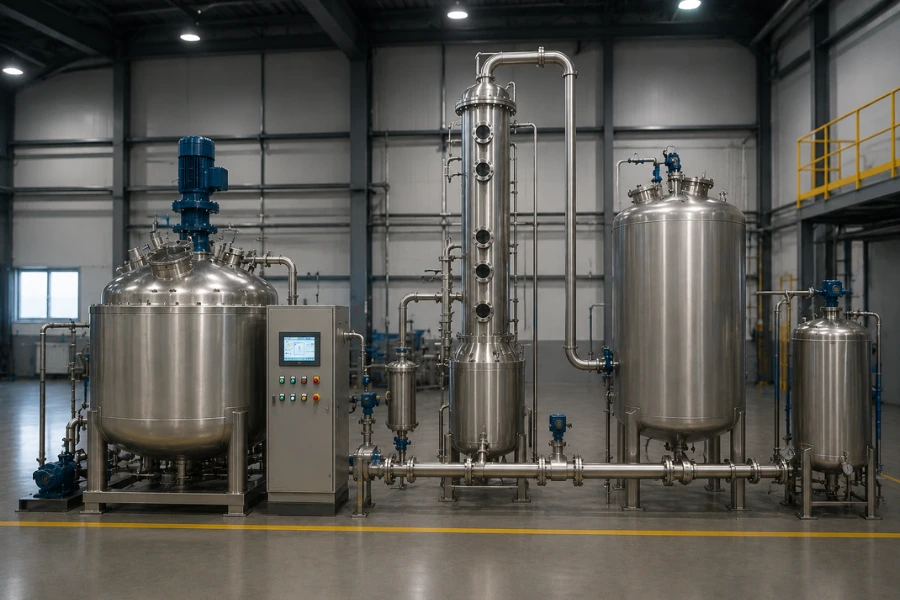
Silane purification often depends on multi-stage vacuum distillation systems designed to remove:
- Residual alcohols
- Low-boiling impurities
- Water contamination
- Unreacted intermediates
- Side-product carryover
These distillation systems may become highly energy-intensive, particularly for high-purity specialty silanes.
Some producers report that purification energy load represents one of the largest contributors to manufacturing cost when ultra-low moisture specifications are required.
Distillation stability also directly influences product consistency. In certain plants, unstable vacuum control or poor distillation cut management may increase impurity carryover between batches.
Moisture-Free Handling and Packaging Economics
Because many silanes are highly moisture-sensitive, handling and packaging systems become part of the overall production economics.
Manufacturers frequently invest in:
- Nitrogen blanketing systems
- Vacuum dehydration equipment
- Inline moisture monitoring
- Sealed stainless transfer lines
- Moisture-barrier packaging liners
- Controlled drum filling systems
to reduce hydrolysis risk during storage and export transportation.
Some manufacturers also implement humidity-controlled warehouse environments because repeated condensation cycles during seasonal temperature changes may gradually destabilize stored materials.
Hidden Industrial Factors That Influence Silane Coupling Agent Pricing
Raw material cost represents only one portion of silane sourcing economics.
Several industrial factors strongly influence final pricing and long-term operational reliability.
Feedstock Volatility
Methanol, chlorosilanes, and specialty intermediates are all affected by fluctuations in upstream petrochemical markets and energy pricing.
When utility costs rise sharply, silane production expenses may increase because distillation purification and moisture-free processing systems consume significant energy.
Yield Stability and Side-Reaction Control
Some silane production routes experience unstable yield performance because moisture-sensitive reactions can generate side products or incomplete conversion.
Residual alcohol impurities, siloxane formation, and oligomer accumulation may all reduce process efficiency and increase purification burden.
Inconsistent reaction control may also increase batch rejection rates during industrial manufacturing.
Export Logistics and Storage Stability
Long international shipping cycles expose silane drums to repeated humidity fluctuation and temperature variation.
Certain manufacturers report that improperly dried containers or repeated drum opening during partial material usage accelerate moisture ingress and hydrolysis degradation.
In some cases, partially hydrolyzed materials later generate unstable viscosity behavior during downstream formulation processing.
Batch Rejection Economics
In industrial manufacturing, even small silane instability may trigger expensive downstream losses.
A single unstable batch may create:
- Coating defects
- Rubber dispersion instability
- Adhesive curing failure
- Composite delamination
- Production shutdowns
- Reformulation downtime
For many processors, these downstream operational losses eventually exceed any short-term purchasing savings achieved during procurement.
How Industrial Buyers Evaluate Cost-Performance Balance
Experienced industrial buyers rarely evaluate silanes using only price-per-ton comparisons.
Instead, they focus on long-term manufacturing stability and total operational economics.
Pilot Validation Before Full-Scale Procurement
Many manufacturers conduct pilot production validation before switching suppliers.
Testing often includes:
- Hydrolysis stability analysis
- Accelerated aging studies
- Humidity exposure testing
- Adhesion retention evaluation
- Dispersion consistency analysis
- Long-term storage simulation
Some production teams discover that silanes performing well in short laboratory trials behave differently during continuous industrial operation where process conditions fluctuate constantly.
Evaluating Supplier Process Consistency
Reliable silane suppliers are often evaluated based on:
- Batch repeatability
- Moisture-control capability
- Purity consistency
- Packaging reliability
- Technical documentation quality
- Export handling procedures
In continuous manufacturing systems, process repeatability frequently becomes more valuable than short-term material savings.
Reviewing Technical Support Capability
Industrial buyers increasingly prefer suppliers capable of supporting downstream process optimization rather than simply delivering raw materials.
Technical guidance related to:
- Hydrolysis timing
- Mixing sequence
- Storage handling
- Curing behavior
- Moisture management
- Formulation compatibility
may significantly reduce long-term operational risk.
Common Mistakes When Sourcing Lower-Cost Silane Coupling Agents
Some procurement teams unintentionally create manufacturing instability by focusing too heavily on initial purchasing cost.
Common sourcing mistakes include:
- Ignoring hydrolysis stability data
- Skipping humidity exposure testing
- Overlooking warehouse storage conditions
- Failing to evaluate impurity profiles
- Ignoring export packaging quality
- Using generic grades in specialized applications
- Overlooking curing-window sensitivity
- Comparing only unit price rather than operational cost
Several manufacturers later discover that slight differences in moisture content or impurity carryover significantly affect downstream process stability during large-scale manufacturing.
Why Reliable Silane Suppliers Help Reduce Long-Term Manufacturing Risk
Reliable silane sourcing involves more than material delivery alone.
Experienced suppliers often invest heavily in:
- Process consistency control
- Continuous moisture management
- Stable purification systems
- Vacuum distillation optimization
- Quality-control testing
- Export-safe packaging
- Technical application support
For manufacturers operating large-scale continuous production systems, stable silane quality frequently reduces operational uncertainty and improves long-term manufacturing efficiency.
In many industrial applications, the most cost-effective silane is not necessarily the cheapest product on paper, but the material that consistently supports stable downstream production with fewer defects, lower downtime, and improved process repeatability.
Final Thoughts
Balancing performance and cost in silane coupling agent sourcing requires far more than simple price comparison.
In modern industrial manufacturing, silane selection directly influences process stability, hydrolysis consistency, downstream manufacturing reliability, adhesion durability, operational efficiency, and long-term product performance.
Manufacturers that focus only on short-term purchasing cost may eventually encounter hidden expenses through moisture instability, impurity-related defects, curing inconsistency, adhesion failure, batch rejection, or production downtime.
By evaluating silane sourcing through the broader perspective of process economics, manufacturing stability, impurity control, and downstream operational performance, industrial buyers can make more reliable long-term procurement decisions while reducing overall production risk.