Why Heat-Sensitive Chemical Concentration Requires Careful Thermal Control
Thermally sensitive chemical materials often experience stability challenges during concentration. In industrial processing, excessive thermal exposure is associated with degradation, discoloration, impurity formation, viscosity drift, and downstream process instability.
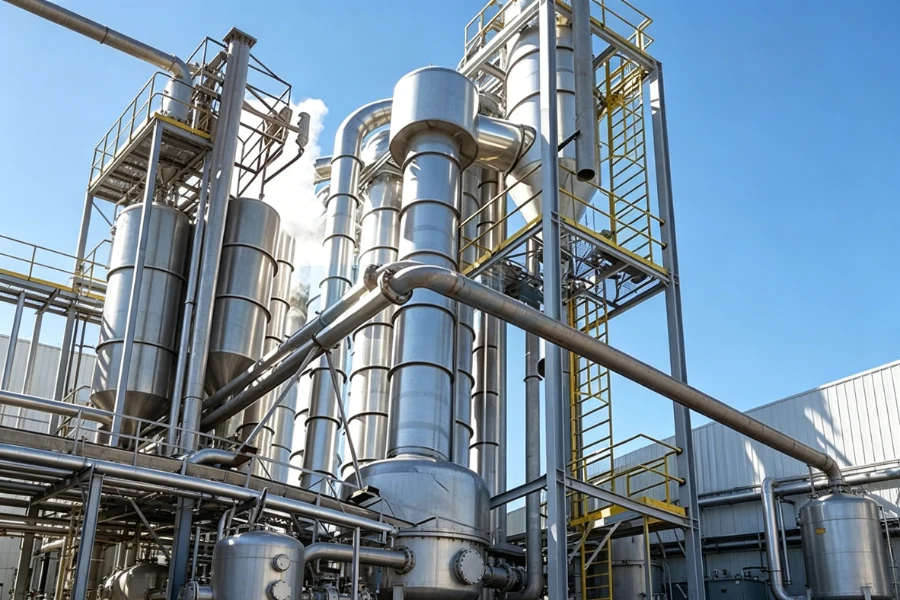
These effects are commonly observed in:
- API intermediates
- PLA prepolymers
- Botanical extracts
- Fermentation-derived products
- Specialty biochemical solutions
In many production systems, degradation does not begin with a single overheating event. Process instability usually develops progressively as fouling resistance increases, vapor load fluctuates, vacuum stability declines, and thermal exposure accumulates across the concentration process.
For this reason, falling film evaporators are widely applied in low-temperature chemical concentration systems. Their ability to combine vacuum operation with extremely short residence time allows evaporation to proceed with lower thermal stress compared with bulk boiling configurations.
The primary value of a falling film system is not limited to evaporation capacity alone. In heat-sensitive processing, the more important objective is maintaining stable concentration while limiting thermal damage and downstream quality variation.
This article explains how low-temperature thin-film evaporation supports thermal exposure control, which material conditions define process suitability, and how engineering optimization affects long-term operational stability in industrial concentration systems.
How Falling Film Systems Reduce Thermal Exposure
How Thin-Film Evaporation Works
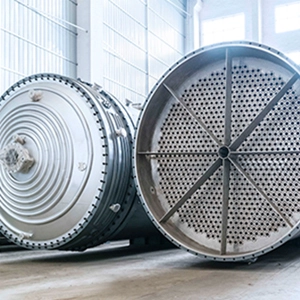
A falling film evaporator distributes liquid from the top of vertical tubes. The liquid forms a continuous film along the inner tube wall and flows downward under gravity while thermal energy is transferred through the shell side.
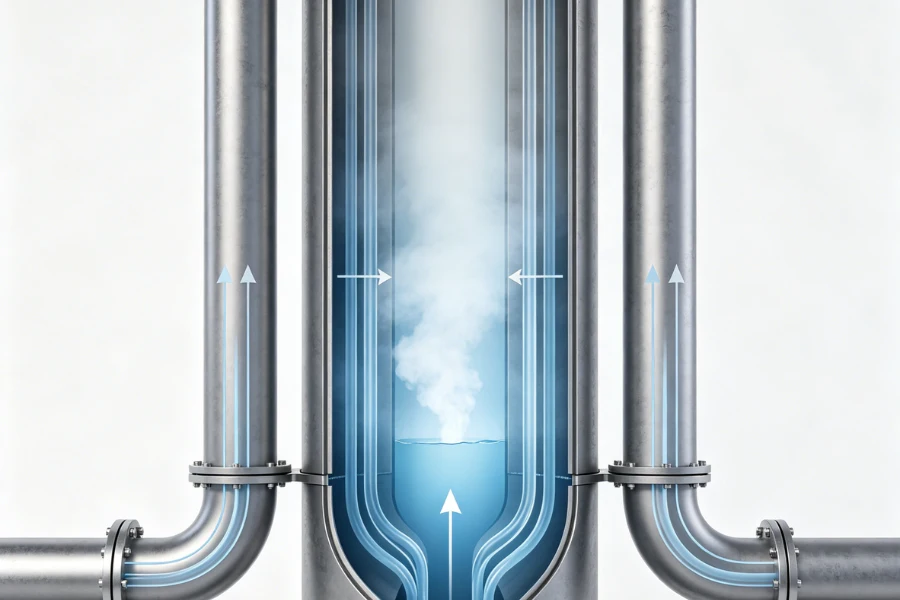
As the liquid film moves through the tubes:
- partial vaporization occurs continuously
- vapor velocity gradually increases
- film thickness decreases progressively
- concentrated liquid exits from the bottom section
- vapor and liquid are separated downstream
Unlike flooded evaporation units, the liquid inventory inside the heated section remains extremely low. Residence time inside the tubes is commonly within 5-30 seconds under industrial operating conditions.
This short exposure period is one of the main reasons thin-film concentration systems are widely used for temperature-sensitive compounds.
Why Heat Transfer Efficiency Remains High
Because the liquid film remains extremely thin, thermal resistance across the evaporation surface stays relatively low. This allows evaporation to proceed with smaller temperature differences and reduced wall-side overheating risk.
Typical systems operate with mean temperature differences of approximately 3-6 K.
Several hydrodynamic effects contribute to stable heat transfer performance:
- vapor shear gradually increases along the tube length
- the liquid film transitions from laminar to wavy flow
- turbulence intensity increases as film thickness decreases
- the evaporation surface is continuously renewed
In industrial operation, these conditions help maintain high heat transfer coefficients without excessive steam-side temperature increase.
Lower wall-side temperature reduces the likelihood of localized thermal degradation, particularly in systems processing fouling-sensitive compounds or thermally unstable intermediates.
How Vacuum Operation Protects Temperature-Sensitive Compounds
Low-pressure operation is commonly applied in falling film concentration systems.
Reducing operating pressure lowers the boiling point of the solution, allowing evaporation to proceed at approximately 40-70 °C in many heat-sensitive applications.
Vacuum stability directly affects process consistency.
Even moderate pressure drift may increase boiling temperature, which can gradually accelerate:
- thermal degradation
- impurity formation
- discoloration
- fouling progression
- viscosity instability
In long-cycle industrial operation, vacuum instability often develops progressively rather than suddenly. Cooling water temperature variation, condenser performance decline, and non-condensable gas accumulation may all contribute to operational drift over time.
For this reason, vacuum performance is typically evaluated as a process reliability parameter rather than only an energy consideration.
How Process Instability Develops in Heat-Sensitive Evaporation
In industrial concentration systems, product degradation rarely appears as an isolated event.
Process instability typically develops through interconnected thermal and hydrodynamic effects that gradually reduce operating stability.
A common operational sequence is observed in heat-sensitive processing lines:
- Liquid distribution becomes uneven
- Local dry zones begin forming
- Wall temperature rises in affected regions
- Fouling develops more rapidly
- Heat transfer resistance increases
- Steam-side temperature is raised to maintain throughput
- Thermal degradation risk increases progressively
This sequence often develops before visible product failure appears.
In many plants, production capacity initially remains stable while:
- fouling resistance gradually increases
- cleaning intervals become shorter
- vapor load becomes less stable
- startup stabilization time increases
- downstream purity consistency begins drifting
Operational drift is particularly common during extended continuous operation where concentration ratio and viscosity progressively increase across the process cycle.
As a result, evaporation stability is increasingly evaluated as a long-term process control issue rather than a standalone equipment performance target.
Which Materials Are Suitable for Falling Film Concentration
Why Thermal Stability Defines System Selection
The thermal degradation profile of the material defines the allowable operating temperature range.
For compounds with degradation thresholds below approximately 60 °C, vacuum operation is generally required to maintain product integrity.
This is especially important in:
- pharmaceutical intermediates
- biodegradable polymer systems
- enzyme-containing solutions
- plant-derived extracts
In these applications, moderate increases in residence time or wall temperature may directly affect purity, color stability, or molecular structure consistency.
How Viscosity Affects Thin-Film Concentration Stability
Falling film systems are primarily designed for low- and moderate-viscosity liquids.
Typical operating range:
- recommended range — below 200 cP
- optimized configurations — up to approximately 1000 cP
As concentration increases, viscosity rises progressively. This influences:
- film stability
- wetting behavior
- vapor-liquid separation
- heat transfer performance
- pressure drop characteristics
In many industrial systems, viscosity progression becomes increasingly important near the final concentration stage.
Once stable film formation becomes difficult, localized dry patches and unstable vapor flow may develop simultaneously.
Under these conditions, forced circulation systems or wiped film evaporation units are often more suitable.
Why Fouling Becomes a Long-Term Reliability Risk
Fouling is one of the primary operational constraints in low-temperature concentration systems.
Deposits forming on the heat transfer surface gradually increase thermal resistance and reduce effective evaporation capacity.
As fouling progresses:
- wall temperature rises
- evaporation rate declines
- steam consumption increases
- cleaning frequency increases
- thermal degradation risk becomes higher
Industrial operators often observe that fouling-related instability develops gradually across production cycles rather than during startup conditions.
Maintaining stable wetting behavior is critical.
In many systems, wetting rates below approximately 70 percent of design flow increase the likelihood of dry-zone formation and accelerated deposit accumulation.
Long-term mitigation strategies commonly include:
- electropolished internal surfaces
- optimized recirculation ratio
- controlled feed distribution
- scheduled CIP procedures
- monitoring of heat transfer decline over time
Foaming and Solids Challenges in Continuous Operation
Foaming behavior can reduce vapor-liquid separation efficiency and increase entrainment losses.
This is commonly observed in:
- surfactant-containing streams
- fermentation products
- biochemical extracts
Separator design often requires optimization based on actual vapor behavior under continuous operation.
Industrial mitigation measures may include:
- demister integration
- separator baffle optimization
- liquid level control
- antifoam dosing strategy
Feed streams containing suspended solids or early-stage crystallization behavior may also destabilize film distribution and increase blockage risk inside the distribution section.
Under these conditions, pretreatment or alternative concentration technologies are often evaluated.
Design Factors That Affect Long-Term Evaporation Stability
Why Liquid Distribution Is Critical
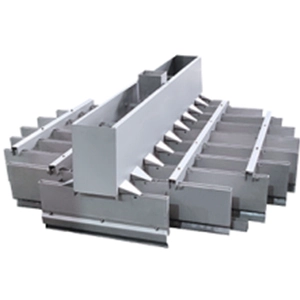
Uniform liquid distribution is one of the most important operating requirements in a falling film evaporator.
Uneven wetting creates localized dry regions that rapidly increase wall temperature and fouling tendency.
Industrial distribution systems are typically designed to maintain stable wetting performance even at approximately 30-40 percent of nominal load conditions.
In long-cycle production, unstable feed distribution often becomes more visible during:
- startup transitions
- throughput fluctuation
- viscosity increase
- partial load operation
These operating conditions frequently expose weaknesses that are not visible during short-term commissioning tests.
How Tube Geometry Influences Process Performance
Tube geometry directly affects both heat transfer behavior and hydrodynamic stability.
Typical industrial configurations include:
- tube length — 4-8 m
- tube diameter — 25-65 mm
Longer tubes increase available heat transfer area but also increase pressure drop sensitivity.
Tube diameter affects:
- film thickness
- vapor shear intensity
- liquid wetting stability
- sensitivity to viscosity change
Design optimization therefore requires balancing evaporation capacity against stable thin-film behavior across varying operating conditions.
Material Selection for Corrosion Resistance and Cleanability
Material selection is defined by corrosion resistance requirements, cleaning procedures, and product purity standards.
Product-contact surfaces are commonly manufactured from:
- SUS316L stainless steel
- higher-grade corrosion-resistant alloys where required
Internal surface condition strongly affects fouling behavior over time.
Electropolished surfaces are commonly used to reduce deposit adhesion and improve cleanability during repeated CIP cycles.
In pharmaceutical and biochemical systems, weld finishing and surface treatment are typically designed to support GMP and CIP compliance requirements.
Choosing Between Single-Effect, Multi-Effect, and MVR Systems
Energy optimization must be balanced against thermal exposure control and operational stability.
Single-Effect Systems
Single-effect concentration systems provide:
- shorter residence time
- simplified operation
- lower thermal accumulation risk
Steam economy is typically approximately 0.8-1.0.
These systems are often preferred in highly temperature-sensitive applications where product stability is prioritized over steam efficiency.
Multi-Effect Systems
Multi-effect systems improve steam utilization by reusing vapor energy across multiple stages.
Each additional effect may reduce steam demand by approximately 30-50 percent.
However, additional stages also increase:
- total residence time
- viscosity progression
- startup complexity
- process balancing sensitivity
In some industrial applications, thermal exposure accumulation becomes more significant as production cycles extend over time.
Optimization therefore depends on balancing energy reduction against product stability requirements.
Mechanical Vapor Recompression Systems
Mechanical vapor recompression systems recycle vapor energy using electrically driven compression.
These systems substantially reduce external steam demand and are commonly used in large-scale continuous processing lines.
Application feasibility depends on:
- operating hours
- energy cost structure
- plant scale
- evaporation load profile
- process continuity requirements
Using Falling Film Systems in PLA Prepolymer Processing
Why PLA Prepolymer Concentration Is Thermally Sensitive
In PLA production, prepolymer concentration directly affects downstream polymerization performance.
During devolatilization, low-molecular-weight components such as water and lactide-related compounds must be removed efficiently without destabilizing the polymer structure.
Excessive thermal exposure may accelerate:
- chain scission
- molecular weight reduction
- racemization
- discoloration
These effects directly influence final polymer consistency and optical performance.
Why Thin-Film Concentration Systems Fit PLA Processing
Thin-film evaporation systems are commonly selected in PLA concentration lines because they combine:
- low-temperature vacuum operation
- short residence time
- continuous processing capability
- stable devolatilization performance
Rapid evaporation under reduced pressure minimizes prolonged thermal exposure of PLA oligomers during concentration.
This helps maintain molecular structure stability before downstream polymerization and crystallization stages.
In long-cycle operation, maintaining stable vapor load and vacuum performance is often more important than maximizing short-term evaporation rate alone.
Integrating Evaporation and Crystallization Systems
In integrated API and PLA concentration lines, evaporation performance is often evaluated together with crystallization stability, solvent recovery balance, and downstream purification requirements.
Variations in concentration stability may directly affect:
- crystallization yield
- purity consistency
- solvent recovery efficiency
- downstream drying performance
For this reason, integrated process engineering has become increasingly important in heat-sensitive chemical manufacturing.
DODGEN typically develops these systems as coordinated process packages rather than isolated equipment units.
Depending on process requirements, integrated systems may include:
- reaction units
- low-temperature concentration systems
- vacuum sections
- crystallization equipment
- solvent recovery systems
This integrated engineering approach helps improve process continuity while reducing instability between upstream concentration and downstream purification stages.
DODGEN also supports integrated process development for API synthesis and heat-sensitive crystallization applications where concentration control directly affects final product quality.
Common Falling Film Evaporator Problems and Solutions
| Operating Issue | Typical Cause | Mitigation Strategy |
|---|---|---|
| Dry zones and localized overheating | Non-uniform liquid distribution | Inspect distributor, increase feed rate, clean distribution holes |
| Accelerated fouling | Low wetting rate or unstable material behavior | Increase circulation rate, apply electropolished surfaces, optimize cleaning intervals |
| Foaming and entrainment | Surface-active compounds | Optimize separator design, apply antifoam strategy, control liquid level |
| Vacuum instability | Insufficient condenser capacity or leakage | Inspect vacuum system, verify condenser sizing, improve sealing |
| Heat transfer decline | Tube fouling or non-condensable gas accumulation | Apply CIP cleaning, remove non-condensable gases, restore thermal performance |