Electronic-grade silane purification requires different separation mechanisms for different impurity classes. Crude SiH₄ can contain light gases, heavier silicon compounds, chlorosilane-related contaminants, and trace boron or phosphorus species that cannot all be controlled economically by the same operation.
Silane distillation handles most volatility-based separation. Selective adsorption becomes useful when trace contaminants approach the practical limit of distillation, while upstream B/P removal can prevent difficult impurities from reaching catalysts, recycle loops, and final polishing stages.
Why Electronic-Grade Silane Needs Multiple Purification Steps
A bulk purity value does not show whether electrically active trace impurities have been adequately controlled. The purification train therefore needs an impurity map based on origin, chemical form, separation behavior, and required removal level.
| Impurity Group | Examples | Main Engineering Concern | Typical Control Route |
|---|---|---|---|
| Light volatile impurities | H₂, N₂ and other light gases | Bulk gas purity | Distillation |
| Heavier silicon species | Disilane and chlorosilanes | Residual synthesis contaminants | Distillation |
| Difficult volatile impurities | Process-dependent close-separation species | High separation duty | Distillation plus polishing |
| Boron/phosphorus species | Route-dependent B/P compounds | Electrically active contamination | Feed control and selective removal |
| Secondary contaminants | Moisture, metals and particles | Recontamination | Materials, handling and polishing |
The impurity profile depends on the silane synthesis route. Feed composition and reaction chemistry therefore determine which contaminants should be removed before synthesis, during distillation, or in the final polishing section.
What Silane Distillation Should Remove
Distillation carries the main separation duty when crude silane components have sufficient volatility differences. Light gases and heavier silicon-containing compounds can be rejected while SiH₄ is recovered as the target stream.
Column performance depends on relative volatility, operating pressure, theoretical stages, feed location, and reflux ratio. Because silane separation requires low-temperature condensation, pressure selection also affects condenser temperature and refrigeration duty.
A practical silane distillation design balances:
- impurity rejection
- silane recovery
- reflux requirement
- refrigeration duty
- theoretical stage count
- downstream polishing load
The useful endpoint is therefore the purity at which further distillation no longer provides enough separation benefit to justify its additional energy and equipment duty.
Where Distillation Reaches Its Practical Limit
Difficult trace separation can require substantially more rectification duty than bulk purification. A relevant upstream example is PCl₃ removal from trichlorosilane, where research reports that stringent phosphorus removal can require multistage rectification and high reflux ratios because the components are difficult to separate.
This example concerns TCS purification rather than direct phosphorus removal from finished SiH₄. Its relevance is the separation principle: when relative volatility provides insufficient selectivity, adding stages and reflux may become less practical than changing the impurity-removal mechanism.
The remaining contaminant can then be assigned to adsorption or chemically assisted capture instead of forcing the distillation system to perform trace polishing.
Why Boron and Phosphorus Need Source-Specific Control
Boron and phosphorus can enter silane production in different chemical forms depending on the feedstock and synthesis route. In chlorosilane-based systems, phosphorus may enter through species such as PCl₃, while boron can enter through boron-containing feed contaminants.
These species can interact with catalysts, enter recycle streams, or change chemical form before the final SiH₄ purification stage. Treating B/P control only as a finished-gas problem can therefore miss earlier opportunities for selective removal.
Three questions determine where B/P control should occur:
- Which B/P species enter with the feed?
- How do they behave or transform during reaction and recycle?
- At which process stage is their removal most selective and least disruptive?
An impurity that is easier to capture in the precursor stream should not necessarily be allowed to circulate until final silane polishing.
Phosphorus Control Can Protect the Reaction System
Trace phosphorus can affect the process before it appears as a final product specification problem.
Research on high-purity monosilane production through trichlorosilane disproportionation identified phosphorus-related catalyst deactivation through chemical modification of active sites and physical pore blockage. A phosphorus-control adsorption-coupled reactive distillation, or PC-ACRD, configuration therefore places a phosphorus-selective adsorption unit upstream of the reactive distillation section.
The engineering benefit is catalyst protection as well as impurity removal. Intercepting phosphorus before the reaction section reduces the contaminant load reaching the catalyst and helps preserve the stability on which reaction and separation performance depend.
How Adsorption Complements Silane Distillation
Adsorption provides a different mechanism for trace impurity removal when the remaining contaminant is too dilute or insufficiently differentiated by volatility for economical distillation.
Depending on the impurity and process stream, candidate materials can include molecular sieves, zeolites, activated carbon, ion-exchange materials, and chemically modified adsorbents. Their suitability cannot be determined from equilibrium adsorption capacity alone.
For a fixed-bed polishing system, design also depends on:
- selectivity at the actual impurity concentration
- breakthrough profile and usable bed capacity
- mass-transfer-zone development
- pressure drop
- competing contaminants
- regeneration or replacement requirements
- compatibility with the process stream
Breakthrough is particularly important because nominal adsorption capacity does not equal the capacity that can safely be used before the downstream impurity concentration approaches specification.
Chemical Selectivity Can Improve Trace Phosphorus Removal
Physical adsorption is not the only mechanism available for difficult phosphorus species.
Recent work on trace PCl₃ removal from a simulated trichlorosilane system used Mo-modified Al₂O₃ to combine adsorption, oxidation, and complexation. The proposed mechanism first converts PCl₃ toward POCl₃, which can interact more strongly with suitable Lewis acid sites.
The study also illustrates two adsorbent-design constraints. Excess active-component loading can obstruct pore access or promote aggregation, while accumulated reaction products and surface changes can progressively reduce removal performance.
For scale-up, initial removal efficiency must therefore be considered together with active-site utilization, pore accessibility, deactivation, and breakthrough behavior.
Where Should Distillation Hand Off to Adsorption?
The handoff point determines whether distillation and adsorption are being used for the separation duties they perform efficiently.
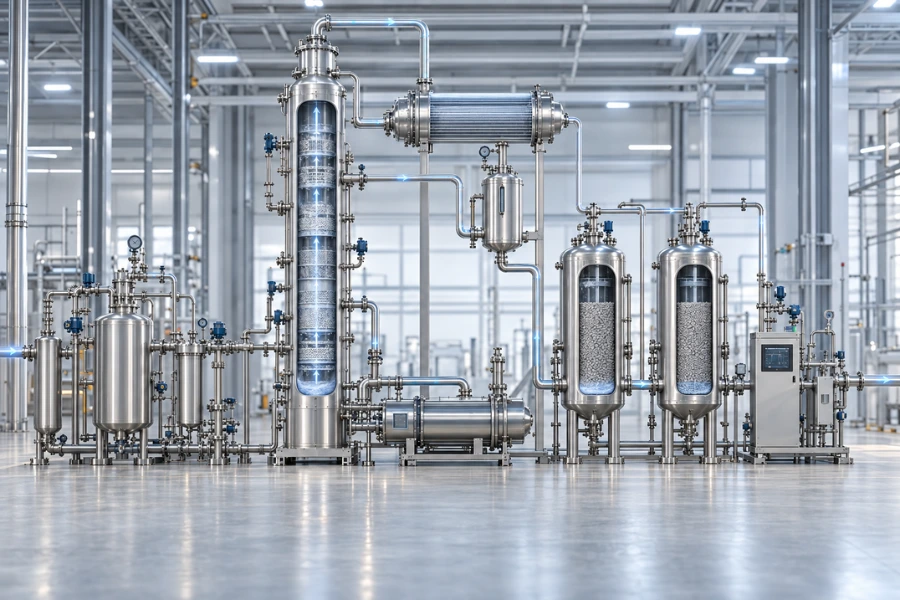
Sending excessive bulk contamination to a polishing bed consumes usable adsorption capacity and shortens operating cycles. Continuing distillation after the remaining impurity has become difficult to separate can instead increase stage, reflux, and refrigeration requirements for progressively smaller reductions in concentration.
The handoff should therefore be evaluated against five variables:
- impurity concentration and separation behavior
- required final specification
- silane recovery
- incremental distillation duty
- expected adsorbent service life
A representative electronic-grade silane purification sequence is:
feed impurity control → synthesis → bulk separation → high-purity distillation → selective polishing → product verification
The actual boundary between these operations should be established from the impurity profile and process economics rather than a predetermined purity target for the distillation column.
Why Recycle Changes the Feed Purification Decision
Recycle can make a low feed impurity concentration operationally important.
If a contaminant is poorly rejected, repeated circulation can increase its effective inventory in the process and raise the load entering reaction or final purification. Evaluating only the impurity concentration in fresh feed can therefore underestimate its downstream effect.
Upstream purification should be assessed against this circulating impurity balance. A pretreatment step becomes more valuable when it prevents a difficult contaminant from repeatedly consuming separation or polishing capacity downstream.
Maintaining ppb-Level Purity Beyond Distillation and Adsorption
At very low impurity levels, contamination introduced after separation can become comparable to the residual process impurity being controlled.
Piping, valves, vessels, seals, sampling lines, and process surfaces are therefore part of the purity boundary. Moisture ingress, particles, surface residues, or trace metals can reintroduce contaminants after the main separation stages.
Analytical design is part of the same control problem. Adsorbent breakthrough cannot be managed reliably if sampling contamination or insufficient detection capability masks the concentration trend approaching the bed outlet limit.
Silane’s pyrophoric behavior adds operating constraints to this high-purity boundary. Inerting, containment, leak detection, isolation, and safe handling of adsorbent beds containing residual silane must be considered when defining the purification equipment and maintenance strategy.
From Pilot Purification to Commercial Operation
Short-duration purification performance does not establish continuous commercial performance.
Scale-up changes column duty, equipment surface area, adsorption-bed dimensions, pressure drop, impurity inventory, and process response time. Feed variation can also change both distillation performance and the impurity profile entering the polishing section.
Pilot validation should therefore resolve different questions for each operation. Distillation testing should establish separation stability, recovery, reflux requirements, and sensitivity to feed variation. Adsorption testing should establish breakthrough curves, usable bed capacity, mass-transfer behavior, and regeneration or replacement intervals.
The units should also be tested as an integrated train. Adsorbent service life measured with an artificially clean feed may not represent performance behind a real distillation system whose outlet impurity profile varies with operating conditions.
How to Design the Integrated Silane Purification Train
Process design should begin with an impurity balance covering feedstock, reaction chemistry, recycle, separation, and final product requirements. Each important contaminant can then be assigned to the stage where its removal mechanism is most selective and operationally practical.
The resulting electronic-grade silane purification process can be evaluated against purity, silane recovery, refrigeration and reflux duty, adsorbent life, catalyst protection, and operating stability.
DODGEN approaches electronic-grade silane purification as this type of integrated process-engineering problem. Pilot testing can be used to define the distillation-adsorption handoff, validate impurity loading and breakthrough behavior, and identify scale-up constraints before the purification train moves toward commercial deployment.
Conclusion
Electronic-grade silane purification requires the separation mechanism to match the impurity behavior. Distillation handles the main volatility-based load, while adsorption and source-specific B/P control become more important as trace impurities reach the practical limit of rectification.
The critical design decisions are where to intercept each impurity, when to hand off from distillation to selective polishing, and whether those decisions remain stable under recycle, breakthrough, feed variation, and commercial operating conditions.