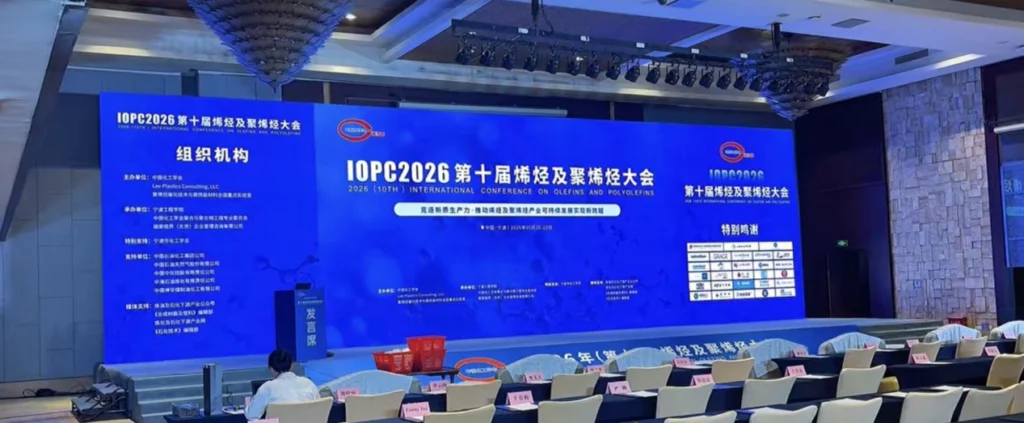
On May 21, the 10th International Conference on Olefins and Polyolefins was successfully held in Ningbo. The conference brought together technical representatives from leading domestic and international organizations, including Wanhua Chemical, LyondellBasell, and Norner of Norway.
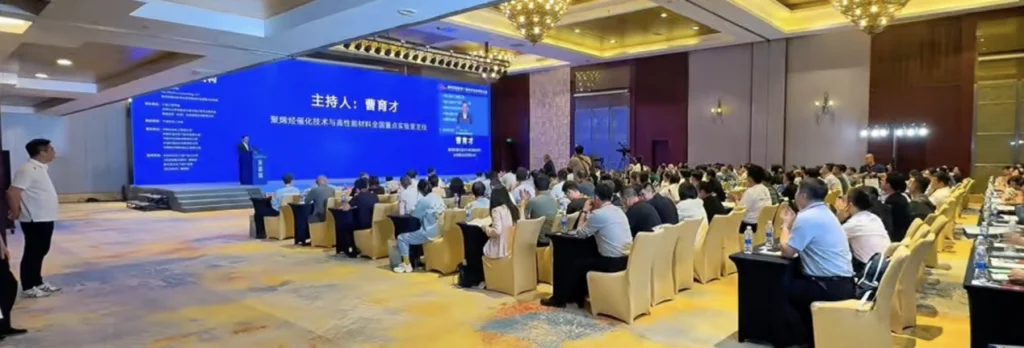
Conference site
DODGEN was invited to attend the conference. Liu Qi, Director of Application Technology, delivered a special presentation titled “Key Process Intensification Technologies for High-End Polyolefins,” systematically outlining DODGEN’s technical accumulation and engineering practice in full-process intensification for solution-process polyolefins.
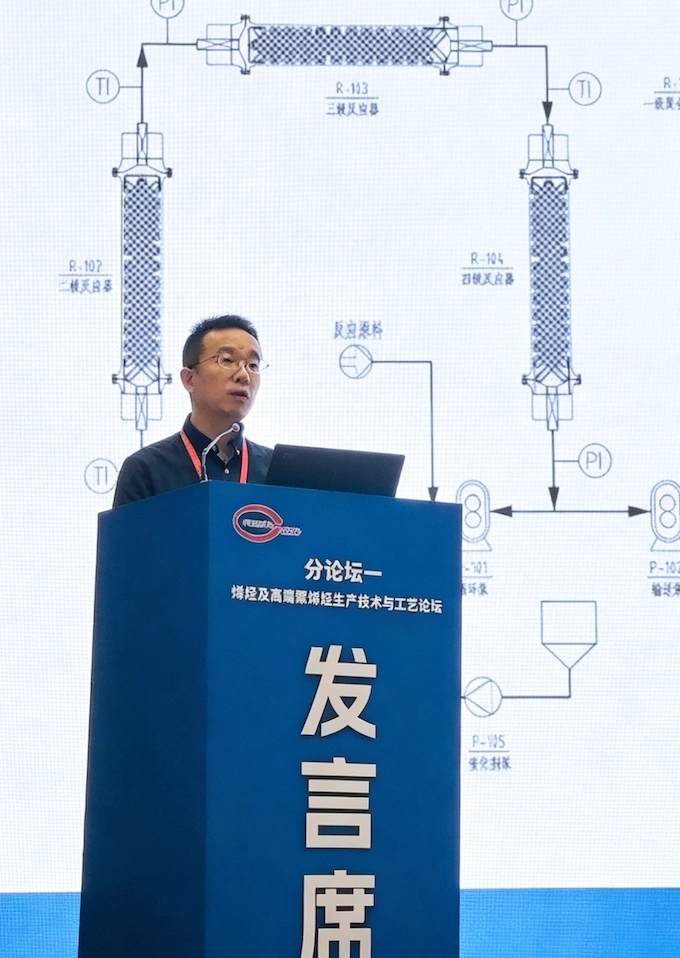
Liu Qi delivering the technical presentation
I. The Polyolefin Industry Is Accelerating Its Structural Divergence, Unlocking Continued Growth Space for High-End Products
As the world’s largest category of synthetic materials by output, polyolefins exceed 150 million metric tons in annual production and account for approximately 40% of total plastics production. Yet this enormous market is undergoing structural divergence:
Industry Divergence — English Translation
| General-Purpose Polyolefins | High-End Polyolefins |
| Persistent capacity-overhang pressure • Continued capacity expansion for commodity grades such as PE and PP • Downstream growth in construction and infrastructure demand has slowed sharply • Supply-demand imbalance and intensified price competition • Severe homogenization and steadily narrowing profit margins | Strategic priority for transformation • Strong pull from emerging sectors such as new energy vehicles and photovoltaics • Market demand growing at an annual average rate of over 7%, sustaining strong momentum • High technical barriers and significantly higher product value added • Broad room for domestic substitution, supported by continued policy momentum |
So how are high-end polyolefins such as POE, COC, mPE, and EPOE produced?
Is there a technology that can further amplify the practical performance attributes of these materials?
The currently recognized core production route is solution polymerization, which has become a technological high ground in the industry. DODGEN has focused on key pain points such as difficult polymerization reaction control, residuals after devolatilization that are hard to bring within specification, and persistently high energy consumption in solvent recovery. It has launched targeted technology development and achieved staged breakthroughs ranging from key unit operations to full-process integration.
II. Focusing on Key Process Intensification to Build Full-Process Integration Capabilities
Through years of engineering practice, DODGEN has developed three core process intensification technologies for solution-process high-end polyolefins. Targeting the three key steps of polymerization reaction, devolatilization separation, and solvent recovery, these technologies work together to form a complete engineering solution.
1. DODGEN DSR Polymerization Reactor Technology
Built around a multi-stage loop/tubular static-mixing reactor, the technology integrates heat-transfer tubes with static mixing elements, eliminating the need for mechanical agitation.
Material flow inside the tubes exhibits plug-flow characteristics, with highly uniform residence time that prevents back-mixing and short-circuiting. During operation, the temperature, pressure, and feed composition of each stage can be flexibly adjusted, enabling staged optimization and control of the reaction.
Comparison of DSR and Conventional Stirred Tank — English Translation
| Comparison Dimension | Conventional Stirred Tank (CSTR) | DODGEN DSR Reactor | DODGEN Advantage |
| Flow pattern | Fully mixed flow; broad residence-time distribution | Plug flow; uniform residence time | Narrower molecular-weight distribution (optimized PDI) |
| Heat-transfer efficiency | Relies on jacket; limited heat-transfer area | High-viscosity heat-transfer tubes; heat-transfer coefficient increased by 30-50% | Rapidly removes polymerization heat and prevents temperature runaway |
| Mixing mode | Mechanical agitation; high shear loss | Static mixing elements; no mechanical movement | No component wear; maintenance-free |
| High-viscosity adaptability | Agitation performance declines at high viscosity; dead zones occur | Handles up to <=3000 Pa.s; no channeling or dead zones | Preferred choice for high-viscosity polymerization systems |
| Energy consumption | High agitation power and high energy use | No agitator; power consumption reduced by 20%+ | Significantly lower long-term operating cost |
| Continuous-operation capability | Mainly batch or semi-continuous | Fully continuous, steady-state operation | Stable product quality and fast grade switching |
| Maintenance cost | Seals and agitator require periodic maintenance | No moving parts; no mechanical maintenance | High reliability and long-cycle operation |
2. DODGEN DSXL Devolatilization Technology
The reaction solution in solution-process polyolefin production typically contains more than 60% solvent, while the final product has extremely stringent requirements for residual solvent; for high-end grades such as metallocene polyethylene, residual solvent must be controlled below 500 ppm.
To address issues such as high residual solvent and thermal degradation caused by high temperature, the process is upgraded to multi-stage devolatilization. Pressure is reduced stage by stage and combined with a low-temperature flash process. A specialized heat exchanger rapidly heats the material to the critical volatilization temperature, and a distributor then disperses the melt into millimeter-scale liquid films or fine strands. This greatly shortens the solvent diffusion distance while enabling precise temperature and pressure control at each stage to avoid overheating.
a. Breakthrough in Solvent Removal Efficiency
Multi-stage devolatilization design, with a high-viscosity dedicated heat exchanger that rapidly heats the material to the critical volatilization temperature.
The distributor disperses the melt into millimeter-scale liquid films, significantly shortening the solvent diffusion path.
Residual solvent can be reduced to below 500 ppm, meeting the purity requirements for metallocene polyethylene.
b. Molecular-Weight Protection Mechanism
A combined process of gradient pressure reduction and low-temperature flash evaporation uses precise temperature control to prevent thermal degradation.
It avoids damage to polymer morphology caused by high shear forces.
It reduces polyolefin molecular-chain scission caused by prolonged residence at high temperature.
c. Significant Cost Advantage
Compared with conventional twin-screw devolatilization, investment cost is reduced by approximately 40%.
With no high-speed rotating mechanical components, maintenance cost is substantially reduced.
Operating expenses are significantly lower than those of conventional processes, delivering outstanding economic benefits.
3. DODGEN Solvent Recovery Process Enhancement Technology
The solvent recovery system accounts for 40-50% of the total energy consumption of the solution-process route.
DODGEN’s three-column process achieves approximately 30% energy savings.
By upgrading a single-column or simple two-column process to a three-column configuration, the optimized integration and heat coupling of the three columns enable more efficient separation and energy utilization.

Original figure: three-column solvent recovery process
English Translation of Figure Text
| 中文原文 | English Translation |
| 脱挥系统:160~180°C余热回收预热进料 | Devolatilization system: waste heat at 160-180°C is recovered to preheat the feed. |
| 精馏塔① 轻组分:蒸汽梯级利用,分级精准分离 | Distillation Column 1 – Light components: cascade steam utilization and precise staged separation. |
| 精馏塔② 主溶剂:高效填料内件,低回流比运行 | Distillation Column 2 – Main solvent: efficient packing/column internals and low-reflux-ratio operation. |
| 精馏塔③ 重组分:冷凝冷量优化,液液高效分离 | Distillation Column 3 – Heavy components: optimized condensation duty and efficient liquid-liquid separation. |
| 溶剂循环再利用:纯度达标,回聚合段 | Solvent recycling and reuse: solvent reaches the purity specification and is returned to the polymerization section. |
This is mainly achieved through the following steps:
01 Utilization of Devolatilization Waste Heat:
Heat from the high-temperature devolatilization vapor phase (160-180°C) is used through a heat-exchange network to preheat the feed, while simultaneously reducing steam consumption for devolatilization condensation and solvent recovery.
02 Precise Staged Separation:
The integrated design of devolatilization and separation enables precise staged recovery of solvents and monomers at each level, while cascade steam utilization maximizes thermodynamic efficiency.
03 High-Efficiency Packing and Column Internals:
The three columns use low-pressure-drop, high-efficiency structured packing. This improves separation efficiency, reduces column height, and effectively lowers the reflux ratio and distillation energy consumption.
04 Heat Pump Integration (Under Development):
DODGEN is advancing integrated optimization of heat pumps and multi-effect distillation, with the potential to achieve additional energy reductions on top of the three-column process.
III. Full-Process Integrated Solution
The technical barriers of high-end polyolefins cannot be overcome by optimizing a single step alone; they require systematic accumulation of full-process engineering capabilities.
This is precisely where DODGEN’s engineering advantage lies. The three modules above can be seamlessly connected to realize full-process intensification:

Original figure: integration of DSR + DSXL + solvent recovery
English Translation of Figure Text
| 中文原文 | English Translation |
| 东庚DSR + DSXL + 溶剂回收 —— 三大模块无缝衔接,全流程过程强化 | DODGEN DSR + DSXL + Solvent Recovery — Seamless Integration of Three Core Modules for Full-Process Intensification |
| 原料(单体+溶剂+催化剂) | Feedstock (monomer + solvent + catalyst) |
| DSR 聚合反应(多段环管) | DSR polymerization reaction (multi-stage loop/tubular reactor) |
| DSXL 落条脱挥(2-3级) | DSXL falling-strand devolatilization (2-3 stages) |
| 溶剂回收 耦合脱挥细化设计(余热利用) | Solvent recovery with a refined, coupled devolatilization design (waste-heat utilization) |
| 高端聚烯烃产品(残单<500ppm) | High-end polyolefin product (residual monomer <500 ppm) |
The DSR multi-stage loop/tubular reactor completes precision polymerization, while the DSXL multi-stage falling-strand system completes solvent removal. High-temperature vapor-phase waste heat generated during devolatilization is directly introduced into the energy network of the three-column solvent recovery system for recycling, enabling cascade utilization of heat across the full process.
Product quality: narrow molecular-weight distribution, high purity, and good uniformity.
Energy benefit: energy consumption for solvent recovery reduced by approximately 30%.
Investment cost: devolatilization investment reduced by 40% compared with twin-screw devolatilization.
Applicable products: solution-process polyolefins, such as POE and COC.
IV. Technology Applications
DODGEN has completed industrial validation across multiple high-end polyolefin grades and has the capability for scalable replication and promotion. Selected application directions are as follows:
English Translation
| Product / Application | Technical Solution |
| POE | DSXL high-efficiency devolatilization + solvent recovery |
| HPOE | DSR continuous polymerization + DSXL high-efficiency devolatilization |
| COC | Solution-process precision polymerization + DSXL high-efficiency devolatilization |