Global CPL Market
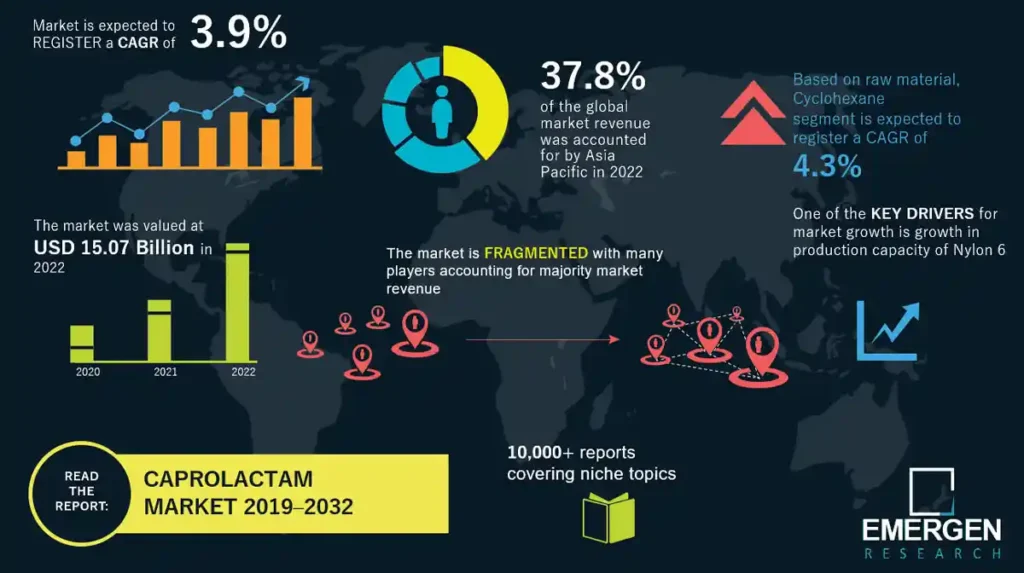
$12.28 billion (2023) → $18.71 billion (2030)
2024-2030 CAGR
6.3%
Core Monomer
Nylon 6 (PA6)
Source: Industry statistics and public data compilation
I. Market Overview
Caprolactam (CPL), as the core monomer of Nylon 6, spans three major sectors: fibers, engineering plastics, and films, demonstrating strong cyclical resilience and integration dividends.
According to statistics, the global caprolactam market reached $12.28 billion in 2023 and is projected to reach $18.71 billion by 2030, with a compound annual growth rate (CAGR) of approximately 6.3% from 2024 to 2030.
- Medium to long-term demand is driven by civil and industrial fibers, engineering plastics upgrades, and functional film expansion.
- Integrated layouts (Benzene-Cyclohexanone/KA Oil-CPL-PA6) enhance raw material and energy synergies, strengthening anti-cyclical capabilities.
II. Industry Chain Structure
Upstream based on benzene; midstream featuring caprolactam plants with ammonium sulfate by-product synergy; downstream polymerization into PA6 chips, extending to fibers, engineering plastics, films, and modified materials.
Upstream
- Benzene
- Cyclohexane / Cyclohexanone (KA Oil)
- Ammonia, Sulfuric Acid, Hydrogen Peroxide (H₂O₂)
Midstream
- Caprolactam (CPL) Plants
- By-product Ammonium Sulfate (Traditional Sulfuric Acid Process)
Downstream
- PA6 Chips → Fibers (Civil, Industrial)
- Engineering Plastics
- Films and Modified Materials
III. Demand Structure and Typical Applications
Nylon 6 accounts for over 95% of caprolactam consumption, with approximately 60-65% for fibers, 25-30% for engineering plastics, and 5-10% for films and others.
Caprolactam Fibers
- Civil Fibers: Underwear, socks, shirts, etc.
- Industrial Fibers: Tire cords, sailcloth, parachutes, insulation materials, fishing nets, seatbelts, etc.
Nylon-6 Engineering Plastics
- Precision machinery gears, housings, hoses
- Oil-resistant containers, cable sheaths, textile equipment parts, etc.
Nylon-6 Films
- Packaging Industry: Food packaging, medical packaging, etc.
IV. Main Production Processes
Currently, the main caprolactam production methods are the ammoximation process and HPO process, with the ammoximation process being the domestic mainstream (accounting for approximately 81%). The main raw material is cyclohexanone, with upstream mostly purchasing petroleum benzene and some using hydrogenated benzene.
Cyclohexanone Oxime Process
Core steps include ammoximation (producing cyclohexanone oxime) and Beckmann rearrangement (generating caprolactam), traditionally using fuming sulfuric acid with ammonium sulfate as a by-product. The process is mature and suitable for large-scale plants.
Cyclohexane Oxidation Process
First oxidized to KA oil, then ammoximation + Beckmann rearrangement; suitable for coupling with cyclohexanone plants, offering significant integrated raw material advantages.
V. Purification Goals and Common Technologies
Goal: Remove chromophores, cyclohexanone/oxime residues, oligomers, metal ions, and moisture to ensure polymerization-grade or high-purity caprolactam quality.
Crystallization Purification
Selective precipitation, high purity, controllable solvent requirements, suitable for polymerization-grade and high-end applications.
Vacuum Distillation
Good continuity, excellent for removing low boilers and moisture, moderate energy consumption, requires attention to distillation column efficiency and heat integration.
Solvent Extraction/Washing
Rapid impurity removal, broad impurity spectrum; requires solvent recovery and VOC control, suitable for crude product pre-purification.
| Method | Advantages | Key Focus | Application Scenarios |
|---|---|---|---|
| Crystallization | High purity, strong selectivity | Moderate energy consumption, crystallization control | Pre-polymerization purification/high-end applications |
| Distillation | Continuous stability, excellent dehydration/low boiler removal | Column efficiency, heat integration | Large-scale, online stable control |
| Extraction | Fast-acting, broad impurity spectrum | Solvent recovery and VOC | Crude product pretreatment |
VI. Melt Crystallization Technology
An efficient, environmentally friendly separation technology used to improve caprolactam purity, especially suitable for removing thermosensitive impurities; corresponding equipment has been modularized for easy scale-up production.
Crystallization
After heating and melting crude caprolactam, it is slowly cooled below the melting point, with pure CPL preferentially crystallizing out while impurities remain in the mother liquor.
Sweating
Temperature is raised close to the melting point to partially melt the surface of the crystal layer, expelling entrapped impurities and further improving purity.
Melting
The crystal layer is completely melted to collect high-purity liquid CPL; mother liquor and sweat can be recycled for material closed-loop circulation.
Core Advantages
- High Purity: Up to 99.99%+, suitable for electronic-grade products.
- Low Energy Consumption: 10%-30% of distillation energy consumption, no need for vaporization latent heat.
- Environmental Friendliness: No solvent used, reducing pollution and recovery costs.
- Low-Temperature Operation: Suitable for thermosensitive substances, avoiding high-temperature decomposition.
Process Integration and Pretreatment
Through the series connection of pretreatment (dehydration, dehydrogenation, de-heavy ends) and crystallization, efficient purification from “amide oil” to “caprolactam” can be achieved; the crystallization process requires no solvent, significantly reducing benzene usage, with a concise, continuous, safe and reliable process, and simultaneous reduction in investment and operating costs.