Levima Huayu Tongfang Commissions 4,000 t/y Vinylene Carbonate (VC) Unit in Shandong
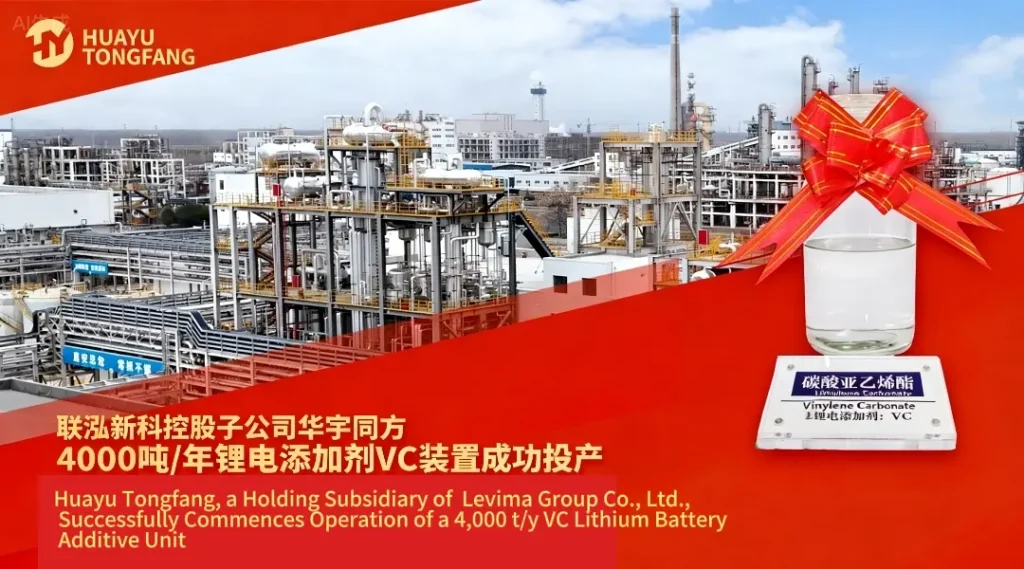
At 23:56 on December 22, 2025, Huayu Tongfang, a holding subsidiary of Levima Advanced Materials, commissioned a 4,000 metric tons per year vinylene carbonate (VC) lithium battery additive unit at Wenshang Chemical Industry Park in Jining, Shandong Province.
The project achieved a one-time full-process start-up and produced qualified products upon initial operation, marking the formal transition to commercial production.
The new capacity strengthens Levima’s presence in the electrolyte additive segment and expands domestic VC supply in China’s battery materials value chain.
Vinylene Carbonate (VC) Market Demand and Lithium Battery Growth Drivers
Demand for lithium batteries continues to increase, supported by electric vehicles, grid-scale energy storage, and portable electronics. Electrolyte formulation remains a critical performance determinant in lithium-ion systems.
Vinylene carbonate (VC) is the highest-volume additive used in lithium battery electrolytes. It functions as:
An organic film-forming additive that promotes stable solid electrolyte interphase formation
An overcharge protection additive that enhances safety characteristics
A performance enhancer that supports capacity retention and cycle life
Market attention toward VC intensified during 2025. Industry data indicate that market prices increased by more than 260 percent since October, reflecting tight supply conditions and downstream restocking activity.
The commissioning of new capacity is therefore strategically aligned with upstream material security and electrolyte cost stabilization.
Integrated VC Production Based on Ethylene Carbonate (EC) Feedstock
The Huayu Tongfang VC unit utilizes internally produced ethylene carbonate (EC) as its primary raw material. Vertical integration supports feedstock stability and margin control within the carbonate value chain.
The company reports independent technological development across multiple core production stages, including:
Reaction pathway optimization
Conversion efficiency improvement
Energy consumption reduction
Product purification and quality stabilization
The process is designed to achieve higher conversion rates and lower specific energy use compared with conventional approaches. Product purity and technical specifications are positioned to meet high-performance lithium-ion electrolyte standards.
Strategic Implications for China’s Lithium Battery Additive Industry
The successful start-up of the 4,000 t/y VC unit enhances:
Domestic supply resilience for electrolyte additives
Integration between EC and VC production
Cost and quality control capabilities within battery material systems
As lithium battery demand expands, additive reliability and purity control become increasingly central to cell performance and safety metrics. Capacity additions that combine feedstock integration with process optimization are expected to shape competitive positioning in the VC market over the next cycle.