Hazardous chemical reactions present engineering challenges involving heat generation, unstable intermediates, corrosive reagents, and complex multiphase behavior. In batch reactors, these challenges can be amplified by relatively large reaction inventories, uneven mixing, and heat removal limitations associated with reactor geometry and operating conditions.
Continuous flow reactors provide an alternative by moving reactants through defined reaction zones rather than processing the entire reaction inventory in one vessel. Their potential advantages include lower active reaction volumes, improved heat transfer, controlled residence-time behavior, and integration of consecutive reaction stages.
However, continuous processing does not eliminate chemical hazards. It changes how material inventory, thermal behavior, pressure, and process deviations are managed across the manufacturing system.
Nitration, diazotization, and oxidation illustrate three distinct engineering challenges. Nitration requires careful management of reaction kinetics, thermal behavior, and product selectivity. Diazotization involves unstable intermediates and potentially complex solid-liquid or multiphase systems. Oxidation frequently depends on the interaction between reaction kinetics and gas-liquid mass transfer.
Understanding these differences is essential when evaluating continuous flow technology for industrial chemical production.
Why Continuous Flow Processing Matters for Hazardous Reactions
Limitations of Conventional Batch Processing
Batch reactors offer flexibility for specialty chemical manufacturing, but their relatively large reaction inventories can increase the consequences of thermal or operational deviations.
When reaction heat generation exceeds cooling capacity, temperature increases may accelerate reaction kinetics and promote secondary reactions. Uneven reactant distribution can also create local concentration and temperature differences, affecting selectivity and product consistency.
Continuous flow processing changes the material handling arrangement. Reactants enter a defined reaction zone while products leave continuously, allowing engineers to control active reaction volume, flow behavior, and exposure time.
The potential safety benefit comes from managing the quantity of reactive material present during processing, not simply from increasing production speed.
Reducing Hazardous Material Inventory
One of the main process safety advantages of continuous flow technology is the potential to reduce hazardous material inventory within the active reaction zone.
Unlike a conventional batch vessel, which may contain a substantial quantity of reacting material throughout the reaction period, a continuous reactor can maintain a smaller active volume while processing material continuously.
This is particularly relevant to highly reactive intermediates, unstable compounds, and reactions with significant thermal hazards. It also reflects the process intensification principle of minimizing hazardous material inventories and supports the broader concept of producing hazardous materials on demand in smaller facilities.
Perry’s Chemical Engineers’ Handbook provides a foundation for this engineering approach through its treatment of chemical reactors, including tubular and packed-bed flow configurations (Green and Southard, 2019).
However, reduced reactor inventory does not necessarily mean reduced total plant inventory. Feed tanks, pumps, connecting lines, intermediate vessels, gas systems, and downstream equipment may still contain hazardous materials.
Engineers should distinguish between hazard reduction, incident probability reduction, and consequence reduction. A smaller active reaction inventory may limit the consequences of certain incidents, but it does not change the inherent chemical hazards or automatically prevent equipment failures.
The assessment should consider maximum credible hold-up, material remaining after isolation, and the quantity of reactive material that could remain trapped in individual process sections during an abnormal shutdown.
Improving Thermal Management
Many tubular and microchannel configurations provide a higher heat transfer area relative to their internal volume than conventional stirred vessels.
Shorter heat transfer distances can improve the removal of reaction heat, particularly when the process involves rapid exothermic reactions.
A simplified energy balance for a defined reaction system is:
\dot Q_{\text{generation}}\dot Q_{\text{removal}}]
Where:
- (U) represents thermal energy stored within the system.
- (\dot Q_{\text{generation}}) represents reaction heat generation.
- (\dot Q_{\text{removal}}) represents heat removed through the cooling system.
This simplified expression illustrates thermal accumulation. A complete continuous reactor energy balance must also account for enthalpy entering and leaving with process streams and other relevant energy transfers.
If reaction heat generation exceeds heat removal, the system may experience temperature increases. The resulting risk depends on reaction kinetics, thermal inertia, cooling capacity, and the stability of the reaction mixture.
Consequently, reactor selection should consider reaction calorimetry, heat transfer performance, cooling system reliability, and credible abnormal operating conditions.
Engineering Principles of Continuous Flow Reactors
Comparing Reactor Configurations
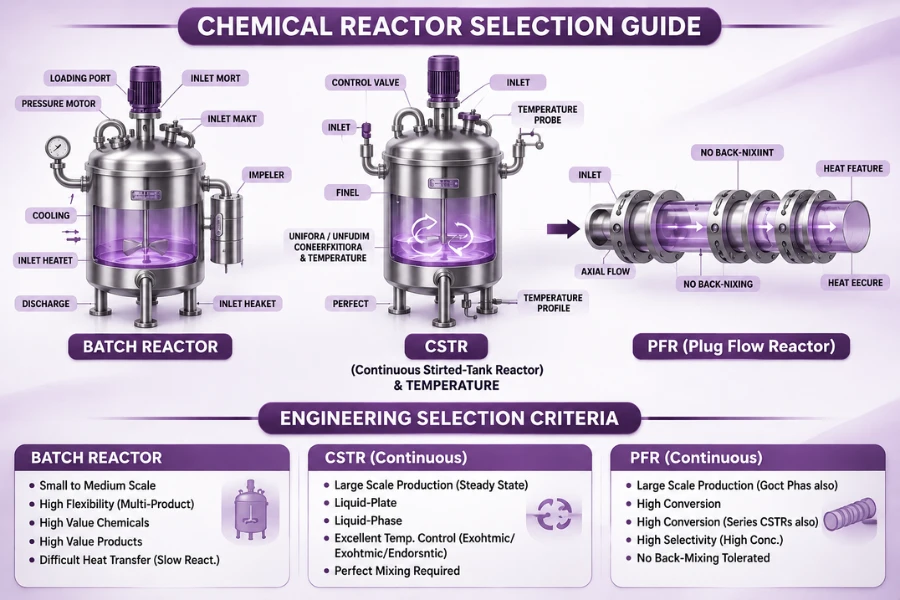
Continuous chemical manufacturing uses different reactor configurations depending on reaction kinetics, phase behavior, heat generation, and mass transfer requirements.
| Reactor configuration | Engineering advantages | Important limitations |
|---|---|---|
| Tubular flow reactor | Defined flow path and flexible heat exchange integration | Axial dispersion, flow distribution, and pressure drop |
| Microchannel reactor | High heat transfer area and short transport distances | Small-channel blockage and cleaning challenges |
| Packed-bed reactor | Suitable for heterogeneous catalytic systems | Pressure drop, channeling, and catalyst deactivation |
| Continuous stirred-tank reactor | Mixing flexibility and compatibility with selected slurry systems | Residence-time distribution and cooling requirements |
Tubular reactors provide continuous material movement through defined channels. Their performance depends on geometry, fluid properties, flow regime, and heat exchange conditions.
Microchannel reactors provide short transport distances and high surface-area-to-volume ratios. They can benefit reactions with demanding heat transfer or mixing requirements, but precipitation and particulate accumulation may restrict small channels.
Packed-bed reactors are commonly considered for heterogeneous catalytic processes. Their performance depends on catalyst properties, bed structure, fluid distribution, and pressure drop.
Continuous stirred-tank reactors, or CSTRs, can accommodate well-mixed liquid systems and selected slurry processes when suspension, mixing, and solids withdrawal are properly engineered. Their residence-time distribution must be considered when reactions are sensitive to exposure time or intermediate stability.
The appropriate configuration depends on the complete process rather than reactor geometry alone. DODGEN’s continuous flow reactor solutions cover several equipment categories, including micro reactors, static mixers, polymerization reactors, and heat exchangers.
Evaluating Heat and Mass Transfer
Heat and mass transfer determine how effectively reactants interact and how efficiently reaction heat is removed.
For exothermic reactions, engineers must evaluate the overall heat transfer coefficient, effective heat transfer area, temperature difference, fluid properties, and reaction heat release.
In multiphase systems, mass transfer introduces additional limitations. A gaseous reactant, for example, must transfer into the liquid phase before participating in a liquid-phase reaction.
Important engineering parameters include:
| Parameter | Engineering significance |
|---|---|
| Heat transfer coefficient | Effectiveness of heat exchange between process and cooling media |
| Specific heat transfer area | Available heat exchange area relative to reactor volume |
| Gas-liquid interfacial area | Contact area between gas and liquid phases |
| Volumetric gas-liquid mass transfer coefficient ((k_La)) | Gas-to-liquid mass transfer performance per unit volume |
| Pressure drop | Hydraulic resistance through the reactor |
| Flow regime | Influence on mixing and phase distribution |
The overall reaction rate may be limited by intrinsic chemical kinetics, heat transfer, mass transfer, or a combination of these factors.
Increasing reactor surface area alone will not resolve a process bottleneck if reactant distribution or interphase transfer remains limiting.
For applications involving high-viscosity streams, mixing requirements may differ substantially from those of low-viscosity liquid systems. DODGEN’s static mixer is positioned for high-viscosity systems, where flow distribution and mixing characteristics require specific engineering consideration. Its suitability for a particular hazardous reaction must still be established through process-specific evaluation.
Residence-Time Distribution and Flow Characterization
Residence time describes how long material remains within a reactor.
An ideal plug flow reactor provides approximately uniform residence time, while real systems experience deviations caused by axial dispersion, mixing patterns, geometry, and variations in fluid behavior.
Nominal residence time can be estimated using:
[\tau=\frac{V_{\text{effective}}}{Q}]
Where:
- (\tau) is nominal residence time.
- (V_{\text{effective}}) is effective fluid hold-up volume.
- (Q) is volumetric flow rate under the relevant process conditions.
Effective fluid hold-up may differ from total geometric equipment volume. In multiphase systems, gas and liquid phases may have different hold-up volumes and flow behavior, requiring separate residence-time characterization.
Tracer testing provides a way to evaluate actual residence-time distribution. The resulting response helps identify axial dispersion, mixing behavior, and deviations from ideal plug flow.
This matters when intermediate stability, secondary reactions, or product decomposition depend on exposure time. An acceptable average residence time does not guarantee suitable performance if the system contains excessive long-residence-time fractions or poorly controlled material accumulation.
Pressure Drop and Flow Distribution
Pressure drop is both a reactor sizing parameter and an indicator of hydraulic stability.
In systems containing solids, deposits or particle accumulation can progressively increase flow resistance. In parallel-channel systems, differences in hydraulic resistance can cause uneven flow distribution, resulting in different residence times and reaction conditions across individual channels.
Gas accumulation, phase separation, and changes in fluid properties can also influence pressure behavior.
Monitoring pressure drop across relevant process sections helps engineers identify developing restrictions and assess whether the original flow distribution remains stable.
These relationships become particularly important when scaling a microreactor or operating multiple modules in parallel.
Continuous Flow Nitration
Nitration is used in the production of specialty chemicals, pharmaceutical intermediates, agrochemical intermediates, and other functional materials.
Its main engineering challenges include reaction heat, phase behavior, corrosive media, product selectivity, and long-term equipment reliability.
Thermal Management and Reaction Control
Many nitration systems involve significant heat release. In batch processing, a substantial reaction inventory combined with limited heat transfer area can increase the consequences of inadequate cooling or uneven reactant distribution.
Continuous flow configurations can improve thermal management through smaller active reaction volumes and greater heat transfer area relative to reactor volume.
However, improved heat transfer does not independently establish process safety. Reaction calorimetry, cooling capacity, temperature response, and potential deviations in feed composition or flow behavior must also be evaluated.
Zhou et al. (2025), in Continuous-Flow-Enabled Intensification in Nitration Processes, identify reaction kinetics, system configuration, critical operating parameters, safety assessment, and scale-up as interconnected aspects of continuous nitration development.
Reaction Kinetics and Process Performance Evaluation
Reaction kinetics determine how quickly reactants are converted under specific process conditions. In continuous nitration, kinetic characterization helps engineers understand the relationship between reaction rate, residence time, temperature, reactant concentration, and reactor performance.
However, kinetic behavior should not be evaluated independently of mass transfer when the reaction involves multiple phases.
A process may be influenced by both intrinsic reaction kinetics and the rate at which reactants reach the reaction interface. This distinction is particularly important for heterogeneous nitration systems.
Several performance indicators should be evaluated together.
| Performance indicator | What it measures | Why it matters |
|---|---|---|
| Conversion | Fraction of reactant consumed | Indicates reaction progress |
| Selectivity | Fraction directed toward the desired product | Evaluates competing reaction pathways |
| Yield | Desired product obtained relative to a defined theoretical basis | Connects conversion and selectivity |
| Space-time yield (STY) | Product mass generated per reactor volume per unit time | Evaluates volumetric production efficiency |
| Throughput | Total production over a defined period | Indicates manufacturing capacity |
| Impurity profile | Composition of undesired products and residual materials | Determines downstream purification requirements |
These indicators answer different questions.
A high conversion does not necessarily indicate high selectivity. A high yield does not automatically establish high production capacity, and a high space-time yield does not guarantee that the final product meets its quality specification.
A useful published example comes from the continuous-flow nitration scale-up data reviewed by Zhou et al. (2025).
In one reported study by Wang et al. (2024), increasing volumetric flow rate from 1.5 to 18 mL/min while maintaining a reported residence time of 120 seconds increased throughput from 1.00 to 8.97 kg/day. Yield changed from 99.21% to 98.32%, while space-time yield changed from 3.877 to 2.884 g/(L·s).
This example demonstrates why scale-up performance should not be judged by a single metric. Production capacity increased substantially, while the reported volumetric productivity and yield changed.
The figures apply to that specific nitration system and should not be interpreted as general design targets for other substrates or reactor configurations.
Mixing, Phase Behavior, and Flow Reliability
Nitration systems may involve multiple liquid phases with different physical properties. Their distribution influences interfacial contact, reactant mixing, and concentration uniformity.
Poor phase distribution can contribute to inconsistent reaction behavior and local concentration differences. Changes in viscosity or phase properties may also affect hydraulic resistance.
Solid formation presents another concern. Precipitation, product deposition, and particulate accumulation can restrict flow and increase pressure drop, particularly in small-channel reactors.
Reactor selection should therefore account for phase separation, potential solids formation, hydraulic stability, and cleaning requirements.
Reaction Selectivity, Side Reactions, and Impurity Control
Conversion alone is not a sufficient measure of nitration performance.
The desired product may compete with alternative substitution pathways, overnitration, and other secondary reactions. Their formation depends on substrate chemistry, reaction conditions, and reactant distribution.
Temperature gradients and inconsistent reactant exposure can affect product selectivity and impurity profiles. Continuous flow may improve process consistency, but it does not automatically eliminate competing reactions.
Industrial evaluation should consider target product selectivity, isomer distribution, overreaction products, secondary reaction products, and the final impurity profile.
A process that achieves high conversion but produces a difficult impurity profile may require more complex separation and purification, reducing overall manufacturing feasibility.
For this reason, continuous nitration should be evaluated through reaction performance and final product quality rather than conversion alone.
Materials Compatibility and Equipment Reliability
Corrosive and oxidizing environments can affect reactor surfaces, pumps, seals, connecting lines, and instrumentation.
Materials compatibility must be evaluated against the complete chemical environment, including temperature, concentration, pressure, and exposure duration.
Long-term reliability also depends on corrosion resistance, sealing integrity, leakage prevention, and maintenance accessibility.
A suitable reactor configuration must maintain chemical compatibility and hydraulic stability over the intended operating life.
Scale-Up Constraints in Continuous Nitration
Scaling continuous nitration requires validation of thermal performance and hydraulic behavior.
Increasing reactor dimensions may change heat transfer, mixing, and residence-time distribution. Numbering-up introduces additional requirements involving flow distribution and module balancing.
Unequal flow across parallel channels can create different reaction conditions and product quality variations, even when the overall feed rate appears stable.
Precipitation, pressure drop differences, and variations in heat removal can further affect individual modules.
Scale-up decisions should therefore rely on validated heat transfer, flow behavior, reaction performance, and extended operating data rather than laboratory conversion alone.
Continuous Flow Diazotization
Diazotization converts primary aromatic amines into diazonium intermediates used in subsequent chemical transformations.
Aromatic diazonium intermediates may exhibit significant thermal and chemical instability. Their accumulation, isolation, or prolonged exposure to unsuitable conditions can create serious process safety concerns.
Continuous flow processing offers opportunities to reduce active intermediate inventory and connect intermediate generation with downstream reactions.
Managing Aromatic Diazonium Intermediate Stability
In conventional batch processing, a relatively large quantity of reaction material may remain inside a vessel during intermediate formation and subsequent handling.
Continuous flow systems can reduce the amount of intermediate present in the active reaction zone by maintaining controlled material movement.
This supports in situ generation and subsequent consumption without requiring unnecessary intermediate accumulation.
However, reducing reactor inventory does not eliminate decomposition risks. Intermediate stability depends on chemical structure, reaction environment, temperature, impurities, and exposure time.
The engineering assessment must therefore include connecting lines, transfer equipment, intermediate conditioning, and downstream processing units.
Phase Behavior and Reactor Selection
The physical state of a diazotization reaction mixture is an important factor in reactor selection.
Not all aromatic diazotization systems behave as homogeneous liquid reactions. Depending on the substrate, solvent environment, reaction conditions, and subsequent transformation, the process may involve aqueous phases, organic phases, liquid-liquid systems, suspended solids, or precipitating products.
These differences create distinct engineering requirements.
| Reaction system | Main engineering considerations |
|---|---|
| Homogeneous aqueous system | Mixing consistency, heat removal, residence-time control, and intermediate stability |
| Organic-phase system | Solvent compatibility, wetted materials, phase behavior, and downstream integration |
| Biphasic liquid system | Interfacial area, phase distribution, mass transfer, and flow stability |
| Solid-forming system | Particle transport, deposition, blockage, and cleaning requirements |
| Heterogeneous catalytic system | Catalyst retention, pressure drop, and stable contact between phases |
A homogeneous liquid system may be suitable for a tubular or microchannel configuration when the required transport and thermal characteristics can be maintained.
A biphasic system requires additional consideration of interfacial contact and phase distribution. A system that produces suspended solids may require a reactor with greater tolerance for particles and suitable solids management.
Packed-bed configurations may be relevant when a solid catalytic phase is intentionally retained inside the reactor. However, they are not automatically appropriate for systems in which freely suspended solids or precipitating products must pass through the equipment.
Chen et al. (2022), in Revisiting Aromatic Diazotization and Aryl Diazonium Salts in Continuous Flow, emphasize that solid management, automation, and process analytical technology remain important challenges in the industrial development of continuous diazotization.
The engineering decision should therefore begin with the actual phase behavior of the reaction mixture rather than assuming that every diazotization process requires the same reactor design.
Residence-Time Control and Intermediate Transfer
Residence-time management is important because the reaction zone must provide suitable conditions for intermediate formation without creating unnecessary intermediate accumulation.
Nominal residence time alone cannot establish whether the process is adequately controlled. Actual RTD, flow behavior, temperature consistency, and downstream transfer conditions must also be considered.
Material may encounter additional hold-up volumes, pressure changes, or incompatible conditions after leaving the primary reactor.
Process monitoring and validated operating limits help maintain consistency throughout the integrated system.
Process Analytical Technology and Solid Management
Process Analytical Technology, or PAT, supports continuous diazotization by connecting process measurements with reaction performance and product quality.
Temperature, pressure, and flow measurements provide information about equipment and process conditions. Where appropriate analytical methods are available, additional measurements can provide information about intermediate formation, composition, and critical quality attributes.
It is important to distinguish process monitoring from PAT. Routine sensors monitor operating variables, while PAT uses suitable analytical information to improve understanding and control of material attributes and process performance.
Solid management is another important consideration. Depending on the chemistry and process conditions, precipitation, suspended solids, or deposits may affect flow behavior and equipment reliability.
Potential consequences include restricted flow, increased pressure drop, changes in residence-time distribution, and unplanned cleaning requirements.
Not every diazotization system generates solids, but this possibility should be evaluated during process development.
Integration With Downstream Reactions
One important opportunity in continuous diazotization is telescoped processing, in which an intermediate is transferred directly into a compatible downstream transformation rather than isolated and stored.
However, connected reaction stages must be compatible in terms of residual reagents, solvent composition, byproduct carryover, phase behavior, and gas generation.
Some systems may require intermediate conditioning, inline phase separation, or other processing operations before the next reaction stage.
A reliable design must coordinate intermediate generation, transfer, consumption, and final purification across the complete process.
Continuous Flow Oxidation
Oxidation reactions may involve gaseous oxidants, liquid oxidants, homogeneous catalysts, or heterogeneous catalytic systems.
Their performance can depend on the interaction between intrinsic reaction kinetics and interphase mass transfer. Reactor selection must therefore reflect the oxidant system, reaction phase, catalyst characteristics, and downstream processing requirements.
Gas-Liquid Mass Transfer and Reaction Kinetics
For oxidation processes involving gaseous reactants such as oxygen, gas-to-liquid transfer can become a major performance limitation.
The overall reaction rate may depend on intrinsic reaction kinetics, gas-liquid interfacial area, liquid-side mass transfer, gas utilization, reactor flow behavior, and operating conditions.
The volumetric gas-liquid mass transfer coefficient, commonly represented as (k_La), combines the liquid-side mass transfer coefficient with the available gas-liquid interfacial area per unit volume.
Improving (k_La) does not automatically increase production performance. Its benefit depends on whether gas-liquid transfer controls the overall reaction rate.
If intrinsic kinetics are relatively slow, increasing interfacial area may produce limited improvement. If the reaction is rapid relative to gas transfer, mass transfer may become the dominant limitation.
Gemoets et al. (2016), in Liquid Phase Oxidation Chemistry in Continuous-Flow Microreactors, discuss this relationship between intrinsic kinetics, mass transfer, reactor selection, and process safety.
Engineers must identify the controlling mechanism before selecting a reactor or modifying process conditions.
Oxidant Management and Thermal Control
Different oxidation systems impose different engineering requirements.
| Oxidant system | Main engineering considerations |
|---|---|
| Oxygen or air | Gas-liquid transfer, gas composition, and flammability assessment |
| Hydrogen peroxide | Chemical compatibility, decomposition behavior, and thermal management |
| Ozone | Gas-liquid contact, oxidant utilization, and residual gas management |
| Other liquid oxidants | Phase behavior, compatibility, reaction heat, and byproduct management |
Oxygen-based systems require attention to gas composition and potential flammable conditions. Peroxide-based systems require compatibility and decomposition assessment, while ozone systems introduce additional gas-liquid contact and residual oxidant management requirements.
Materials compatibility, reaction heat, phase behavior, and abnormal operating conditions must be evaluated for the specific oxidant system.
Reactor Selection for Multiphase Oxidation
Tubular and microchannel configurations can provide controlled flow behavior and efficient heat exchange. Packed-bed systems may be appropriate for selected heterogeneous catalytic processes.
The selection should be based on the process limitation rather than reactor geometry alone.
| Selection factor | Engineering question |
|---|---|
| Mass transfer | Is gas-liquid transfer limiting the reaction rate? |
| Catalyst configuration | Is homogeneous or immobilized catalytic activity required? |
| Phase behavior | Are gas, liquid, and solid phases present? |
| Pressure drop | Can the system maintain acceptable hydraulic performance? |
| Heat removal | Can the reactor manage the reaction heat load? |
| Product separation | Can downstream equipment remove catalysts, residual oxidants, and byproducts? |
A reactor that performs well in a single-phase laboratory experiment may behave differently under gas-liquid or liquid-solid conditions.
Phase-specific validation is therefore necessary before industrial implementation.
Phenol Oxidation and Continuous Flow Scale-Up
A 2026 study by Liu and colleagues investigated the continuous-flow oxidation of phenol using gas-liquid segmented flow in a microchannel reactor.
The research formed part of a phenol oxidation-reduction route for hydroquinone production. In this route, phenol oxidation produces p-benzoquinone, which is subsequently converted through a reduction stage to hydroquinone.
The researchers used a heterogeneous catalytic oxidation system involving solid particles and introduced gas-liquid segmented flow to improve process performance.
The reported results included:
| Parameter | Research result |
|---|---|
| Reaction system | Phenol oxidation to p-benzoquinone |
| Microchannel internal diameter | 2 mm |
| p-Benzoquinone yield | 98% |
| Microreactor volumetric productivity | 0.179 kg/(h·L) |
| Enlarged channel internal diameter | 4 mm |
| Enlarged-channel volumetric productivity | 0.117 kg/(h·L) |
| Reported microreactor residence time | 14.4 minutes |
The 98% result refers specifically to p-benzoquinone yield, not hydroquinone yield.
The study reported a microreactor operating condition of 80°C and 4 MPa. It also used a quantitative mass transfer model to predict operating conditions for the enlarged channel and conducted a stability experiment under the predicted conditions (Liu et al., 2026).
The enlarged channel supported continuous operation, but its reported volumetric productivity was lower than that of the original microchannel configuration.
This illustrates an important scale-up distinction. A larger reactor can maintain stable operation without preserving every performance indicator at its original value.
Engineers must evaluate transport characteristics, channel geometry, hydraulic behavior, and production capacity together. Mass transfer models can help guide this assessment, but experimental validation remains necessary.
These results apply to the specific phenol oxidation system studied and should not be treated as general performance benchmarks for other oxidation processes.
Industrial Challenges in Continuous Flow Processing
Fouling, Blockage, and Solid Handling
Continuous systems depend on stable flow through reactors, pumps, connecting lines, and downstream equipment.
Solid formation, precipitation, catalyst particles, and byproduct accumulation can change hydraulic behavior.
Three related mechanisms should be distinguished.
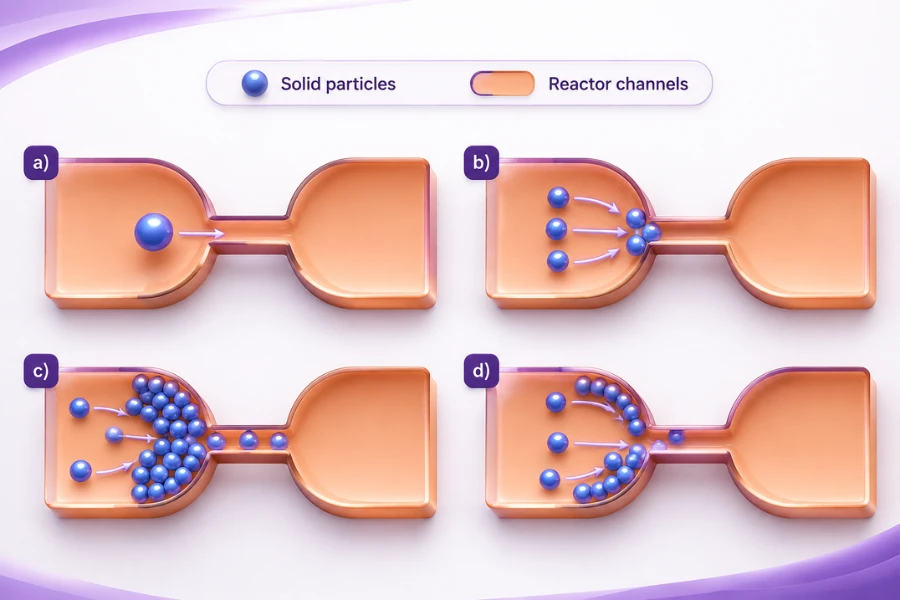
Clogging refers to an obstruction that restricts or blocks flow through a channel or fitting. It may result from particle bridging, size exclusion, or localized accumulation.
Fouling refers to the progressive accumulation of material on reactor surfaces, which changes channel geometry, heat transfer, and hydraulic resistance.
Jamming occurs when particle concentration and interactions become sufficiently high to prevent effective movement within the flowing suspension.
These mechanisms can produce different pressure and flow responses, requiring different monitoring and maintenance strategies.
Microchannel reactors may be particularly sensitive to particulate accumulation because small internal dimensions can restrict flow when deposits develop. Tubular and packed-bed systems also require fouling assessment, although their tolerance for solids depends on geometry and operating conditions.
Diprima, Anwar, and Noël (2026), in Overcoming the Achilles Heel of Flow Chemistry: Strategies for Solid Handling in Heterogeneous Continuous-Flow Reactors, identify particle deposition, blockage, and hydrodynamic instability as important barriers to reliable heterogeneous flow processing.
Fouling Monitoring and Maintenance Strategy
Pressure drop is a useful indicator of changes in hydraulic resistance.
A gradual increase may indicate progressive deposition, while fluctuating pressure drop may suggest intermittent bridging or unstable particle accumulation.
Engineers should evaluate pressure trends alongside flow rate, operating time, feed properties, and product consistency.
Maintenance planning should consider:
- Accessibility of reactor channels and fittings
- Compatibility of cleaning methods with construction materials
- Potential changes in surface condition after cleaning
- Frequency and duration of cleaning interruptions
- Availability of inspection and replacement components
A cleaning strategy must be compatible with the chemical system and the equipment design. It should not assume that all deposits can be removed through a single universal procedure.
For commercial systems, maintenance requirements directly influence equipment availability, production continuity, and lifecycle cost.
Risk Transfer Across Process Units
Reducing hazardous inventory inside the reactor does not eliminate risks elsewhere in the manufacturing system.
Continuous processing changes how materials move through the plant, making feed preparation, pumps, transfer lines, pressure equipment, and downstream units important parts of the safety assessment.
| Process unit | Important risk considerations |
|---|---|
| Feed preparation | Chemical compatibility, storage inventory, and feed consistency |
| Pumps and transfer lines | Leakage, flow interruption, and pressure changes |
| Reaction zone | Heat accumulation, flow deviation, and reaction instability |
| Gas-liquid separation | Gas accumulation, pressure control, and phase separation |
| Product collection | Residual reactivity and downstream material inventory |
| Waste treatment | Residual oxidants, reactive byproducts, and chemical compatibility |
HAZOP and Layer of Protection Analysis can help identify hazardous scenarios and evaluate the need for safeguards.
Depending on the process, additional measures may include pressure relief, emergency isolation, shutdown functions, and monitoring of critical process variables.
The required protective measures must follow the specific process hazard assessment rather than rely on low reactor volume as the sole safety argument.
Process Monitoring and Safety Interlocks
Continuous production requires monitoring of variables that influence reaction stability and equipment integrity.
Temperature, pressure, and flow measurements can identify abnormal heat generation, equipment restrictions, feed interruption, and other process deviations.
Depending on the hazard assessment, the system may require high-temperature protection, pressure monitoring, low-flow detection, emergency isolation, and controlled shutdown functions.
Safety instrumented functions should be evaluated separately from ordinary process control, with their design based on required risk reduction and the independence of protective layers.
Management of change is also necessary when feed composition, equipment configuration, operating conditions, or procedures are modified.
Downstream Separation and Purification
Reaction conversion and product yield do not determine overall manufacturing performance.
Reaction streams may contain residual reagents, solvents, catalysts, byproducts, or multiple product phases. These components must be managed to meet final product specifications.
Depending on the chemistry, downstream processing may involve liquid-liquid extraction, phase separation, distillation, solvent recovery, crystallization, and other purification operations.
For gas-containing reaction streams, appropriate gas-liquid separation equipment may also be relevant, depending on process pressure, phase properties, and separation requirements.
The appropriate separation strategy depends on product properties, impurity behavior, phase equilibrium, and purity requirements.
When multiple reaction stages are connected, impurities from one stage may interfere with downstream transformations or increase purification requirements. Reaction and separation should therefore be evaluated as an integrated manufacturing system.
From Pilot Validation to Commercial Production
Sizing-Up, Numbering-Up, and Scale-Up Constraints
Two common strategies for increasing continuous flow production capacity are sizing-up and numbering-up.
Sizing-up increases the dimensions or capacity of an individual reactor. Numbering-up increases throughput by operating multiple reactor modules in parallel.
| Evaluation factor | Sizing-Up | Numbering-Up |
|---|---|---|
| Reactor configuration | Increases individual reactor dimensions | Uses multiple parallel modules |
| Heat transfer | Requires validation at larger dimensions | Requires consistency across modules |
| Flow distribution | Requires evaluation of internal flow behavior | Requires balanced parallel branches |
| Pressure drop | Changes with geometry and operating conditions | Depends on branch resistance and distribution |
| Maintenance | May involve larger individual equipment | Involves more modules and connections |
| Production expansion | Depends on equipment capacity | Depends on module and distribution capacity |
Sizing-up can simplify equipment arrangements but may change heat transfer, mixing, and flow behavior.
Numbering-up can preserve selected characteristics of an established reactor design, but unequal flow distribution may create different residence times and reaction conditions across parallel modules.
Multiphase systems introduce further complications because gas and liquid may not distribute uniformly across parallel branches.
The appropriate scale-up strategy depends on reaction kinetics, reactor geometry, phase behavior, throughput requirements, and production economics.
Pilot-Scale Process Validation
Pilot validation determines whether laboratory process performance can be reproduced under representative operating conditions at a larger scale.
It should address more than conversion and yield.
| Validation area | What needs to be established |
|---|---|
| Reaction performance | Conversion, selectivity, and impurity profile |
| Thermal performance | Heat removal capacity and temperature stability |
| Residence-time behavior | Actual RTD and exposure-time consistency |
| Hydraulic performance | Pressure drop and flow distribution |
| Materials compatibility | Suitability of wetted materials, seals, and pumps |
| Fouling and cleaning | Long-term flow stability and maintenance requirements |
| Product quality | Consistency of final product specifications |
| Downstream integration | Compatibility with separation, purification, and solvent recovery |
Short laboratory runs may demonstrate technical feasibility, but they cannot independently establish long-term industrial reliability.
Pilot testing should generate the engineering data required for equipment sizing, process control, safety evaluation, and commercial design.
Commercial Feasibility and Lifecycle Economics
Technical feasibility does not automatically establish commercial feasibility.
A continuous flow process may improve thermal management and reduce active reaction inventory while requiring investment in pumps, heat exchange systems, instrumentation, automation, and downstream equipment.
Economic evaluation should include:
- Reactor and auxiliary equipment capital costs
- Pumping and utility consumption
- Equipment maintenance and cleaning
- Catalyst replacement where applicable
- Production uptime and equipment availability
- Downstream separation and purification costs
- Waste treatment requirements
- Product value and required production volume
Continuous processing may be attractive for high-value chemicals, hazardous reactions with substantial batch inventory, and processes where improved heat or mass transfer provides measurable production benefits.
Batch processing may remain economically preferable for low-volume production, frequently changing product portfolios, or systems with difficult solid handling and cleaning requirements.
The decision should reflect total manufacturing economics rather than reactor performance alone.
DODGEN Continuous Flow Reactor Technology
DODGEN provides industrial continuous flow reactor equipment, including micro reactors, static mixers, polymerization reactors, and heat exchangers.
Its D-AMERT high-flux micro reactor uses engineered internal elements to create micron-scale reaction interfaces within millimeter-scale flow passages. The design combines metered feed delivery, temperature control, internal fluid distribution, and modular equipment configuration.
These characteristics address several engineering considerations associated with industrial microreaction technology, including mixing, heat transfer, throughput, and equipment cleaning.
DODGEN also offers static mixers for high-viscosity systems. Their application should be evaluated according to fluid rheology, flow distribution, pressure drop, and the mixing requirements of the process.
These equipment categories provide different engineering functions. A micro reactor is relevant when reaction and transport characteristics benefit from its internal flow structure, while a static mixer addresses mixing within a defined flow path.
Neither equipment type should be assumed suitable for every hazardous reaction without evaluating the actual chemistry, phase behavior, materials compatibility, pressure requirements, and operating conditions.
DODGEN’s continuous flow reactor portfolio can serve as a starting point for evaluating equipment configurations within a broader industrial process design.
How to Evaluate a Continuous Flow Process for Hazardous Chemistry
Before converting an existing hazardous reaction from batch to continuous processing, engineers should evaluate the chemistry, reactor configuration, and complete manufacturing system.
| Evaluation area | Key engineering question |
|---|---|
| Reaction kinetics | Can the reaction operate within a suitable continuous processing window? |
| Thermal behavior | Can the system manage heat generation and credible deviations? |
| Hazardous inventory | How much reactive material is present across the complete process? |
| Reactor configuration | Which structure matches the reaction phase and transport requirements? |
| Materials compatibility | Can wetted components withstand the complete chemical environment? |
| Residence-time behavior | Does actual RTD support reaction performance and intermediate stability? |
| Mass transfer | Are interphase transport limitations controlling the reaction rate? |
| Fouling potential | Can the system maintain reliable flow during extended operation? |
| Process monitoring | Are critical variables and abnormal conditions adequately detected? |
| Separation requirements | Can downstream equipment deliver the required product quality? |
| Scale-up feasibility | Can pilot results be reproduced at the intended production capacity? |
| Process economics | Are equipment, maintenance, utilities, and operating costs commercially appropriate? |
These criteria must be evaluated together. A reactor may provide excellent heat transfer but remain unsuitable if precipitation causes persistent blockage. Similarly, high conversion may have limited commercial value if the resulting impurity profile makes downstream purification uneconomical.
The decision to adopt continuous flow technology should therefore balance process safety, reaction performance, equipment reliability, product quality, and total manufacturing economics.
Conclusion
Continuous flow reactors can improve the engineering management of hazardous chemical reactions through inventory minimization, controlled heat transfer, and more predictable material movement.
Their application requirements differ across reaction types. Nitration requires thermal management, reaction kinetics characterization, phase control, and selectivity assessment. Diazotization requires intermediate stability, phase-specific reactor selection, process monitoring, and controlled downstream integration. Oxidation frequently depends on the interaction between reaction kinetics, gas-liquid mass transfer, and oxidant management.
Industrial implementation requires more than selecting a reactor. Hydraulic performance, equipment reliability, downstream purification, pilot validation, and lifecycle economics must be evaluated as parts of one manufacturing system.
DODGEN‘s continuous flow reactor portfolio, including micro reactors and static mixers, provides equipment options for industrial process intensification. Selecting the appropriate configuration requires matching equipment characteristics with reaction kinetics, phase behavior, transport requirements, and operating conditions.
Planning to evaluate continuous flow technology for a hazardous chemical process? Contact DODGEN to discuss reactor configurations, process engineering requirements, and industrial equipment integration.
FAQs
Continuous flow reactors can reduce active reaction inventory and improve heat and mass transfer compared with many conventional batch configurations. These characteristics can help manage exothermic reactions, unstable intermediates, and hazardous reagents. Their suitability depends on reaction chemistry, reactor configuration, process monitoring, and a system-level safety assessment.
Continuous flow reactors can offer safety advantages through inventory minimization and improved thermal management. However, pumps, connecting lines, pressure systems, blockages, and downstream equipment introduce additional hazards. A comprehensive assessment is necessary to determine whether the complete continuous process provides a meaningful safety improvement.
The main engineering difference concerns how reactants are introduced, mixed, and maintained under reaction conditions. Continuous flow systems provide opportunities for improved heat removal and reduced active reaction inventory. Batch processing offers flexibility, while continuous processing requires reliable flow control, phase management, and integrated equipment design.
Continuous flow processing can reduce the quantity of unstable diazonium intermediates present in the active reaction zone. It also supports controlled residence time and direct transfer to downstream transformations. Intermediate stability, transfer conditions, solid formation, and potential accumulation points must still be assessed across the complete process.
Industrial scale-up can involve increasing reactor dimensions or operating multiple parallel modules through numbering-up. Both approaches require validation of heat transfer, flow distribution, pressure drop, and product consistency. Pilot-scale testing establishes whether the process can maintain operating stability, equipment reliability, and downstream integration at the intended capacity.