Introduction
Polymerization is often described as a chemical reaction, yet successful industrial production depends on much more than reaction kinetics. As conversion increases and polymer chains grow, transport phenomena—including heat transfer, mass transfer, residence time distribution (RTD), and flow behavior—gradually become the dominant factors governing product quality, process stability, and plant productivity. In many commercial polymerization processes, these engineering constraints ultimately determine whether a laboratory formulation can be successfully scaled into a reliable manufacturing process.
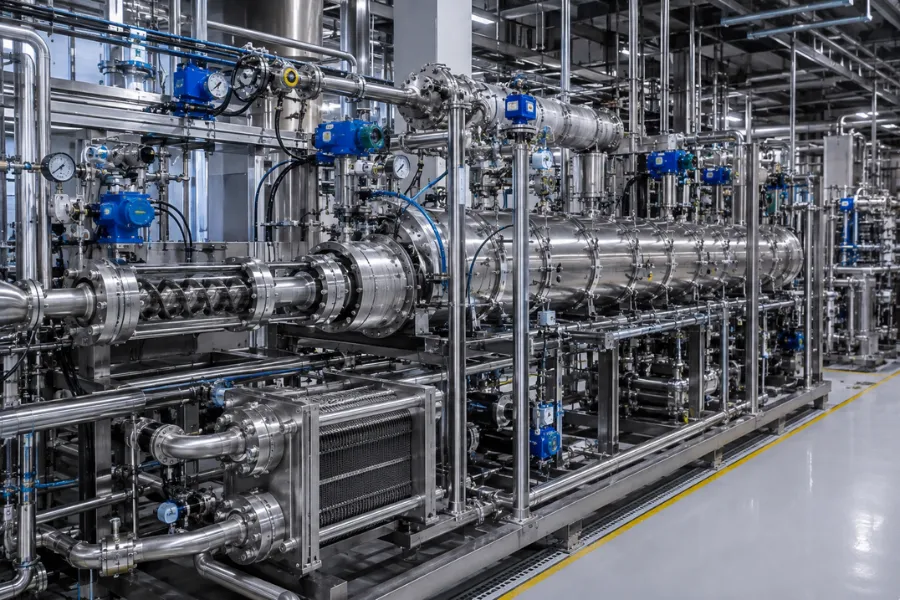
This challenge is particularly evident in highly exothermic systems such as free-radical polymerization used to manufacture LDPE, PVC, PS, PMMA, PVAc, and SBR. As polymer concentration rises, viscosity increases rapidly, molecular diffusion slows, and heat removal becomes progressively more difficult. Localized temperature gradients may accelerate reaction kinetics, while diffusion limitations and broad RTD can alter molecular weight distribution, branching behavior, and polymer microstructure. During commercial scale-up, these effects become even more pronounced because reactor volume increases faster than available heat-transfer surface area, making thermal management one of the primary engineering bottlenecks.
For decades, process optimization focused mainly on larger reactors or higher agitation power. Modern polymer reaction engineering, however, has shifted toward process intensification—an integrated strategy that improves transport efficiency rather than simply increasing equipment size. Instead of treating mixing as an isolated operation, process intensification combines reactor design, reactive mixing, heat-transfer enhancement, flow optimization, and continuous processing to maintain stable reaction environments throughout polymer production.
Static mixers are among the most mature and widely adopted process intensification technologies. Although often classified as motionless mixers for inline blending, their industrial value extends far beyond homogenizing fluids. By continuously redistributing flowing material, improving radial transport, enhancing heat exchange, and narrowing residence time distribution, static mixers help overcome many transport limitations that emerge during polymerization.
More importantly, static mixers should not be viewed as standalone equipment. Modern polymer plants frequently integrate them with tubular reactors, loop reactors, microreactors, reactive extrusion systems, advanced heat exchangers, and real-time monitoring technologies such as CFD-assisted design and Process Analytical Technology (PAT). Together, these technologies form a comprehensive engineering solution for safer operation, higher product consistency, and more reliable commercial deployment.
This article explores why polymerization quickly becomes an engineering challenge beyond simple mixing, how process intensification addresses these limitations, and why static mixers have become an essential component of modern polymer manufacturing rather than merely an inline mixing device.
Why Polymerization Becomes an Engineering Challenge Beyond Mixing
Many discussions about polymerization equipment begin with mixing efficiency. In industrial reality, however, inadequate mixing is rarely the root cause of process limitations. As polymerization proceeds, reaction kinetics become increasingly coupled with transport phenomena, requiring engineers to simultaneously control temperature, viscosity, diffusion, flow distribution, and residence time rather than optimizing a single operating parameter.
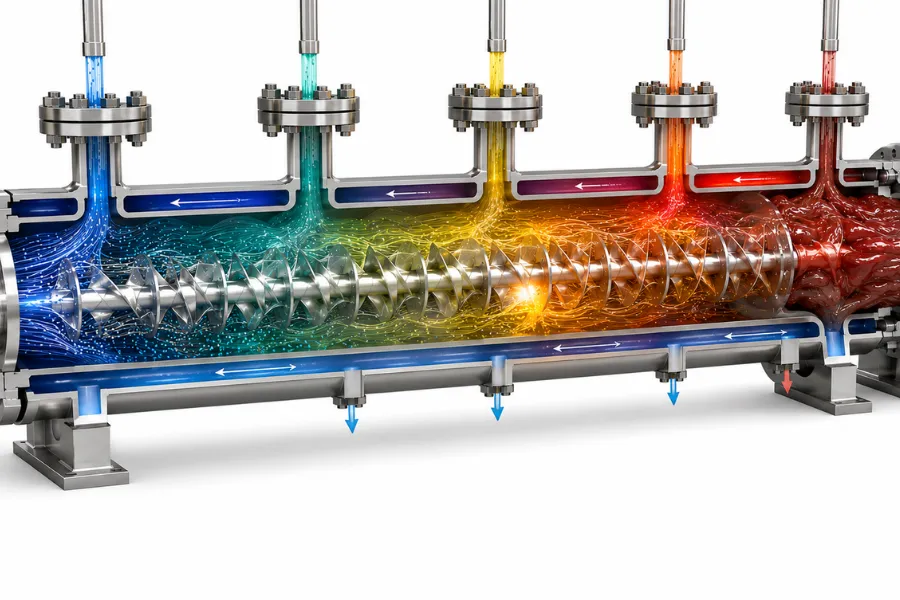
Heat generation is usually the first major challenge. Most polymerization reactions are highly exothermic, and heat-release rates accelerate as conversion increases. When heat removal cannot keep pace with reaction kinetics, localized temperature increases further accelerate polymerization, creating a positive feedback loop. In free-radical polymerization, this phenomenon is commonly associated with the gel effect (Trommsdorff effect), where reduced chain mobility suppresses termination reactions, increases radical concentration, and dramatically accelerates polymerization. Without adequate thermal management, these conditions may result in molecular weight variability, polymer degradation, or even thermal runaway.
At the same time, increasing viscosity fundamentally changes reactor hydrodynamics. Higher viscosity weakens convection, slows diffusion, and reduces the effectiveness of conventional agitation. Even well-designed reactors may develop localized temperature gradients or concentration differences, causing different regions of the reactor to experience different reaction histories.
Residence time distribution introduces another engineering challenge. A broad RTD means portions of the reacting material remain inside the reactor for significantly different durations. Since molecular weight, branching, and conversion continue evolving throughout residence, excessive RTD broadening produces wider molecular weight distributions and less consistent polymer properties. This is especially critical in continuous polymerization, where product quality depends on maintaining nearly identical thermal and reaction histories for every material element.
Mass-transfer limitations become equally important as viscosity rises. Initiators, catalysts, comonomers, and additives may not disperse uniformly before significant reaction occurs. Poor micromixing can generate localized overreaction, compositional drift, or uneven branching, while insufficient radial transport further amplifies these differences during commercial production.
These coupled transport limitations explain why successful polymerization cannot be achieved simply by increasing agitation intensity. Instead, engineers seek to improve overall transport efficiency—balancing heat transfer, mass transfer, RTD, pressure drop, and viscosity management throughout the process.
| Engineering Challenge | Typical Industrial Consequence |
|---|---|
| Insufficient heat removal | Hot spots, thermal runaway risk, polymer degradation |
| Increasing viscosity | Reduced heat and mass transfer efficiency |
| Broad residence time distribution | Wider molecular weight distribution and inconsistent polymer quality |
| Poor micromixing | Uneven initiator or catalyst distribution, side reactions |
| Diffusion limitations | Lower conversion efficiency at high solids content |
| Fouling and wall deposits | Reduced heat-transfer coefficient and unstable long-term operation |
These engineering challenges become even more significant during industrial scale-up. Laboratory reactors often maintain excellent thermal control because of their high surface-area-to-volume ratio, but commercial reactors behave very differently. Larger equipment is more susceptible to thermal gradients, dead zones, fouling, and RTD broadening, making process debottlenecking and transport optimization essential parts of engineering integration rather than optional process improvements.
Industrial Insight
Commercial LDPE production illustrates this challenge well. As conversion increases, viscosity rises rapidly while heat generation accelerates, making thermal control far more important than simply increasing agitation power. Modern polymer plants therefore rely on integrated process intensification strategies—including optimized reactor configuration, enhanced heat-transfer systems, and static mixers—to stabilize transport phenomena before focusing on higher production rates. This engineering-first approach forms the foundation of successful process validation, pilot-to-commercial scale-up, and long-term production reliability.
Process Intensification: A Broader Strategy Than Static Mixing
Static mixers are often regarded as standalone mixing devices, but this perspective overlooks their real engineering value. In modern polymer manufacturing, they represent just one component of a much broader process intensification (PI) strategy. The objective of PI is not simply to improve blending, but to redesign transport processes so that reaction kinetics, heat transfer, mass transfer, and flow behavior remain balanced throughout the entire polymerization process.
Traditional scale-up typically relies on larger stirred vessels or higher agitation power to increase production capacity. While these approaches may improve bulk circulation, they rarely eliminate the transport limitations created by increasing viscosity and reactor size. As the surface-area-to-volume ratio decreases, heat removal becomes progressively less efficient, residence time distribution widens, and localized concentration gradients become more difficult to control. Eventually, these transport phenomena—not reaction kinetics—become the primary constraints on productivity and product consistency.
Process intensification addresses these bottlenecks by integrating multiple engineering solutions rather than relying on a single reactor or mixer. Depending on the polymerization mechanism, engineers may combine motionless mixers, tubular reactors, loop reactors, microreactors, static mixer reactors (SMRs), reactive extrusion systems, intensified heat exchangers, and advanced process control technologies into one coordinated production system.
Instead of viewing mixing as an isolated operation, process intensification simultaneously optimizes several engineering objectives:
- Enhance heat removal during highly exothermic polymerization.
- Narrow residence time distribution for consistent molecular weight development.
- Improve micromixing to reduce concentration gradients.
- Increase radial transport in high-viscosity polymer systems.
- Support stable continuous polymerization with predictable product quality.
- Enable process debottlenecking and more efficient industrial scale-up.
- Simplify engineering integration between reaction, separation, and downstream processing.
As polymer production shifts toward continuous manufacturing, process intensification has become less of an equipment choice and more of a process-development philosophy. It enables engineers to achieve higher productivity, improved safety, and greater operational flexibility without proportionally increasing plant size.
Polymerization Bottlenecks and Process Intensification Strategies
| Engineering Bottleneck | Industrial Impact | Typical Process Intensification Strategy |
|---|---|---|
| Insufficient heat removal | Hot spots, runaway risk | Static mixer reactors, multitube heat-transfer reactors |
| Broad RTD | Molecular weight variability | Tubular reactors, static mixers, plug-flow designs |
| High viscosity | Poor radial transport | Motionless mixers, reactive extrusion, SMRs |
| Slow mass transfer | Uneven conversion | Microreactors, inline static mixing |
| Catalyst or initiator maldistribution | Product inconsistency | Reactive mixing and optimized feed injection |
| Long production campaigns | Fouling and reduced efficiency | Continuous inline processing and debottlenecking strategies |
Process Intensification Decision Flow
Identify the Primary Process Limitation
                │
                ▼
 Is heat removal the bottleneck?
                │
      Yes ─────────────► Static Mixer Reactor
                │
               No
                ▼
 Is residence time distribution critical?
                │
      Yes ─────────────► Tubular Reactor / Static Mixer
                │
               No
                ▼
 Is viscosity increasing rapidly?
                │
      Yes ─────────────► Reactive Extruder / Motionless Mixer
                │
               No
                ▼
 Is reaction extremely fast or highly exothermic?
                │
      Yes ─────────────► Microreactor
                │
               No
                ▼
 Optimize reactor configuration and process integration
This engineering-first workflow illustrates that equipment selection should always follow process analysis rather than equipment preference. Selecting the right PI technology begins with identifying the dominant transport limitation that restricts process performance.
Industrial Insight
A good example is PET production. During the final stages of melt polycondensation, reaction rates become increasingly limited by the removal of volatile by-products rather than by chemical kinetics alone. Modern PET plants therefore combine efficient devolatilization, thin-film or disc reactors, and optimized thermal management instead of simply increasing agitation intensity. This demonstrates that successful process intensification is fundamentally about eliminating the process bottleneck rather than maximizing mixing energy.
How Static Mixers Improve Polymerization Performance
Among all process intensification technologies, static mixers remain one of the most practical solutions because they improve several transport phenomena simultaneously while requiring no rotating mechanical components. Their contribution extends far beyond blending fluids. In polymerization, they enhance heat transfer, flow distribution, residence time control, and reactive mixing, allowing reactors to maintain stable operating conditions as viscosity increases.
Unlike conventional stirred vessels, where energy is introduced only near rotating impellers, static mixers continuously divide, rotate, and recombine flowing material throughout the process line. This repeated redistribution increases radial transport, minimizes stagnant regions, and creates more uniform thermal and concentration fields without adding moving parts. These characteristics make static mixers particularly valuable in continuous polymerization systems where consistency is more important than peak turbulence.
Enhancing Heat Transfer in Exothermic Polymerization
Most polymerization reactions release significant amounts of heat. As viscosity increases, conventional convection becomes less effective, allowing localized temperature increases to accelerate reaction kinetics.
Static mixing elements repeatedly move material between the reactor wall and the core flow, increasing radial heat transport and improving overall heat-transfer coefficients. More uniform temperature profiles help suppress the gel effect, reduce thermal degradation, and maintain stable polymer growth throughout continuous operation.
For highly exothermic LDPE production, this enhanced thermal uniformity contributes directly to safer operation and more consistent polymer quality.
Narrowing Residence Time Distribution
Residence time distribution has a direct influence on polymer microstructure. Materials experiencing different residence times also experience different thermal histories, resulting in broader molecular weight distributions and variable polymer properties.
Static mixers reduce bypass flow, dead zones, and axial dispersion, creating flow behavior that more closely approaches plug-flow conditions. Narrower RTD improves conversion consistency and helps produce polymers with more uniform molecular weight distributions.
This is particularly important in continuous polyolefin production, where stable RTD contributes to more consistent catalyst utilization and improved product reproducibility.
Improving Micromixing and Reactive Mixing
Uniform distribution of initiators, catalysts, chain-transfer agents, and comonomers becomes increasingly difficult as viscosity rises.
Static mixers significantly improve micromixing, allowing additives to disperse before substantial reaction occurs. Better reactive mixing reduces concentration gradients, minimizes localized side reactions, and improves control over branching and polymer microstructure.
For polypropylene (PP) impact copolymer production, where reactor hydrodynamics strongly influence polymer morphology and phase distribution, maintaining stable transport conditions is often more important than maximizing mixing intensity alone.
Supporting Continuous Polymer Manufacturing
Continuous production requires every material element to experience nearly identical process conditions.
Static mixers support this objective by maintaining stable radial transport while integrating easily with tubular reactors, loop reactors, inline dosing systems, devolatilization units, and downstream processing equipment. Their compact geometry also simplifies engineering integration, making them valuable components of larger continuous manufacturing systems rather than isolated mixing devices.
Why Static Mixers Are More Than Mixing Devices
From an engineering standpoint, static mixers simultaneously:
- Improve radial heat and mass transfer.
- Enhance reactive mixing under high-viscosity conditions.
- Narrow residence time distribution.
- Reduce concentration gradients and side reactions.
- Improve continuous processing stability.
- Support process validation during pilot and commercial scale-up.
- Complement CFD-based reactor optimization and PAT-enabled process monitoring.
Their widespread adoption across polymer manufacturing demonstrates that their greatest contribution is not mechanical mixing itself, but improving the transport phenomena that ultimately determine reaction stability, product consistency, and successful industrial commercialization.
Industrial Insight
Commercial polyolefin plants rarely install static mixers simply to “improve mixing.” Instead, they are introduced where better radial transport, narrower RTD, or improved temperature uniformity can remove production bottlenecks. When combined with CFD analysis during design and PAT during operation, static mixers become part of a broader process intensification strategy that supports reliable continuous manufacturing, consistent product quality, and long-term operational stability.
Comparing Process Intensification Equipment for Polymerization
Although static mixers are among the most widely adopted process intensification technologies, they are rarely the only solution in commercial polymer manufacturing. Every polymerization route presents different transport limitations, and successful equipment selection depends on identifying the dominant engineering constraint rather than choosing the most sophisticated reactor.
For example, highly exothermic free-radical polymerization prioritizes rapid heat removal, while bulk polymerization must cope with continuously increasing viscosity. Polyolefin production emphasizes catalyst utilization and residence time distribution, whereas condensation polymerization often becomes limited by volatile by-product removal. These differences explain why modern polymer plants increasingly integrate multiple process-intensification technologies instead of relying on a single reactor configuration.
The objective is always the same: improve transport phenomena so that reaction kinetics can proceed under stable, controllable conditions throughout commercial production.
Comparison of Common Process Intensification Technologies
| Technology | Typical Polymerization Application | Primary Engineering Strength | Typical Limitation |
|---|---|---|---|
| Static Mixer (Motionless Mixer) | Inline reactive mixing, continuous polymerization | Enhanced radial mixing, improved heat transfer, narrower RTD | Additional pressure drop |
| Static Mixer Reactor (SMR) | Bulk and melt polymerization | Simultaneous reaction and heat removal | More complex reactor design |
| Tubular Reactor | Continuous free-radical polymerization | Near plug-flow behavior, stable RTD | Fouling under high-viscosity conditions |
| Loop Reactor | Polyethylene and polypropylene production | Excellent circulation, efficient catalyst utilization | Larger circulation system |
| Microreactor | Fast or highly exothermic reactions | Outstanding heat and mass transfer | Limited throughput for commodity polymers |
| Reactive Extruder | High-viscosity and condensation polymerization | Mixing, devolatilization, reactive processing | Higher mechanical complexity |
Rather than competing with one another, these technologies complement each other. A commercial polymerization line frequently combines static mixers, tubular reactors, heat exchangers, devolatilization units, and advanced control systems into a single integrated process.
Matching Equipment to Polymerization Mechanisms
Different polymerization mechanisms require different engineering priorities.
Free-radical polymerization is dominated by heat release and viscosity growth. Equipment capable of maintaining efficient heat transfer and stable temperature profiles is essential for suppressing the gel effect, minimizing molecular weight variation, and preventing thermal runaway.
Bulk polymerization becomes increasingly transport-limited as polymer melts thicken. Static mixer reactors and reactive extrusion systems improve radial transport, reduce thermal gradients, and maintain more uniform conversion where conventional impellers lose efficiency.
Polyolefin production, including HDPE, LLDPE, and polypropylene, introduces additional complexity because catalyst behavior, particle morphology, and RTD directly influence molecular weight distribution, comonomer incorporation, and final mechanical properties. Commercial loop reactors are widely adopted because continuous circulation improves temperature control while maintaining catalyst productivity under high-throughput operation. Static mixers are frequently installed in auxiliary process sections to improve additive dispersion, stabilize feed distribution, and support continuous downstream processing.
Condensation polymerization, represented by PET and nylon, follows a different engineering philosophy. Here, the limiting factor is often the removal of volatile by-products such as water, methanol, or glycols rather than reaction kinetics themselves. Consequently, process intensification focuses on devolatilization, thin-film formation, gas-liquid mass transfer, and residence time optimization instead of increasing mixing intensity alone.
These examples demonstrate that effective polymer process optimization begins by identifying the governing transport limitation before selecting equipment.
Industrial Insight
Commercial polymer plants rarely purchase equipment because it is considered “advanced.” Instead, engineers first determine whether heat transfer, RTD, viscosity, mass transfer, or volatile removal limits production. Only then do they select the appropriate combination of reactors, motionless mixers, devolatilization systems, and downstream equipment. This engineering-driven approach explains why successful process development focuses on eliminating bottlenecks rather than maximizing individual equipment performance.
Engineering Trade-Offs in Static Mixer Selection
While static mixers offer significant advantages for polymerization process intensification, they are never selected solely for their mixing capability. Every design decision involves balancing transport improvement against hydraulic performance, operational reliability, maintenance requirements, and lifecycle cost.
One of the first considerations is pressure drop. Increasing the number of mixing elements generally enhances radial transport and thermal homogenization, but also increases hydraulic resistance. In high-viscosity polymer systems, excessive pressure loss raises pumping energy, increases operating costs, and may limit production capacity.
Heat-transfer enhancement presents another engineering trade-off. Better radial transport improves wall heat transfer and reduces temperature gradients, but additional mixing elements eventually produce diminishing returns once heat-transfer resistance shifts from the fluid to the reactor wall or cooling medium. Beyond this point, increasing mixing intensity adds energy consumption without proportional thermal benefit.
Viscosity evolution further complicates equipment selection. Polymer melts often exhibit dramatic rheological changes as conversion increases. A static mixer that performs efficiently during early-stage polymerization may generate substantially higher pressure losses near the reactor outlet. Consequently, engineers evaluate mixer performance across the complete viscosity profile instead of a single operating condition.
Long-term plant operation introduces additional challenges. Polymer deposition, fouling, and gradual pressure-drop increases can reduce heat-transfer efficiency and interrupt production campaigns. Equipment selection therefore considers not only mixing performance but also maintenance accessibility, cleaning procedures, and long-term operational reliability.
Modern engineering teams increasingly use CFD simulations during reactor design to predict flow distribution, pressure drop, and thermal performance before construction. During plant operation, PAT (Process Analytical Technology) provides continuous monitoring of process variables, allowing operators to detect transport deviations early and improve process validation during scale-up and commercial production.
Engineering Trade-Off Matrix
| Design Objective | Engineering Benefit | Engineering Trade-Off |
|---|---|---|
| Stronger radial mixing | Better heat and mass transfer | Higher pressure drop |
| More mixing elements | Narrower RTD and improved conversion consistency | Greater pumping energy |
| Enhanced heat removal | Lower hot-spot and gel-effect risk | More complex thermal design |
| Compact reactor volume | Higher space-time yield | Reduced maintenance accessibility |
| Aggressive process intensification | Increased productivity | Greater sensitivity to fouling and hydraulic resistance |
| Higher process integration | Better overall plant efficiency | More demanding system optimization |
The most successful polymerization projects therefore optimize the entire process instead of maximizing any single parameter. Heat transfer, RTD, pressure drop, viscosity evolution, and maintenance strategy are evaluated together to achieve the best balance between productivity, product quality, safety, and operating cost.
Industrial Insight
Many industrial polymer projects achieve their largest performance improvements through process debottlenecking rather than installing entirely new reactors. Optimizing static mixer geometry, refining feed injection locations, integrating CFD-guided flow design, and validating operating conditions through PAT often deliver greater long-term benefits than simply increasing mixing intensity. This systems-level perspective is a defining characteristic of modern polymer reaction engineering and one of the key reasons process intensification has become central to commercial polymer manufacturing.
Scale-Up Considerations for Polymerization Process Intensification
A process intensification strategy that performs well in a laboratory reactor does not automatically deliver the same results in commercial production. Polymerization scale-up is fundamentally an engineering challenge rather than a geometric one. As reactor size increases, heat transfer, flow behavior, pressure drop, viscosity evolution, and residence time distribution all change simultaneously. These coupled transport phenomena often become the primary barriers to successful commercialization.
One of the most significant challenges is the decline in heat-transfer efficiency. Reactor volume increases much faster than available heat-transfer surface area, reducing the surface-area-to-volume ratio. At the same time, polymer viscosity rises continuously during conversion, weakening convective heat transfer and making localized hot spots increasingly difficult to eliminate. In highly exothermic systems, inadequate thermal management can trigger the gel effect, broaden molecular weight distribution, accelerate degradation, or even initiate thermal runaway.
Flow behavior also evolves during scale-up. Larger equipment is more susceptible to dead zones, channeling, and RTD broadening. Material passing through different flow paths experiences different thermal histories, directly influencing polymer molecular weight, branching, crystallinity, and final mechanical performance. These effects are rarely visible in laboratory experiments but become critical during commercial production.
Another practical consideration is continuous operation. Unlike laboratory reactors operating for several hours, industrial polymer plants often run continuously for weeks or months. During these campaigns, polymer deposition, fouling, increasing pressure drop, and declining heat-transfer coefficients gradually reduce process performance. Consequently, successful process intensification must be evaluated over the entire production cycle rather than only at start-up conditions.
For this reason, industrial scale-up increasingly combines experimental validation with digital engineering tools. CFD supports reactor and mixer optimization before construction, while PAT (Process Analytical Technology) continuously monitors critical process variables during production. Together with pilot testing and process validation, these tools improve design confidence and reduce technical risks before full commercial deployment.
Scale-Up Checklist for Process Intensification
Before implementing static mixers or other process intensification technologies in commercial polymerization, engineers typically evaluate the following factors:
| Engineering Evaluation | Primary Objective |
|---|---|
| Heat-transfer capability | Maintain stable temperature throughout conversion |
| Residence time distribution | Achieve consistent molecular weight and polymer properties |
| Pressure-drop prediction | Verify hydraulic stability and pumping requirements |
| Viscosity evolution | Maintain transport efficiency throughout polymerization |
| Fouling tendency | Preserve long-term heat-transfer performance |
| Equipment maintainability | Minimize cleaning time and production downtime |
| Pilot-scale validation | Reduce scale-up uncertainty before commercialization |
| CFD and PAT integration | Support continuous monitoring and process optimization |
These evaluations demonstrate that successful scale-up depends less on increasing production capacity than on preserving transport behavior. Process intensification therefore becomes an essential component of process development, ensuring that laboratory performance can be reproduced consistently at industrial scale.
Industrial Insight
The evolution of Borstar® polyethylene technology provides a representative example of engineering-driven scale-up. Rather than relying on a single large reactor, the process combines loop and gas-phase reactors to optimize molecular weight distribution, comonomer incorporation, and heat management across multiple production stages. This illustrates how commercial polymerization increasingly depends on engineering integration between reactors and transport equipment rather than on individual unit performance.
Engineering Selection Guide for Different Polymerization Processes
Because every polymerization route presents different engineering challenges, there is no universal process intensification solution. Equipment selection should always begin by identifying the dominant transport limitation rather than selecting a reactor based on familiarity or capital cost.
The following guide summarizes common engineering priorities for representative polymerization processes.
| Polymerization Process | Primary Engineering Challenge | Recommended Process Intensification Strategy |
|---|---|---|
| Free-radical polymerization | Heat removal, gel effect, RTD control | Static mixers, tubular reactors, enhanced heat-transfer systems |
| Bulk polymerization | High viscosity and thermal gradients | Static mixer reactors, reactive extrusion, multitube reactors |
| Suspension polymerization | Phase dispersion and particle uniformity | Inline motionless mixers and optimized agitation |
| Emulsion polymerization | Micromixing and particle-size control | Static mixers, controlled feed systems, microreactors |
| Polyolefin production (PE/PP) | Catalyst utilization, RTD, particle morphology | Loop reactors, gas-phase reactors, integrated process systems |
| PET and condensation polymerization | Volatile removal and mass transfer | Devolatilization units, thin-film reactors, reactive extrusion |
Although the recommended technologies differ, their engineering objective remains remarkably consistent: remove transport bottlenecks before they become reaction limitations.
In practice, industrial polymer plants rarely depend on a single piece of equipment. Static mixers are frequently integrated with heat exchangers, tubular reactors, devolatilization systems, online monitoring, and advanced control platforms to form a coordinated process. This systems-level approach improves product consistency, increases operational flexibility, and shortens the path from laboratory development to commercial production.
Process Selection Principles
When selecting process intensification equipment, engineers typically follow four sequential questions:
- What is the dominant transport limitation?
Heat transfer, viscosity, RTD, mass transfer, or volatile removal? - Which technology removes that bottleneck most effectively?
Static mixer, loop reactor, microreactor, reactive extruder, or another intensified process? - Can the solution remain stable during commercial operation?
Evaluate fouling, maintenance, pressure drop, and operational reliability. - Can the process be validated and monitored continuously?
Combine pilot testing, CFD analysis, PAT, and process validation before full industrial deployment.
Following this engineering workflow enables process developers to optimize the entire polymer manufacturing system instead of individual pieces of equipment.
Conclusion
Modern polymerization is no longer governed solely by reaction chemistry. As conversion increases and viscosity evolves, transport phenomena—including heat transfer, mass transfer, residence time distribution, and flow behavior—become the dominant factors influencing product quality, operational safety, and commercial scalability.
Within this broader engineering framework, static mixers contribute far more than fluid blending. They enhance radial transport, improve heat removal, narrow RTD, stabilize reactive mixing, and support continuous polymer manufacturing. However, their greatest value is realized when they are integrated with complementary process intensification technologies such as tubular reactors, loop reactors, reactive extrusion systems, advanced heat exchangers, and digital engineering tools.
Ultimately, successful polymer reaction engineering is not about selecting a single high-performance device. It is about building an integrated process capable of maintaining stable transport behavior from laboratory research through pilot testing and full-scale commercial production. Companies that adopt this systems-engineering approach are better positioned to improve product consistency, reduce operational risk, accelerate commercial deployment, and achieve long-term manufacturing competitiveness.
As polymer materials continue to evolve toward higher performance and more demanding processing requirements, process intensification will remain a cornerstone of industrial innovation. Static mixers are therefore best understood not as standalone mixing equipment, but as essential enablers of efficient, scalable, and sustainable polymer manufacturing.