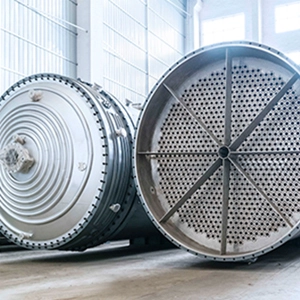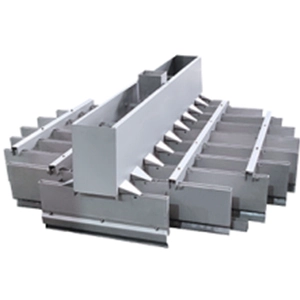
Sorbitol dehydration to isosorbide proceeds through two sequential intramolecular dehydration steps, but high sorbitol conversion alone does not guarantee a selective or scalable process. Reactor conditions determine heat and mass transfer, water removal, and contact time, while catalyst properties influence both productive cyclodehydration and competing pathways.
The industrial objective is therefore not maximum conversion in isolation. It is to maintain an operating window in which sorbitan intermediates progress toward isosorbide without excessive oligomerization, color formation, or degradation that increases downstream purification requirements.
Why Sorbitol Conversion Does Not Equal Isosorbide Yield
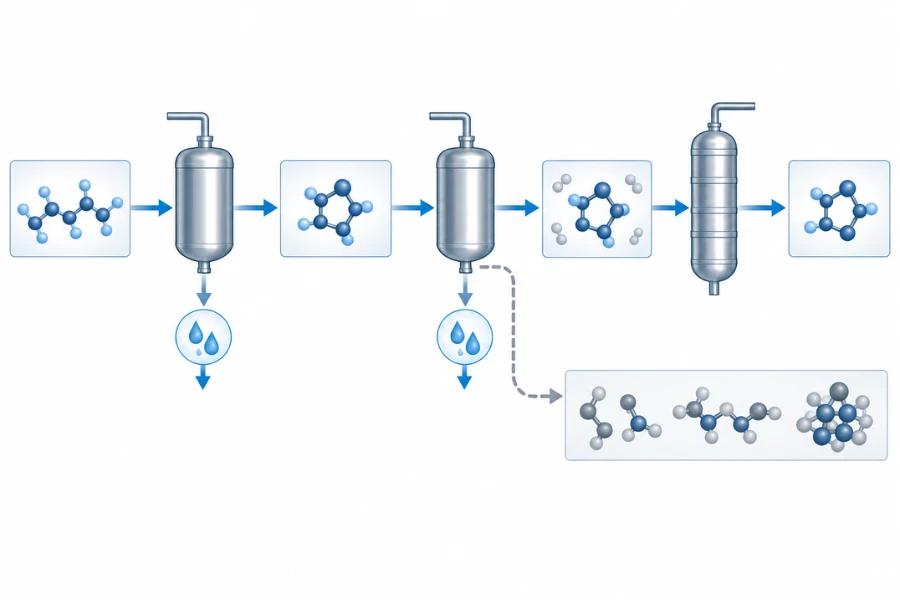
Sorbitol dehydration proceeds through sequential cyclodehydration rather than direct conversion in a single step. The principal productive pathways can be represented as:
Sorbitol → 1,4-sorbitan / 3,6-sorbitan → Isosorbide
The first dehydration can also produce mono-anhydrohexitols that do not proceed efficiently toward the desired bicyclic product. Pathway selectivity therefore begins with the first ring-closing reaction.
The second dehydration introduces another constraint. Sorbitol may be largely consumed while productive sorbitan intermediates remain incompletely converted, so conversion alone can overstate actual process performance.
Where Selectivity Is Lost
Several competing pathways can reduce isosorbide yield:
- formation of nonproductive mono-anhydrohexitols
- incomplete conversion of 1,4-sorbitan or 3,6-sorbitan
- oligomerization of dehydration products
- formation of heavy, colored humin-type materials
- secondary degradation under prolonged thermal and acid exposure
A reactor showing high sorbitol conversion but substantial sorbitan or heavy byproducts has solved feed conversion, not selective isosorbide production.
The more useful target is therefore high conversion within a controlled reaction-severity window, where productive intermediates continue toward isosorbide before secondary pathways become dominant.
Reactor Design Controls More Than Residence Time
Reactor configuration determines temperature history, mixing, water removal, catalyst contact, and residence-time distribution. These variables become increasingly coupled as sorbitol concentration rises and the reaction medium becomes more viscous.
Batch Vacuum Dehydration
Batch operation allows sorbitol to be heated under acidic conditions while vacuum assists water removal. As dehydration proceeds, however, removing water changes the total mass, volume, reactant concentration, and physical properties of the reaction mixture.
The reactor therefore operates under a nonconstant-volume reaction environment. Kinetic interpretation based only on the initial composition can become misleading when concentration and catalyst exposure evolve continuously during the batch.
Mixing is particularly important in concentrated or molten sorbitol. Increasing viscosity can produce transport limitations, temperature gradients, or nonuniform catalyst distribution, causing apparent kinetic behavior to include hydrodynamic effects.
During scale-up, reproducing the laboratory temperature set point is not enough. Mixing quality, heating profile, water-removal rate, and local reaction severity must remain within a comparable operating window.
Continuous-Flow Processing
Continuous-flow systems allow residence time and catalyst contact time to be defined more narrowly. With heterogeneous catalysts, fixed catalytic zones can also reduce downstream catalyst-separation requirements.
Published H-β zeolite studies under specific aqueous conditions have demonstrated that continuous operation can favor selective sorbitol dehydration while rapidly moving intermediates and products through the catalytic environment. This makes flow configuration relevant to reaction selectivity, not only throughput.
The engineering constraints also change. Pressure drop, catalyst shaping, flow distribution, fouling, hydrothermal stability, and long-term catalyst deactivation become central when operation shifts from short experiments to extended time on stream.
Batch vs. Continuous Is a Process Decision
Neither reactor configuration is universally superior. Selection depends on the dominant transport, catalyst, feed, and operating constraints.
| 공정 신호 | Batch Implication | Continuous-Flow Implication |
|---|---|---|
| High feed viscosity | Agitation and heat transfer become critical | Flow distribution and pressure drop require attention |
| Long catalyst contact | Secondary reactions can increase late in the batch | Contact time can be more narrowly controlled |
| Water generation | Vacuum or stripping must be integrated | Water and solvent behavior must be managed continuously |
| Solid catalyst use | Catalyst recovery is required | Fixed-bed operation may simplify separation |
| Variable feed conditions | Batch operation offers greater flexibility | Stable feed quality becomes more important |
| Scale-up requirement | Mixing and thermal similarity become difficult | Scale-out or reactor numbering may be possible |
The reactor should therefore be selected according to the mechanism limiting process performance rather than a general preference for batch or continuous production.
Catalyst Selection Is a Selectivity Problem
Acid catalysis promotes sorbitol cyclodehydration, but acid strength alone is an incomplete basis for catalyst selection.
Industrial evaluation must consider reaction rate, pathway selectivity, catalyst stability, corrosion, transport behavior, separation requirements, and recoverability.
Homogeneous Mineral Acids
Sulfuric acid and other mineral acids provide strong catalytic activity and direct contact with the liquid reaction phase, avoiding internal pore-diffusion limitations.
Their trade-offs appear in both equipment and downstream processing. Homogeneous acids can increase corrosion requirements and may require neutralization and removal before high-purity isosorbide recovery, adding salts and separation load to the process.
Increasing acid dosage also changes overall reaction severity. Faster sorbitol dehydration is useful only while the additional acid exposure does not disproportionately accelerate oligomerization or degradation.
Solid Acid Catalysts
Heterogeneous systems investigated for sorbitol dehydration include acidic ion-exchange resins, H-β zeolites, niobium-based materials, acidic carbons, and other metal oxide or phosphate catalysts.
잠재적인 장점으로는 다음과 같은 것들이 있습니다:
- easier catalyst-product separation
- catalyst recovery or regeneration
- compatibility with fixed-bed operation
- lower neutralization requirements
- integration with continuous processing
Performance depends on more than nominal acidity. Brønsted acid-site density, pore architecture, accessibility, surface properties, and hydrothermal stability influence whether sorbitol and sorbitan intermediates reach active sites and whether isosorbide leaves them without excessive secondary reaction.
Long-duration operation introduces another criterion: catalyst deactivation. A material with high initial activity may lose performance through fouling, structural changes, or instability in hot aqueous environments.
Why Catalyst Strength Alone Is the Wrong Metric
Catalyst activity must be matched with reactor transport and contact time.
Higher activity can accelerate:
Sorbitol → Sorbitan → Isosorbide
but excessive reaction severity can also promote:
Intermediates / Isosorbide → Oligomers → Heavy or Colored Byproducts
A more useful industrial evaluation is therefore:
Activity × Selectivity × Stability × Transport × Recoverability
Catalyst screening should consequently progress from initial conversion and yield toward impurity profiles, deactivation behavior, regeneration potential, and time-on-stream performance.
Water Removal Changes the Reaction Environment
Each cyclodehydration step generates water, making water management part of the reaction system rather than an independent utility operation.
Under vacuum batch conditions, water removal changes composition, volume, viscosity, effective catalyst concentration, and heat-transfer behavior as the reaction progresses. In continuous systems, water or solvent conditions also influence catalyst exposure, phase behavior, and the environment around active sites.
Water removal must therefore be evaluated together with temperature, residence time, catalyst loading, and feed concentration. These variables collectively define the operating window and reaction severity experienced by sorbitol, intermediates, and isosorbide.
Aggressive water removal is not automatically optimal under every process configuration. Its value depends on how the resulting concentration and transport changes affect both productive dehydration and secondary chemistry.
Byproduct Control Starts Inside the Reactor
Downstream separation cannot fully compensate for a reaction system that generates excessive nonproductive sorbitans, oligomers, or color bodies. The impurity profile should instead be used to identify where reaction selectivity is being lost.
Sorbitan Accumulation Is a Process Signal
1,4-Sorbitan is not simply an unwanted impurity. It is a productive intermediate in the pathway toward isosorbide.
A high residual concentration can indicate that the second cyclodehydration is limiting. Possible causes include insufficient reaction severity, inadequate contact time, catalyst behavior, or transport limitations.
The response should not automatically be higher temperature. Intermediate accumulation should first be interpreted together with sorbitol conversion, isosorbide formation, catalyst activity, and heavy-byproduct generation.
Oligomers, Humins, and Color Formation
When reaction severity becomes excessive, dehydration products and isosorbide can undergo additional reactions that generate oligomers and dark humin-type materials. These species reduce carbon balance and make high-purity recovery more difficult.
Color development can therefore function as an operational signal rather than only a final product specification. Increasing color with residence time or temperature can indicate that the process has moved beyond the preferred reaction window.
The Temperature–Residence Time–Catalyst Window
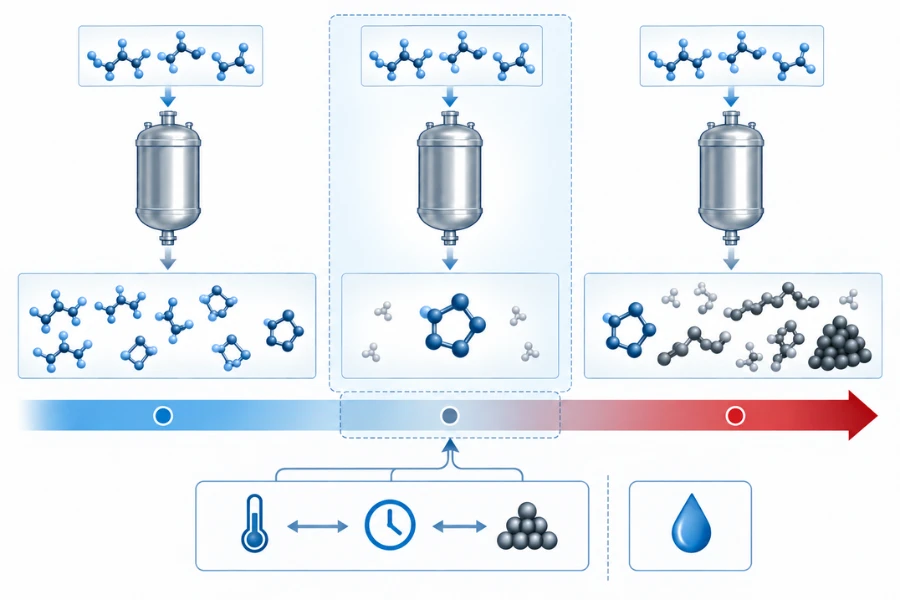
Temperature, residence time, catalyst loading, and water removal should not be optimized independently because each changes the effective severity of the reaction.
A useful operating-window concept is:
Too mild → Sorbitan accumulation → Incomplete second dehydration
Controlled severity → Productive sorbitan conversion → Higher isosorbide selectivity
Too severe → Oligomerization / degradation → Heavy impurities and color formation
Kinetic studies indicate that competing reactions such as oligomerization can be highly temperature-sensitive. Increasing temperature may therefore accelerate the desired second dehydration while narrowing the time available before secondary reactions become significant.
The optimum is a reaction-severity window, not a maximum value for any single operating parameter.
Purification Requirements Begin With Reaction Selectivity
The reactor impurity profile determines the difficulty of the downstream separation train.
An effluent dominated by isosorbide and manageable sorbitan intermediates presents a different separation problem from one containing multiple dehydration isomers, heavy oligomers, color bodies, and residual catalyst.
A conceptual process sequence may include:
Reaction → Catalyst Removal or Neutralization → Impurity Management → Distillation → Crystallization → High-Purity Isosorbide
Distillation can recover or concentrate isosorbide, while crystallization or melt crystallization can provide additional purification when high-purity monomer specifications are required.
This is where reaction-separation integration becomes important. Improving selectivity upstream can reduce thermal exposure, product loss, separation duty, and complexity downstream, while purification performance may determine how much impurity formation the reactor can economically tolerate.
For polymer-grade applications, reaction development and purification design should therefore be evaluated as one process rather than optimized independently.
Scaling Sorbitol Dehydration From Lab to Production
Laboratory catalyst performance establishes chemistry and operating trends, but scale-up changes heat transfer, mixing, catalyst behavior, and operating duration.
The central question is whether the reaction-severity window responsible for laboratory selectivity can be reproduced under production conditions.
Heat Transfer and Mixing Become Process Variables
Heat-transfer area does not increase proportionally with reactor volume. In viscous sorbitol-rich systems, larger equipment can therefore develop slower heating, temperature gradients, and mixing limitations that are negligible in small reactors.
Poor circulation can simultaneously affect catalyst distribution, water removal, and local temperature. An apparent kinetic change after scale-up may therefore originate from transport rather than intrinsic chemistry.
Scale-up should preserve relevant thermal and hydrodynamic conditions, not merely laboratory temperature, pressure, and catalyst dosage.
Catalyst Stability Becomes a Time-on-Stream Problem
For continuous processing, catalyst evaluation shifts from short-term activity to sustained performance.
주요 질문은 다음과 같습니다:
- Does activity remain stable?
- Does selectivity change with time on stream?
- Does fouling increase catalyst deactivation?
- Is the catalyst hydrothermally stable?
- Does catalyst attrition or deposit formation increase pressure drop?
- Can activity be restored through regeneration?
These factors determine whether laboratory catalyst performance can support stable commercial operation. Initial yield alone cannot answer that question.
Pilot Validation Connects Chemistry With Industrial Operation
Pilot testing should connect reaction kinetics with equipment and separation behavior.
A practical development sequence is:
Lab Kinetics → Catalyst Screening → Reactor Validation → Impurity Mapping → Long-Duration Operation → Purification Validation → Pilot Scale → Commercial Design
Laboratory work defines reaction pathways and operating windows. Pilot operation then tests whether those windows remain reproducible when heat transfer, mixing, catalyst stability, water management, control strategy, and downstream purification operate as an integrated system.
Engineering Decision Matrix for Isosorbide Production
Process development can use operating signals to identify the mechanism limiting overall performance rather than relying on conversion alone.
| 공정 신호 | 추정되는 작용 기전 | 확인해야 할 사항 | 기술 대응 |
|---|---|---|---|
| High sorbitol conversion but low isosorbide yield | Competing dehydration pathways | Sorbitan and heavy-byproduct profile | Reassess catalyst selectivity and reaction severity |
| 1,4-Sorbitan accumulates | Second dehydration is limiting | Temperature, contact time, catalyst activity | Adjust the second-step operating window |
| Product color increases with reaction time | Secondary degradation or oligomerization | Thermal and acid exposure history | Reduce excessive reaction severity |
| Conversion changes after scale-up | Heat or mass-transfer limitation | Mixing, viscosity, temperature profile | Reevaluate reactor hydrodynamics |
| Solid catalyst activity declines | Fouling or hydrothermal deactivation | Time-on-stream behavior and deposits | Evaluate regeneration or catalyst redesign |
| Pressure drop rises in continuous operation | Fouling or catalyst-bed problems | Bed condition, catalyst form, feed impurities | Review catalyst shaping and reactor configuration |
| Purification load increases | Reaction selectivity has deteriorated | Heavy impurities and intermediate profile | Optimize reaction before increasing separation duty |
The matrix shows why reactor configuration, catalyst behavior, impurity control, and purification cannot be optimized independently.
From Reaction Optimization to an Industrial Isosorbide Process
Industrial sorbitol dehydration requires control of the complete reaction network, not simply an acid catalyst capable of consuming sorbitol. Reactor configuration sets the thermal and contact-time environment, catalyst properties determine productive and competing pathways, and water removal continuously changes the conditions under which those reactions occur.
The resulting impurity profile then defines the requirements for 증류, crystallization, and high-purity recovery. Commercialization therefore depends on validating the operating window across kinetics, catalyst stability, reactor behavior, impurity formation, purification, and pilot operation.
도겐 approaches isosorbide production as a process industrialization and reaction-separation integration problem. The engineering objective is to connect reaction behavior, catalyst selection, purification strategy, and pilot-to-commercial scale-up so that process stability and product quality can be evaluated under realistic production conditions.