Solvent dehydration becomes more difficult when a solvent-water mixture approaches an azeotrope. Adding theoretical stages or increasing reflux may no longer achieve the required water specification because vapor-liquid equilibrium limits the separation available from conventional distillation.
Azeotropic distillation and extractive distillation overcome this limit through different mechanisms. Selecting between them requires evaluating how the entrainer changes phase equilibrium, column hydraulics, recovery requirements, energy demand, product contamination risk, and the overall solvent purification flowsheet.
Why Conventional Distillation Reaches a Limit in Solvent Dehydration
Conventional distillation requires sufficient relative volatility between the solvent and water. Near an azeotropic composition, the vapor and liquid compositions converge, limiting further separation at the selected pressure.
Additional stages may improve separation before this limit but cannot eliminate the azeotrope itself. Further water removal therefore requires a change in phase behavior or relative volatility.
How Azeotropic and Extractive Distillation Change the Separation
Azeotropic distillation introduces an entrainer that changes the azeotropic behavior of the system. In many solvent dehydration applications, a volatile entrainer creates favorable azeotropic behavior and may produce two liquid phases after condensation, allowing phase separation to assist entrainer recovery.
Extractive distillation uses a relatively nonvolatile solvent that interacts differently with the original components. By changing activity coefficients and relative volatility, it allows one component to leave overhead while the extractive solvent remains predominantly in the liquid phase.
| 공학 계수 | Azeotropic Distillation | 추출 증류 |
|---|---|---|
| Separation mechanism | Creates favorable azeotropic behavior | Changes relative volatility |
| Added component | Typically volatile entrainer | Typically high-boiling or relatively nonvolatile solvent |
| Phase behavior | May involve VLE and VLLE | Primarily VLE |
| Typical auxiliary separation | Decanter and entrainer recovery | Solvent regeneration column |
| Main recycle | Entrainer and phase recycle | Extractive solvent recycle |
| Major design concern | Phase splitting and recycle stability | Solvent loading and regeneration |
The practical route depends on whether these thermodynamic effects remain favorable after entrainer circulation, recovery, hydraulics, and utilities are included.
Entrainer Selection Is the First Process Decision
Entrainer screening starts with phase-equilibrium behavior, but a candidate that performs well thermodynamically can still create excessive circulation, recovery duty, hydraulic loading, safety requirements, or contamination risk.
Entrainer selection should therefore be evaluated together with recovery and recycle design.
Entrainer Requirements for Azeotropic Distillation
An azeotropic entrainer must produce phase behavior that supports the required solvent-water separation. In heterogeneous azeotropic distillation, a useful liquid-liquid phase split after condensation can simplify entrainer recovery.
Important screening factors include:
- azeotrope formation and composition
- vapor-liquid-liquid equilibrium behavior
- phase splitting after condensation
- entrainer solubility in the product
- boiling behavior and circulation requirements
- recovery and recycle performance
- thermal and chemical stability
- flammability, toxicity, and VOC constraints
- corrosion and materials compatibility
Hydrocarbon entrainers such as cyclopentane and cyclohexane illustrate the trade-off. Their volatility can support azeotropic separation, while flammability increases requirements for vapor containment, instrumentation, and safe recycle handling.
Solvent Requirements for Extractive Distillation
An extractive solvent should selectively interact with one component, increase the useful relative volatility, and remain largely in the liquid phase.
Useful screening criteria include:
- relative volatility enhancement and selectivity
- sufficiently high boiling point and low volatility
- miscibility with the feed
- thermal stability
- manageable viscosity
- practical solvent-to-feed ratio
- low corrosion and toxicity
- efficient regeneration
Ethylene glycol, for example, is widely studied for ethanol-water separation because it changes relative volatility while remaining predominantly in the liquid phase. Its process value still depends on the solvent circulation and regeneration required to achieve the target purity.
Entrainer Choice Changes the Entire Process Flowsheet
Entrainer selection determines more than the primary separation. It also determines how the added component is recovered, conditioned, and returned to the process.
Azeotropic Distillation Requires Phase and Recycle Management
A heterogeneous azeotropic dehydration system may include a dehydration column, overhead condenser, decanter, entrainer recycle, and secondary recovery or water-separation column.
After condensation, the overhead stream separates into organic and aqueous phases when the equilibrium system provides a suitable liquid-liquid split. Phase composition determines what is recycled and what proceeds to further recovery.
Decanter temperature can therefore affect phase composition, recycle flow, column loading, and downstream energy demand. During scale-up, liquid-liquid equilibrium data and phase disengagement behavior must be reliable enough to maintain a stable recycle loop.
Extractive Distillation Requires Solvent Regeneration
A conventional extractive process generally uses an extractive column followed by a solvent recovery column. The solvent is introduced above the main feed to maintain sufficient concentration through the extractive section.
The dehydrated product is typically recovered overhead, while the solvent and retained component leave in the bottoms. Regeneration then recovers the solvent for recycle.
Recycle quality matters because residual water or accumulated impurities can change the solvent composition entering the extractive column and reduce the intended relative-volatility effect.
Column Internals Must Match the Entrainer System
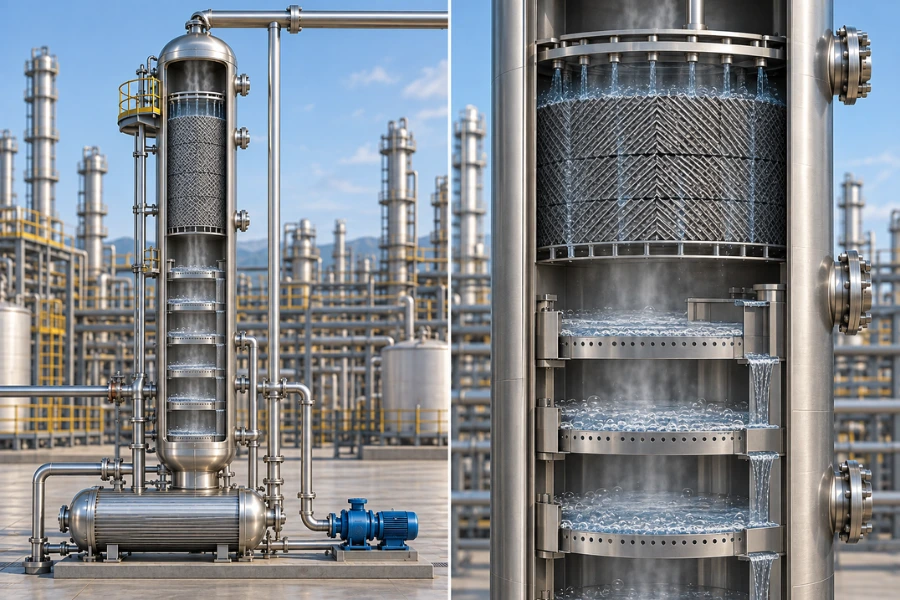
Thermodynamic feasibility determines whether separation is possible. Column internals determine whether the required mass transfer can be delivered at practical vapor and liquid loads.
Entrainer addition can change viscosity, surface tension, density, liquid circulation, and vapor traffic, so internals should be evaluated using the properties and flow profiles of the actual ternary or multicomponent system.
Liquid and Vapor Loads Change Across the Column
In extractive distillation, solvent addition near the top can increase liquid traffic through much of the column. Higher liquid load can increase pressure drop, reduce flooding margin, and increase the diameter required for hydraulic capacity.
Azeotropic systems may instead experience substantial vapor and reflux circulation because the entrainer participates in the overhead system. Column capacity, condenser duty, and entrainer recycle therefore become coupled design variables.
Solvent-to-feed ratio and entrainer circulation should consequently be optimized against both separation performance and hydraulic capacity.
Viscosity Can Offset Better Thermodynamics
An extractive solvent may improve relative volatility while increasing liquid-phase viscosity.
Higher viscosity can reduce diffusivity and liquid-film mass transfer. In packed columns, it can also affect wetting and liquid distribution, while tray columns may experience changes in mixing and effective stage efficiency.
This means that improved equilibrium selectivity does not necessarily produce an equivalent improvement in actual column performance.
Trays and Packing Serve Different Operating Requirements
Structured packing can provide low pressure drop and high effective mass-transfer area, which is useful when pressure drop or thermal exposure must be limited. Its performance depends on adequate liquid distribution and wetting.
Trays provide staged vapor-liquid contacting and can offer operational robustness in many industrial services. Random packing may also be appropriate where its capacity, pressure drop, and mass-transfer performance match the fluid system.
Internals should therefore be selected from the expected hydraulic envelope and fluid properties rather than from a generic preference for trays or packing.
Feed Location and Entrainer Distribution Matter
Extractive solvent is normally introduced above the main mixture feed so that sufficient solvent concentration is maintained across the extractive section.
A solvent feed placed too low reduces the effective contacting region. Increasing solvent circulation can compensate only to a point because additional liquid load and regeneration duty may exceed the incremental separation benefit.
Feed stage, solvent-feed location, and solvent-to-feed ratio should therefore be optimized together.
Recovery Duty Can Reverse an Apparently Good Entrainer Choice
Energy comparisons based only on the primary dehydration column can be misleading. The relevant boundary includes dehydration, entrainer recovery or solvent regeneration, condensation, cooling, recycle conditioning, and the steam levels required by each reboiler.
A volatile azeotropic entrainer may create substantial vaporization and condensation duty. A high-boiling extractive solvent reduces entrainer vaporization but can transfer part of the energy requirement to solvent regeneration.
Published ethanol dehydration comparisons illustrate this system dependence. Extractive distillation with ethylene glycol has shown energy and economic advantages over some azeotropic configurations, but the result changes with entrainer identity, feed composition, purity target, operating pressure, utility pricing, and heat integration.
A complete comparison should include:
- reboiler and condenser duties and steam levels
- entrainer or solvent circulation
- recovery efficiency and recycle purity
- column dimensions and auxiliary equipment
- heat integration opportunities
- entrainer makeup and losses
- capital and operating costs
The lowest primary-column heat duty therefore does not establish the lowest total process cost.
Azeotropic vs. Extractive Distillation: Which Route Fits the Process?
Route selection becomes clearer when thermodynamics and recovery requirements are evaluated together.
| Process Condition | Route Worth Evaluating |
|---|---|
| Favorable heterogeneous azeotrope and phase split | Azeotropic distillation |
| Practical decanter-based entrainer recovery | Azeotropic distillation |
| Volatile entrainer can be safely contained and recycled | Azeotropic distillation |
| Highly selective, relatively nonvolatile solvent is available | 추출 증류 |
| Low entrainer concentration is required overhead | 추출 증류 |
| Solvent can be regenerated efficiently | 추출 증류 |
| Circulation creates significant hydraulic constraints | Compare both integrated routes |
| Recovery dominates process energy | Compare complete flowsheets |
| Product has strict residual-entrainer limits | Evaluate contamination and recovery for both |
Feed composition, final water specification, phase behavior, utilities, safety constraints, and downstream purity requirements should define the comparison basis. A route that is attractive for one solvent-water system cannot be assumed to remain favorable for another.
What Changes During Pilot-to-Commercial Scale-Up?
A flowsheet that converges in process simulation is not yet a validated industrial solvent dehydration process.
Activity-coefficient models such as NRTL can represent strongly nonideal mixtures when appropriate interaction parameters are available. Heterogeneous azeotropic systems additionally require reliable representation of both VLE and VLLE because vapor-liquid separation and liquid-liquid phase splitting affect the recycle structure.
Scale-up must then verify whether predicted equilibrium performance remains achievable under real hydraulic and mass-transfer conditions. Important validation areas include:
- feed composition and water-content variability
- entrainer purity, recycle composition, and losses
- actual solvent-to-feed or entrainer circulation requirements
- tray efficiency or packing distribution performance
- pressure drop, hydraulic capacity, and flooding margin
- decanter phase separation where applicable
- solvent degradation and recycle impurity accumulation
- startup, shutdown, and process-control behavior
- long-term recovery-loop stability
Pilot testing is particularly useful when phase behavior, physical-property data, or mass-transfer performance remain uncertain. It can validate simulation assumptions before column diameter, internals, heat exchangers, and recovery systems are fixed for commercial deployment.
결론
Azeotropic and extractive distillation should be compared as integrated solvent purification systems rather than only by their primary separation mechanisms. Entrainer behavior determines not only equilibrium separation but also circulation, column hydraulics, recovery configuration, utility demand, and contamination risk.
도겐 can support entrainer evaluation, separation process development, column configuration, and pilot-to-commercial scale-up for solvent dehydration projects.