La deshidratación con disolvente se vuelve más difícil cuando una mezcla de disolvente y agua se aproxima a un azeótropo. La adición de etapas teóricas o el aumento del reflujo pueden dejar de ser suficientes para alcanzar los parámetros de agua requeridos, ya que el equilibrio vapor-líquido limita la separación que se puede obtener mediante la destilación convencional.
La destilación azeotrópica y la destilación extractiva superan este límite mediante mecanismos distintos. Para elegir entre ambas, es necesario evaluar cómo el agente de arrastre modifica el equilibrio de fases, la hidráulica de la columna, los requisitos de recuperación, la demanda energética, el riesgo de contaminación del producto y el esquema general de purificación del disolvente.
Por qué la destilación convencional alcanza un límite en la deshidratación con disolventes
La destilación convencional requiere una volatilidad relativa suficiente entre el disolvente y el agua. Cuando se aproxima a una composición azeotrópica, las composiciones del vapor y del líquido convergen, lo que limita una mayor separación a la presión seleccionada.
Es posible que unas etapas adicionales mejoren la separación antes de alcanzar este límite, pero no pueden eliminar el azeótropo en sí. Por lo tanto, para eliminar más agua es necesario modificar el comportamiento de las fases o la volatilidad relativa.
Cómo la destilación azeotrópica y la destilación extractiva modifican la separación
La destilación azeotrópica consiste en introducir un agente de arrastre que modifica el comportamiento azeotrópico del sistema. En muchas aplicaciones de deshidratación con disolventes, un agente de arrastre volátil genera un comportamiento azeotrópico favorable y puede dar lugar a dos fases líquidas tras la condensación, lo que permite la separación de fases para facilitar la recuperación del agente de arrastre.
La destilación extractiva utiliza un disolvente relativamente poco volátil que interactúa de forma diferente con los componentes originales. Al modificar los coeficientes de actividad y la volatilidad relativa, permite que un componente se elimine por la parte superior, mientras que el disolvente extractivo permanece predominantemente en la fase líquida.
| Factor de ingeniería | Destilación azeotrópica | Destilación extractiva |
|---|---|---|
| Mecanismo de separación | Genera un comportamiento azeotrópico favorable | Volatilidad relativa de las variaciones |
| Componente añadido | Agente de arrastre típicamente volátil | Disolvente que suele tener un punto de ebullición elevado o que es relativamente poco volátil |
| Comportamiento de las fases | Puede implicar VLE y VLLE | Principalmente VLE |
| Separación auxiliar típica | Recuperación del decantador y del arrastrador | Columna de regeneración con disolvente |
| Reciclaje principal | Reciclaje de portadora y de fase | Reciclaje de disolventes de extracción |
| Principal problema de diseño | Separación de fases y estabilidad del reciclaje | Carga y regeneración del disolvente |
La ruta práctica depende de si estos efectos termodinámicos siguen siendo favorables una vez que se tienen en cuenta la circulación del agente de arrastre, la recuperación, la hidráulica y los servicios auxiliares.
La selección del entrenador es la primera decisión del proceso
La selección de los separadores de aire comienza por el comportamiento en equilibrio de fases, pero un modelo que ofrezca un buen rendimiento termodinámico puede, aun así, provocar una circulación excesiva, una carga de recuperación elevada, una sobrecarga hidráulica, requisitos de seguridad adicionales o un riesgo de contaminación.
Por lo tanto, la selección del transportador debe evaluarse junto con el diseño de los sistemas de recuperación y reciclaje.
Requisitos del agente de arrastre para la destilación azeotrópica
Un agente de arrastre azeotrópico debe producir un comportamiento de fases que permita la separación necesaria entre el disolvente y el agua. En la destilación azeotrópica heterogénea, una separación útil de fases líquido-líquido tras la condensación puede simplificar la recuperación del agente de arrastre.
Entre los factores importantes para la detección precoz se incluyen:
- formación y composición del azeótropo
- comportamiento del equilibrio vapor-líquido-líquido
- separación de fases tras la condensación
- solubilidad del agente de arrastre en el producto
- comportamiento de ebullición y requisitos de circulación
- rendimiento en materia de recuperación y reciclaje
- estabilidad térmica y química
- restricciones relativas a la inflamabilidad, la toxicidad y los COV
- corrosión y compatibilidad de materiales
Los agentes de arrastre de hidrocarburos, como el ciclopentano y el ciclohexano, ilustran esta disyuntiva. Su volatilidad permite la separación azeotrópica, mientras que su inflamabilidad impone mayores requisitos en cuanto a la contención de vapores, la instrumentación y la gestión segura del reciclaje.
Requisitos de los disolventes para la destilación extractiva
Un disolvente extractivo debe interactuar de forma selectiva con un componente, aumentar la volatilidad relativa útil y permanecer en su mayor parte en fase líquida.
Entre los criterios de selección útiles se incluyen:
- aumento relativo de la volatilidad y la selectividad
- punto de ebullición suficientemente alto y baja volatilidad
- miscibilidad con la materia prima
- estabilidad térmica
- viscosidad manejable
- proporción práctica entre disolvente y materia prima
- baja corrosividad y toxicidad
- regeneración eficiente
El etilenglicol, por ejemplo, es objeto de numerosos estudios para la separación de etanol y agua, ya que cambia su volatilidad relativa sin dejar de permanecer predominantemente en fase líquida. Su utilidad en el proceso sigue dependiendo de la circulación del disolvente y de la regeneración necesarias para alcanzar la pureza deseada.
La elección del agente de separación modifica todo el diagrama de flujo del proceso
La elección del separador no solo determina la separación primaria, sino que también determina cómo se recupera, se acondiciona y se devuelve al proceso el componente añadido.
La destilación azeotrópica requiere una gestión de fases y del reciclaje
Un sistema de deshidratación azeotrópico heterogéneo puede incluir una columna de deshidratación, un condensador de cabeza, un decantador, un circuito de recirculación del agente de arrastre y una columna de recuperación secundaria o de separación de agua.
Tras la condensación, la corriente de cabeza se separa en fases orgánica y acuosa cuando el sistema en equilibrio ofrece una separación líquido-líquido adecuada. La composición de las fases determina qué se recicla y qué se destina a procesos posteriores de recuperación.
Por lo tanto, la temperatura del decantador puede afectar a la composición de las fases, al caudal de recirculación, a la carga de la columna y a la demanda energética en las etapas posteriores. Durante la ampliación de la escala, los datos de equilibrio líquido-líquido y el comportamiento de separación de fases deben ser lo suficientemente fiables como para mantener un circuito de recirculación estable.
La destilación por extracción requiere la regeneración del disolvente
Un proceso de extracción convencional suele utilizar una columna de extracción seguida de una columna de recuperación del disolvente. El disolvente se introduce por encima de la alimentación principal para mantener una concentración suficiente a lo largo de la sección de extracción.
El producto deshidratado se recupera normalmente en la fracción de cabeza, mientras que el disolvente y el componente retenido se eliminan en la fracción de fondo. A continuación, mediante la regeneración se recupera el disolvente para su reciclado.
La calidad del reciclaje es importante porque el agua residual o las impurezas acumuladas pueden alterar la composición del disolvente que entra en la columna de extracción y reducir el efecto de volatilidad relativa deseado.
Los componentes internos de la columna deben ser compatibles con el sistema de arrastre
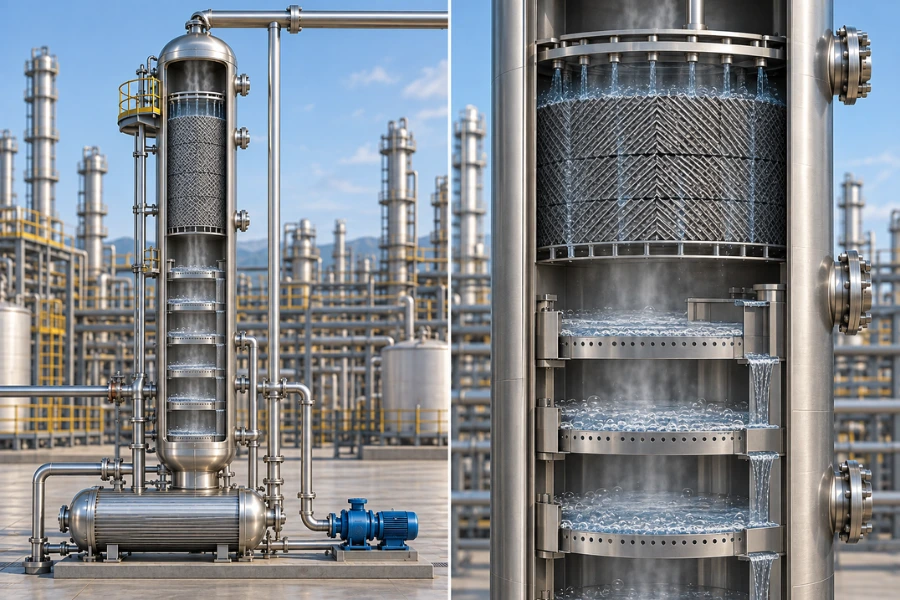
La viabilidad termodinámica determina si la separación es posible. Los elementos internos de la columna determinan si se puede lograr la transferencia de masa necesaria con cargas prácticas de vapor y líquido.
La adición de un agente de arrastre puede alterar la viscosidad, la tensión superficial, la densidad, la circulación del líquido y el flujo de vapor; por lo tanto, los componentes internos deben evaluarse teniendo en cuenta las propiedades y los perfiles de flujo del sistema ternario o multicomponente real.
Las cargas de líquido y vapor varían a lo largo de la columna
En la destilación extractiva, la adición de disolvente en la parte superior puede aumentar el flujo de líquido a lo largo de gran parte de la columna. Una mayor carga de líquido puede aumentar la caída de presión, reducir el margen de inundación y aumentar el diámetro necesario para garantizar la capacidad hidráulica.
Por el contrario, los sistemas azeotrópicos pueden presentar una circulación considerable de vapor y reflujo, ya que el agente de arrastre forma parte del sistema de cabeza. Por lo tanto, la capacidad de la columna, la carga del condensador y el reciclaje del agente de arrastre se convierten en variables de diseño interrelacionadas.
Por lo tanto, la relación entre el disolvente y la alimentación, así como la circulación del agente de arrastre, deben optimizarse teniendo en cuenta tanto el rendimiento de la separación como la capacidad hidráulica.
La viscosidad puede compensar unas mejores propiedades termodinámicas
Un disolvente de extracción puede mejorar la volatilidad relativa al tiempo que aumenta la viscosidad en fase líquida.
Una mayor viscosidad puede reducir la difusividad y la transferencia de masa en la película líquida. En las columnas de relleno, también puede afectar a la humectación y a la distribución del líquido, mientras que en las columnas de bandejas pueden producirse cambios en la mezcla y en la eficiencia efectiva de cada etapa.
Esto significa que una mayor selectividad de equilibrio no se traduce necesariamente en una mejora equivalente del rendimiento real de la columna.
Las bandejas y los embalajes se adaptan a diferentes necesidades operativas
El relleno estructurado puede ofrecer una baja caída de presión y una gran superficie efectiva de transferencia de masa, lo que resulta útil cuando es necesario limitar la caída de presión o la exposición térmica. Su rendimiento depende de una distribución adecuada del líquido y de una humectación correcta.
Las bandejas permiten un contacto por etapas entre el vapor y el líquido y pueden ofrecer solidez operativa en numerosas aplicaciones industriales. El relleno aleatorio también puede resultar adecuado cuando su capacidad, caída de presión y rendimiento en la transferencia de masa se ajustan al sistema de fluidos.
Por lo tanto, los componentes internos deben seleccionarse en función de la envolvente hidráulica prevista y de las propiedades del fluido, y no en función de una preferencia genérica por las bandejas o el relleno.
La ubicación del alimentador y la distribución de los transportadores son importantes
El disolvente de extracción se introduce normalmente por encima de la entrada de la mezcla principal, de modo que se mantenga una concentración suficiente de disolvente a lo largo de toda la sección de extracción.
Si la alimentación de disolvente se sitúa a un nivel demasiado bajo, se reduce la zona de contacto efectiva. Aumentar la circulación de disolvente solo puede compensar hasta cierto punto, ya que la carga líquida adicional y la carga de regeneración pueden superar la mejora incremental en la separación.
Por lo tanto, la etapa de alimentación, la ubicación de la alimentación de disolvente y la relación entre disolvente y alimentación deben optimizarse conjuntamente.
La recuperación puede contrarrestar una elección de entrenador que, a primera vista, parece acertada
Las comparaciones energéticas basadas únicamente en la columna de deshidratación primaria pueden resultar engañosas. El ámbito relevante incluye la deshidratación, la recuperación del agente de arrastre o la regeneración del disolvente, la condensación, la refrigeración, el acondicionamiento del reciclaje y los niveles de vapor que requiere cada rehervidor.
Un agente de arrastre azeotrópico volátil puede generar una carga considerable de vaporización y condensación. Un disolvente extractivo de alto punto de ebullición reduce la vaporización del agente de arrastre, pero puede trasladar parte de la energía necesaria a la regeneración del disolvente.
Las comparaciones publicadas sobre la deshidratación con etanol ilustran esta dependencia del sistema. La destilación extractiva con etilenglicol ha demostrado presentar ventajas energéticas y económicas frente a algunas configuraciones azeotrópicas, pero el resultado varía en función del tipo de agente de arrastre, la composición de la carga, el nivel de pureza deseado, la presión de funcionamiento, el precio de los servicios públicos y la integración térmica.
Una comparación completa debería incluir:
- funciones del recalentador y del condensador, y niveles de vapor
- circulación del agente de arrastre o del disolvente
- eficiencia de recuperación y pureza del material reciclado
- dimensiones de las columnas y equipamiento auxiliar
- oportunidades de integración térmica
- Composición y pérdidas del transportador
- costes de capital y de explotación
Por lo tanto, la menor carga térmica de la columna primaria no implica el menor coste total del proceso.
Destilación azeotrópica frente a destilación extractiva: ¿qué método se adapta mejor al proceso?
La elección de la ruta resulta más clara cuando se evalúan conjuntamente los aspectos termodinámicos y los requisitos de recuperación.
| Condiciones del proceso | Una ruta que merece la pena valorar |
|---|---|
| Azeótropo heterogéneo favorable y separación de fases | Destilación azeotrópica |
| Recuperación práctica de aireadores mediante decantador | Destilación azeotrópica |
| El agente de arrastre volátil puede contenerse y reciclarse de forma segura | Destilación azeotrópica |
| Existe un disolvente altamente selectivo y relativamente poco volátil | Destilación extractiva |
| Se requiere una baja concentración de agente de arrastre en la parte superior | Destilación extractiva |
| El disolvente se puede regenerar de forma eficaz | Destilación extractiva |
| La circulación genera importantes limitaciones hidráulicas | Compara ambas rutas integradas |
| La recuperación es el factor dominante en la energía de proceso | Comparar esquemas de proceso completos |
| El producto tiene límites estrictos en cuanto a los residuos de agentes de arrastre. | Evaluar la contaminación y la recuperación en ambos casos |
La composición de la materia prima, las especificaciones finales del agua, el comportamiento en las distintas fases, los servicios técnicos, las restricciones de seguridad y los requisitos de pureza en las etapas posteriores deben constituir la base de la comparación. No se puede dar por sentado que una ruta que resulte atractiva para un sistema disolvente-agua siga siendo favorable para otro.
¿Qué cambia al pasar de la fase piloto a la escala comercial?
Un esquema de proceso que converge en la simulación del proceso no constituye todavía un proceso industrial validado de deshidratación con disolvente.
Los modelos de coeficientes de actividad, como el NRTL, pueden representar mezclas muy lejos del ideal cuando se dispone de los parámetros de interacción adecuados. Los sistemas azeotrópicos heterogéneos requieren, además, una representación fiable tanto de la VLE como de la VLLE, ya que la separación vapor-líquido y la separación de fases líquido-líquido afectan a la estructura de recirculación.
A continuación, en la fase de ampliación a escala industrial hay que verificar si el rendimiento de equilibrio previsto sigue siendo alcanzable en condiciones reales de hidráulica y transferencia de masa. Entre los aspectos importantes que deben validarse se incluyen:
- composición del pienso y variabilidad del contenido de agua
- pureza del agente de arrastre, composición del material reciclado y pérdidas
- necesidades reales de circulación del disolvente respecto a la materia prima o del agente de arrastre
- eficiencia de la bandeja o rendimiento en la distribución del embalaje
- caída de presión, capacidad hidráulica y margen de inundación
- separación de fases en decantador, cuando proceda
- degradación del disolvente y acumulación de impurezas en el proceso de reciclaje
- Comportamiento durante el arranque, el apagado y el control de procesos
- estabilidad a largo plazo del bucle de recuperación
Las pruebas piloto resultan especialmente útiles cuando aún existen incertidumbres respecto al comportamiento de las fases, los datos sobre las propiedades físicas o el rendimiento de la transferencia de masa. Permiten validar los supuestos de la simulación antes de que se determinen el diámetro de la columna, los elementos internos, los intercambiadores de calor y los sistemas de recuperación para su implantación comercial.
Conclusión
Destilación azeotrópica y extractiva deben compararse como sistemas integrados de purificación con disolvente, en lugar de hacerlo únicamente en función de sus mecanismos de separación primarios. El comportamiento del agente de arrastre determina no solo la separación en equilibrio, sino también la circulación, la hidráulica de la columna, la configuración de la recuperación, la demanda de servicios y el riesgo de contaminación.
DODGEN puede contribuir a la evaluación de los agentes de arrastre, el desarrollo de procesos de separación, la configuración de columnas y la ampliación de la escala piloto a la comercial en proyectos de deshidratación con disolventes.