정의
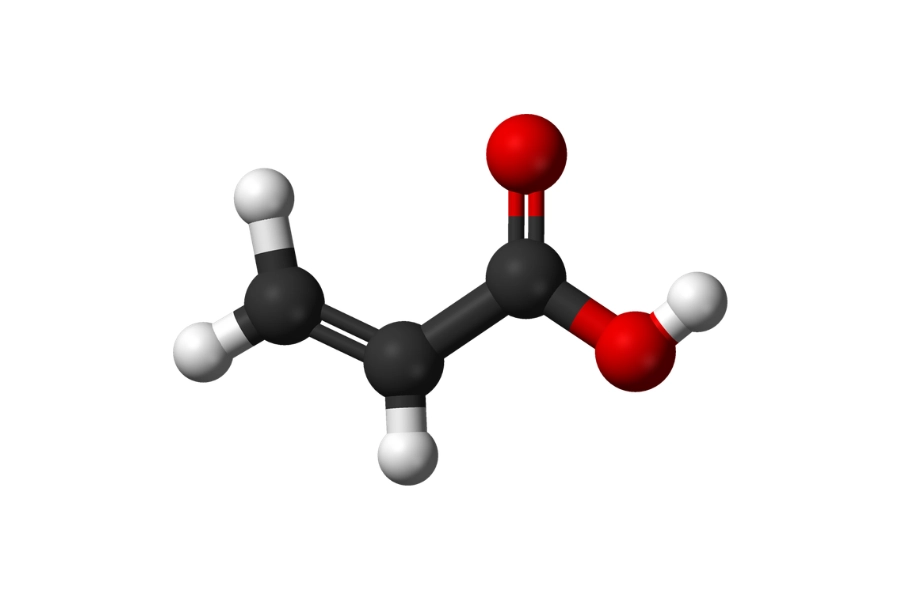
Acrylic acid, also known as propenoic acid, is a colorless, highly reactive unsaturated carboxylic acid with the molecular formula CH₂=CHCOOH.
It is the simplest unsaturated carboxylic acid and serves as a key building block in the production of acrylates, resins, coatings, adhesives, and polymer materials.
Due to the presence of both a carboxyl group and a carbon-carbon double bond, acrylic acid exhibits high chemical reactivity and readily undergoes polymerization and esterification reactions.
물리적 및 화학적 성질
Acrylic acid is a volatile liquid with strong irritant odor and high reactivity.
주요 특징은 다음과 같습니다:
- Molecular formula: CH₂=CHCOOH
- Density: ~1.05 g/cm³ (20°C)
- Melting point: ~14°C
- Boiling point: ~141°C
- Miscible with water, ethanol, and ether
- Highly reactive unsaturated structure
Acrylic acid tends to polymerize easily, especially under heat, light, or in the presence of catalysts, which makes stabilization critical during storage and transport.
산업 분야 적용
Acrylic acid is one of the most important monomers in the chemical industry.
It is primarily used in:
- Production of acrylic esters (e.g., methyl acrylate, butyl acrylate)
- Superabsorbent polymers (SAP) used in hygiene products
- Coatings and surface treatment materials
- Adhesives and sealants
- Water treatment and dispersion agents
- Textile and paper processing additives
Most industrial applications rely on acrylic acid as a feedstock rather than a final product, due to its high reactivity.
생산 기술
Industrial acrylic acid is typically produced through the oxidation of propylene in a multi-step catalytic process.
A simplified route includes:
- Propylene oxidation to acrolein
- Further oxidation to acrylic acid
- Gas-phase catalytic reaction systems
- Separation and purification via distillation
- Stabilization to prevent premature polymerization
Because acrylic acid is highly reactive, industrial systems require careful control of temperature, oxygen levels, and inhibitor concentration during both production and storage.
엔지니어링 고려 사항
From a process engineering perspective, acrylic acid systems require strict control over reaction stability and polymerization risk.
주요 고려 사항은 다음과 같습니다:
Polymerization Control
Acrylic acid can spontaneously polymerize under unsuitable conditions, making inhibitor systems essential.
Thermal Management
Reaction heat must be carefully managed to avoid runaway polymerization or by-product formation.
Purity Control
Impurities significantly affect downstream esterification and polymer quality.
관련 화학물질
- Methyl Acrylate
- Ethyl Acrylate
- Butyl Acrylate
- Methacrylic Acid (MAA)
- Acrylic Esters
- Polyacrylic Acid (PAA)