Definición
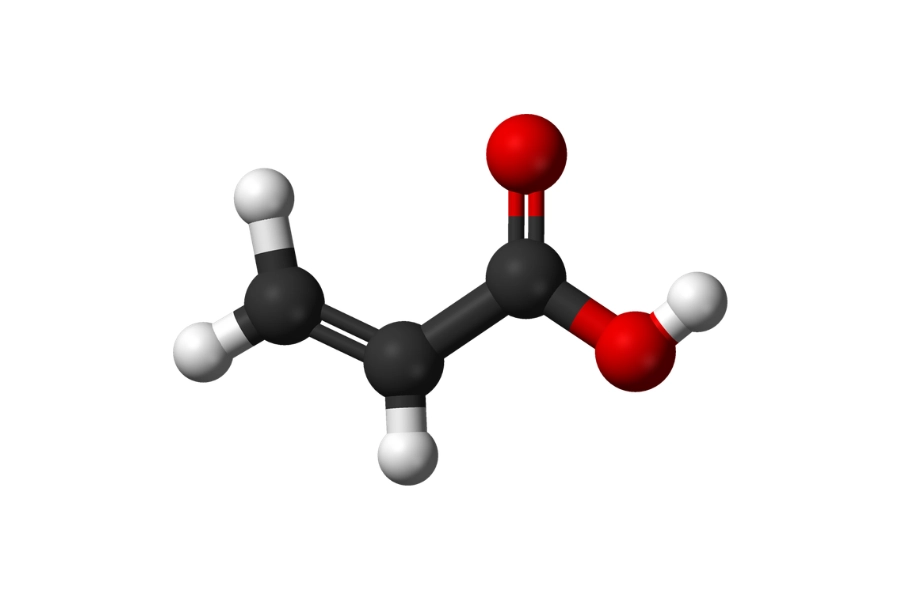
El ácido acrílico, también conocido como ácido propenoico, es un ácido carboxílico insaturado, incoloro y muy reactivo, cuya fórmula molecular es CH₂=CHCOOH.
Es el ácido carboxílico insaturado más simple y constituye un componente fundamental en la producción de acrilatos, resinas, recubrimientos, adhesivos y materiales poliméricos.
Debido a la presencia tanto de un grupo carboxilo como de un doble enlace carbono-carbono, el ácido acrílico presenta una elevada reactividad química y entra fácilmente en reacciones de polimerización y esterificación.
Propiedades físicas y químicas
El ácido acrílico es un líquido volátil con un fuerte olor irritante y una elevada reactividad.
Las características clave incluyen:
- Fórmula molecular: CH₂=CHCOOH
- Densidad: ~1,05 g/cm³ (20 °C)
- Punto de fusión: ~14 °C
- Punto de ebullición: ~141 °C
- Miscible con agua, etanol y éter
- Estructura insaturada altamente reactiva
El ácido acrílico tiende a polimerizarse con facilidad, especialmente bajo la acción del calor, la luz o en presencia de catalizadores, lo que hace que su estabilización sea fundamental durante el almacenamiento y el transporte.
Aplicaciones industriales
El ácido acrílico es uno de los monómeros más importantes de la industria química.
Se utiliza principalmente en:
- Producción de ésteres acrílicos (por ejemplo, acrilato de metilo, acrilato de butilo)
- Polímeros superabsorbentes (SAP) utilizados en productos de higiene
- Recubrimientos y materiales para el tratamiento de superficies
- Adhesivos y selladores
- Agentes de tratamiento y dispersión del agua
- Aditivos para el procesamiento de textiles y papel
La mayoría de las aplicaciones industriales utilizan el ácido acrílico como materia prima y no como producto final, debido a su elevada reactividad.
Tecnología de producción
El ácido acrílico industrial se produce normalmente mediante la oxidación del propileno en un proceso catalítico de varias etapas.
Una ruta simplificada incluye:
- Oxidación del propileno a acroleína
- Oxidación posterior hasta obtener ácido acrílico
- Sistemas de reacción catalítica en fase gaseosa
- Separación y purificación mediante destilación
- Estabilización para evitar la polimerización prematura
Dado que el ácido acrílico es muy reactivo, los sistemas industriales requieren un control minucioso de la temperatura, los niveles de oxígeno y la concentración de inhibidores, tanto durante la producción como durante el almacenamiento.
Consideraciones técnicas
Desde el punto de vista de la ingeniería de procesos, los sistemas de ácido acrílico requieren un control estricto de la estabilidad de la reacción y del riesgo de polimerización.
Entre los aspectos clave a tener en cuenta se incluyen:
Control de la polimerización
El ácido acrílico puede polimerizarse espontáneamente en condiciones inadecuadas, por lo que es imprescindible utilizar sistemas inhibidores.
Gestión térmica
El calor de reacción debe controlarse cuidadosamente para evitar una polimerización descontrolada o la formación de subproductos.
Control de pureza
Las impurezas afectan de manera significativa a la esterificación posterior y a la calidad del polímero.
Sustancias químicas relacionadas
- Acrilato de metilo
- Acrilato de etilo
- Acrilato de butilo
- Ácido metacrílico (MAA)
- Ésteres acrílicos
- Ácido poliacrílico (PAA)