Destilación reactiva combina la reacción química y la separación en varias etapas en una misma columna, pero la mera integración no garantiza un proceso mejor. El rendimiento industrial depende de que la cinética de la reacción, el equilibrio vapor-líquido (EVL), el contacto catalítico, la transferencia de masa, la hidráulica y el comportamiento térmico puedan desarrollarse dentro de un margen compatible.
El relleno estructurado catalítico proporciona la interfaz física necesaria para esta integración de reacción y separación. Su función va más allá de servir de soporte al catalizador: debe crear un contacto catalítico suficiente, al tiempo que preserva el contacto vapor-líquido y la capacidad hidráulica necesarios para la separación.
Por lo tanto, la cuestión desde el punto de vista de la ingeniería no es simplemente si se puede instalar un catalizador en una columna de destilación, sino si el sistema completo de separación reactiva puede seguir siendo eficiente, controlable y escalable en condiciones de funcionamiento industrial.
Por qué funciona la destilación reactiva… y cuándo no funciona
La destilación reactiva resulta especialmente interesante para las reacciones reversibles, ya que la retirada continua del producto desplaza el equilibrio químico hacia una mayor conversión. La esterificación y la eterificación son ejemplos habituales en los que esta combinación puede reducir los requisitos de recirculación o de separación posterior.
La integración también puede reducir el número de equipos y, en casos favorables, el consumo de energía. El calor de reacción puede influir en la carga de vaporización, mientras que la eliminación de las etapas intermedias de separación y reciclaje puede simplificar el esquema de proceso general.
Estas ventajas están sujetas a ciertas condiciones. La reacción y la destilación deben compartir rangos de temperatura, presión, composición, tiempo de residencia y condiciones de funcionamiento del catalizador que sean compatibles.
| Requisitos del proceso | Restricción industrial |
|---|---|
| Cinética de las reacciones | Velocidad de reacción suficiente en condiciones de columna |
| Equilibrio de fases | Relaciones de volatilidad que respaldan la separación requerida |
| Catalizador | Actividad, selectividad, estabilidad y rango de funcionamiento adecuado |
| Transferencia de masa | Contacto eficaz entre vapor y líquido |
| Hidráulica | Caída de presión admisible y margen de inundación |
| Tiempo de residencia | Un contacto catalítico adecuado sin exceso de existencias |
Una reacción que se desarrolle satisfactoriamente en un reactor de laboratorio con agitación puede no ser adecuada para la destilación reactiva. La temperatura de reacción necesaria puede ser incompatible con las condiciones de VLE, o bien el tiempo de residencia necesario para la conversión puede superar el que puede proporcionar la columna sin comprometer el rendimiento hidráulico.
El relleno estructurado catalítico une la reacción con la separación
Cuando se utiliza un catalizador heterogéneo, la destilación reactiva también se describe habitualmente como destilación catalítica. El relleno estructurado catalítico integra el catalizador sólido con la estructura de transferencia de masa, de modo que la reacción y la separación pueden tener lugar dentro de la misma zona reactiva.
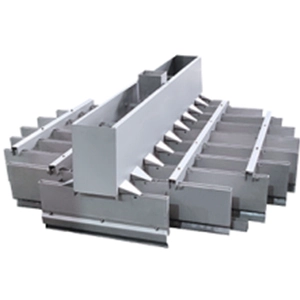
Un diseño típico combina chapas metálicas onduladas con compartimentos que contienen catalizador, sujetos mediante una malla metálica permeable. La estructura ondulada crea canales de flujo de vapor y líquido, mientras que la zona del catalizador proporciona la superficie sólida necesaria para la reacción.
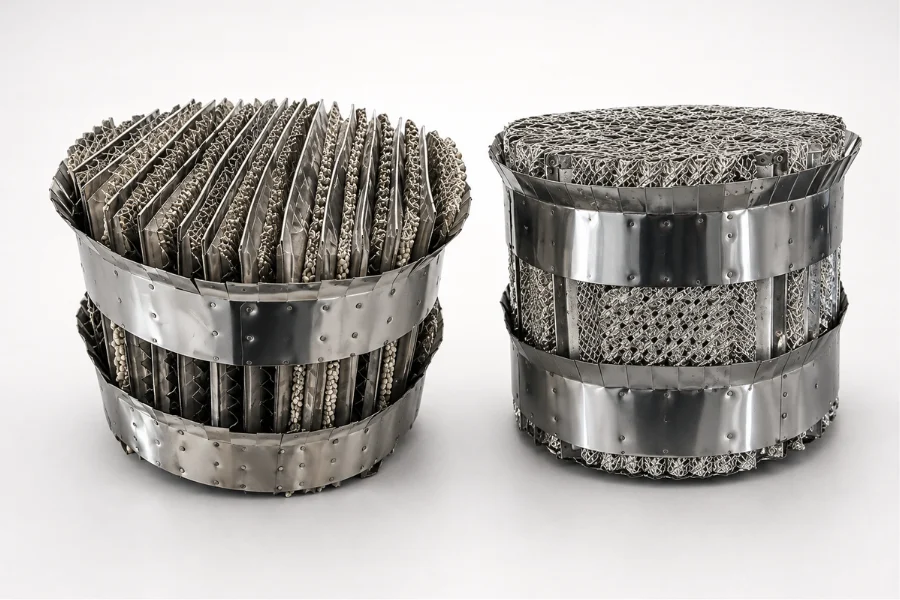
Por lo tanto, una configuración tipo sándwich o de chapa ondulada puede desempeñar varias funciones al mismo tiempo:
- proporcionar superficie de interfaz para la transferencia de masa entre el vapor y el líquido;
- retener el catalizador y, al mismo tiempo, permitir que los fluidos de reacción entren en contacto con él;
- establecer canales controlados para el flujo de vapor y de líquido;
- definir zonas reactivas modulares dentro de la columna.
Lo difícil es encontrar el equilibrio entre estas funciones. Una mayor cantidad de catalizador aumenta la capacidad reactiva potencial, pero también puede alterar la retención de líquido, reducir el área de flujo libre, aumentar la resistencia o desplazar la superficie que, de otro modo, contribuiría a la separación.
La disyuntiva resultante es importante:
Mayor carga de catalizador → mayor capacidad de reacción potencial → cambios en la retención de líquido y en la resistencia al flujo → mayor demanda hidráulica → posible pérdida del margen de transferencia de masa o del margen de inundación.
DODGEN aborda el relleno estructurado catalítico como parte del sistema completo de reacción y separación, en lugar de como un elemento interno aislado de la columna. Es necesario evaluar conjuntamente la geometría del relleno, la cantidad de catalizador, los requisitos de separación y la hidráulica de la columna.
Cuatro variables internas de las columnas que controlan el rendimiento
Carga del catalizador y contacto efectivo
El inventario de catalizador instalado y el contacto catalítico efectivo no son lo mismo.
Los fluidos de reacción deben llegar al catalizador en condiciones que garanticen una humectación y un transporte de masa adecuados. El tamaño de las partículas del catalizador, la geometría de las cavidades, la permeabilidad, la resistencia a la difusión, la distribución del líquido y la composición local pueden influir en la utilización del catalizador.
Por lo tanto, añadir catalizador sin resolver una limitación de transporte puede aumentar la caída de presión o la complejidad interna, al tiempo que aporta una conversión adicional mínima. El objetivo no es lograr la máxima carga de catalizador, sino disponer de una capacidad catalítica efectiva suficiente para la velocidad de reacción requerida.
Distribución de líquidos y humectación de catalizadores
La distribución desigual del líquido afecta a dos funciones a la vez: la reacción y la separación.
Una fase líquida mal distribuida puede provocar:
Distribución inadecuada → humectación desigual del catalizador → diferencias locales en la velocidad de reacción → gradientes de composición y temperatura → menor eficiencia de separación → conversión o selectividad inestables.
El distribuidor inicial debe garantizar una cobertura adecuada en toda la sección transversal de la columna. En lechos de relleno más altos o en columnas de mayor diámetro, puede ser necesario utilizar redistribuidores, ya que los pequeños errores de distribución pueden acumularse a medida que el líquido desciende.
Esto cobra especial importancia durante la ampliación de la producción. El comportamiento de humectación que parece aceptable en una columna piloto de pequeño tamaño puede no reproducirse de manera uniforme en una columna comercial de mayor diámetro.
Caída de presión, inundación y capacidad hidráulica
Las estructuras que contienen catalizador ocupan un espacio que, de otro modo, estaría disponible para el flujo de vapor y líquido en contracorriente. A medida que aumenta el caudal, la caída de presión se incrementa y el sistema se acerca cada vez más a la saturación.
Por lo tanto, una configuración optimizada principalmente para la reacción puede resultar restrictiva desde el punto de vista hidráulico con cargas de vapor comerciales. Esta es una de las razones por las que el relleno catalítico no puede seleccionarse basándose únicamente en la capacidad del catalizador o en los datos de conversión obtenidos en laboratorio.
La carga de vapor, la carga de líquido, la geometría del relleno, el área abierta, el inventario de catalizador, la caída de presión, el margen de inundación y el rango de regulación deben evaluarse como un único sistema hidráulico.
Retención de líquido y tiempo de permanencia reactivo
La retención de líquido puede proporcionar el tiempo de residencia necesario para las reacciones catalíticas más lentas, pero aumentarlo indefinidamente no es una estrategia de diseño útil.
Un mayor tiempo de retención implica un mayor inventario de proceso y puede alterar la caída de presión, la respuesta dinámica, el comportamiento durante la puesta en marcha y la controlabilidad del proceso. Dependiendo del sistema, también puede modificar las condiciones locales de transferencia de masa.
El objetivo adecuado es lograr un tiempo de permanencia en el reactor suficiente, manteniendo al mismo tiempo una separación eficaz, unas condiciones hidráulicas aceptables y un funcionamiento estable.
Diagnostica el problema antes de cambiar la empaquetadura
Muchos problemas de destilación reactiva no pueden resolverse aumentando la carga de catalizador. Las señales de funcionamiento suelen revelar qué parte del sistema acoplado se está convirtiendo en el factor limitante.
| Señal de proceso | Posible limitación | Respuesta de ingeniería |
|---|---|---|
| Añadir más catalizador apenas mejora la conversión. | Limitación por humectación o por transferencia de masa | Mejorar el acceso a los fluidos y la distribución de los líquidos |
| La tasa de conversión disminuye a medida que aumenta el rendimiento | Tiempo de residencia o inventario efectivo de catalizador | Reequilibrar la carga de catalizador y la retención de líquido |
| La caída de presión aumenta rápidamente | Restricción hidráulica | Revisar la geometría, la superficie abierta y la carga de vapor |
| Aparecen gradientes de temperatura locales | Reacción o distribución desigual | Mejorar la redistribución y evaluar los efectos del calor |
| La separación empeora a medida que aumenta la carga del catalizador | Capacidad insuficiente de transferencia de masa | Reequilibrar las funciones de reacción y separación |
| Los resultados del estudio piloto no se reproducen a mayor escala | Efecto de distribución o de escala hidrodinámica | Validar los modelos hidráulicos y los modelos de procesos acoplados |
Esta lógica de diagnóstico es importante porque la conversión es un resultado a nivel de sistema. La cinética de reacción puede ser adecuada, pero el acceso al catalizador, el equilibrio de fases, la transferencia de masa o la hidráulica pueden impedir que el catalizador instalado alcance su rendimiento teórico.
El diseño de la zona reactiva debe ajustarse al perfil de la columna
El relleno catalítico no debe colocarse sin tener en cuenta los perfiles de temperatura y composición en el interior de la columna.
Una configuración práctica puede combinar una zona de reacción catalítica con secciones convencionales de rectificación y separación. La ubicación de la alimentación, la altura de la zona catalítica, el tipo de relleno, la carga del rehervidor, el funcionamiento del condensador y la extracción del producto determinan la composición a la que se ve realmente sometida la zona catalítica.
Esto convierte la ubicación del catalizador en una variable importante del proceso:
El lugar donde se instala el catalizador puede ser tan importante como la cantidad de catalizador que se instala.
Ampliar la zona reactiva a una región con una concentración insuficiente de reactivos o una temperatura desfavorable puede aportar una conversión mínima. En cambio, ese mismo volumen de columna podría resultar más útil como sección de separación convencional.
Por lo tanto, la altura y la posición de la zona reactiva deberían determinarse a partir de un análisis conjunto de la reacción y la separación, y no únicamente a partir del inventario del catalizador.
La integración de procesos debería eliminar un verdadero cuello de botella
La destilación reactiva es en sí misma una estrategia de intensificación de procesos, pero algunos procesos pueden beneficiarse de una mayor integración.
La integración térmica es una de las posibilidades. En función de la entalpía de la reacción, los niveles de temperatura y la capacidad de separación, la interacción entre la reacción y la separación puede reducir las necesidades de energía externa. No obstante, hay que sopesar el beneficio que se puede obtener frente a la capacidad de control, la flexibilidad operativa y la sensibilidad a las perturbaciones.
Las configuraciones más avanzadas pueden combinar la separación reactiva con conceptos de destilación con pared divisoria o con integración térmica. También pueden tenerse en cuenta las configuraciones asistidas por membranas y otras tecnologías de contacto intensificado cuando permiten superar una limitación específica de separación o transporte.
Añadir integración por el simple hecho de hacerlo rara vez resulta útil. Un esquema de proceso más eficiente desde el punto de vista energético puede resultar más difícil de poner en marcha, controlar, mantener o adaptar a las variaciones en la alimentación.
La pregunta más acertada es: ¿Qué integración adicional elimina el cuello de botella principal sin generar una limitación operativa mayor?
La ampliación a escala de la destilación reactiva requiere modelos acoplados y datos de pruebas piloto
La ampliación a escala industrial de la destilación reactiva no puede basarse únicamente en la conversión medida en un reactor de laboratorio ni en la eficiencia de separación medida con un relleno convencional.
El rendimiento comercial es el resultado de la interacción entre cinética de reacción, termodinámica y transferencia de masa vapor-líquido (VLE), contacto catalítico, retención de líquido e hidráulica de columnas. La modelización basada en velocidades resulta especialmente útil, ya que permite representar conjuntamente las velocidades de reacción y de transporte, en lugar de suponer que cada etapa alcanza el equilibrio.
Sin embargo, la simulación no elimina la necesidad de una validación física. La fase piloto debe determinar cómo se comporta el sistema en condiciones de funcionamiento realistas, incluyendo:
- utilización del catalizador y comportamiento de humectación;
- retención del líquido y tiempo de permanencia;
- caída de presión y margen de inundación;
- perfiles de temperatura y composición;
- distribución y redistribución de líquidos;
- actividad y estabilidad del catalizador;
- rendimiento y sensibilidad a la composición de la alimentación;
- arranque, apagado y respuesta de control.
El aumento de escala no solo afecta a las dimensiones de los equipos. Al aumentar el diámetro de la columna, cambia el comportamiento de la distribución del líquido; las cargas comerciales de vapor y líquido alteran la hidráulica; y las secciones de relleno más largas ofrecen más posibilidades de que se produzca una distribución irregular.
Por lo tanto, los datos de las pruebas piloto resultan de gran valor cuando se utilizan para validar el modelo acoplado e identificar las limitaciones dependientes de la escala antes de que se concrete el diseño comercial.
De la viabilidad del proceso a la integración comercial
Un programa de desarrollo práctico no tiene por qué tratar el diseño de la reacción, el empaquetamiento y la columna como proyectos independientes. Estos pueden ir conectándose progresivamente a medida que se reduce la incertidumbre técnica.
El proceso suele comenzar con análisis de reacciones y termodinámica: la cinética, las limitaciones de equilibrio, el rendimiento del catalizador, el VLE, la presión de funcionamiento y la compatibilidad entre la temperatura de reacción y la de separación determinan si el concepto merece un desarrollo posterior.
A continuación viene Funcionamiento interno de las columnas y diseño de procesos acoplados. La carga de catalizador, la posición de la zona reactiva, la geometría del relleno, la distribución del líquido, la transferencia de masa, el tiempo de residencia y la capacidad hidráulica se integran en un modelo de proceso basado en la velocidad.
A continuación, la validación piloto comprueba si la conversión, la selectividad, la caída de presión, el perfil de temperatura y el margen de funcionamiento previstos pueden reproducirse realmente. Los resultados sirven de base para determinar el diámetro de la columna comercial, la altura del relleno, la configuración del distribuidor, la cantidad de catalizador y la estrategia de control.
Por último, la columna debe integrarse con los sistemas de preparación de la alimentación, el condensador y el rehervidor, la recuperación de calor, la gestión del reciclaje, la purificación posterior y la planificación del mantenimiento. La comercialización solo se logra cuando el sistema completo es capaz de mantener la calidad del producto y la estabilidad del proceso durante el funcionamiento continuo.
La destilación reactiva como proceso integrado
El óptimo destilación reactiva La columna no viene definida por la carga máxima de catalizador, la retención máxima de líquido ni el área máxima de transferencia de masa. El rendimiento se consigue equilibrando la cinética de reacción, el contacto catalítico, la fuerza motriz de separación, el tiempo de residencia, la hidráulica y el comportamiento térmico dentro de un margen operativo viable.
El relleno catalítico estructurado proporciona la arquitectura necesaria para esta integración, pero la ingeniería de separación industrial debe ir más allá del propio relleno. La configuración de la columna, la termodinámica, el control del proceso, la validación piloto y la ampliación a escala industrial determinan, en última instancia, si un concepto prometedor de separación reactiva se convierte en un proceso comercial fiable.
DODGEN combina la viabilidad de los procesos, el diseño de los rellenos catalíticos y la ingeniería de los elementos internos de las columnas con la modelización acoplada, la ampliación de la escala piloto a la comercial y la integración de los procesos industriales. El objetivo no es simplemente intensificar la reacción y la separación, sino traducir esa integración en un proceso de fabricación continuo, estable y escalable.