What Is Residence Time in Chemical Engineering?

목차

정의

Residence time refers to the average time that a fluid or material element remains inside a processing unit such as a reactor, separator, or distillation column.

In chemical engineering, residence time is a fundamental process parameter used to describe how long reactants are exposed to reaction or separation conditions before exiting the system.

A commonly used ideal definition is based on equipment volume and volumetric flow rate:

where:

  • τ\tauτ = residence time
  • VVV = effective equipment volume
  • QQQ = volumetric flow rate
Residence Time in Chemical Engineering

Core Engineering Meaning

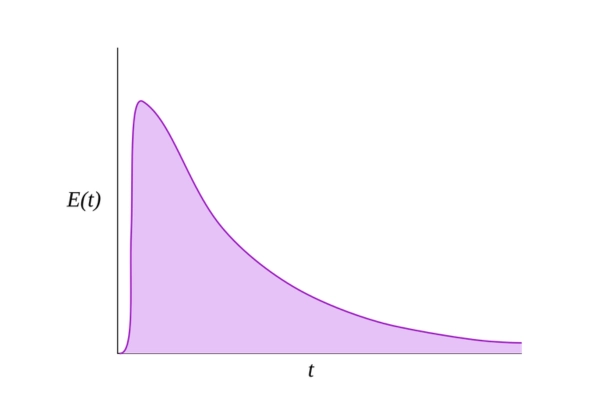
Residence time is not a single fixed value in real industrial systems.

Instead, it is a distribution, meaning different fluid elements spend different amounts of time inside equipment due to:

  • Flow patterns
  • Mixing conditions
  • Channeling effects
  • Equipment geometry

In ideal models, such as plug flow systems, residence time is uniform. In real systems, it deviates significantly from ideal behavior.

Why Residence Time Matters

Residence time directly determines:

  • Conversion in chemical reactions
  • Selectivity of desired products
  • Yield efficiency
  • Degree of side reactions
  • Product quality consistency

In industrial chemical processes, even small changes in residence time can significantly affect final product distribution.

산업 분야 적용

Residence time is a key design parameter in multiple 도겐-related industrial systems.

Continuous Flow Reactors

In continuous flow systems, residence time determines how long reactants stay under reaction conditions.

It directly impacts:

  • Reaction completion
  • Heat release control
  • Safety in exothermic systems

이는 특히 다음의 경우에 중요합니다:

  • 정밀 화학 제품
  • 제약 중간체
  • LiFSI electrolyte synthesis

Separation Processes

In separation systems such as:

residence time affects:

  • Phase equilibrium achievement
  • Separation efficiency
  • Product purity stability

Polymerization Systems

In polymer production (e.g., PLA, PGA):

residence time controls:

  • 분자량 분포
  • Polymer chain growth
  • Viscosity evolution
  • Final material performance

엔지니어링 고려 사항

From a process design perspective, residence time must be carefully controlled and matched with reaction kinetics.

Key engineering factors include:

  • Reactor volume design
  • Flow rate stability
  • Mixing characteristics
  • Heat transfer limitations
  • Axial dispersion effects

A mismatch between residence time and reaction kinetics often leads to:

  • Low conversion
  • Excess by-products
  • Poor selectivity
  • Runaway reactions in exothermic systems

Residence Time Distribution (RTD)

In real industrial systems, residence time is better described by RTD rather than a single value.

RTD analysis helps engineers understand:

  • Back-mixing behavior
  • Flow non-idealities
  • Dead zones in equipment
  • Channeling effects

This is critical in scaling up processes from laboratory to industrial plants.

Relationship to DODGEN Technologies

Residence time is tightly connected to:

It is a foundational parameter in nearly all chemical process design decisions.

Challenges in Industrial Control

Controlling residence time in real systems is difficult due to:

  • Flow instability
  • Equipment fouling
  • Scale-up deviations
  • Multiphase flow complexity
  • Temperature gradients

Advanced reactor designs (such as plug flow reactors and microreactors) are often used to reduce these uncertainties.

관련 용어

  • Plug Flow
  • 연속 프로세스
  • Conversion
  • 선택성
  • 물질 전달
  • Axial Dispersion
  • Reaction Kinetics

관련 라이선스 기술 및 장비

화학 공정 솔루션

애플리케이션

지속 가능성

메시지 보내기

반응 및 분리 전문, 저탄소 기술 파트너

도겐-화학-공정-회사

문의하기

고객의 요구 사항을 충족하기 위해 최선을 다합니다.