High-molecular-weight 폴리글리콜산(PGA) production requires control of more than glycolide conversion. During continuous polymerization, changes in viscosity, crystallization and heat transfer can affect material transport, while residual monomer, moisture and thermal exposure influence final resin properties.
Glycolide ring-opening polymerization (ROP) is an established route to high-molecular-weight PGA. However, reactor design and downstream processing depend on whether polymerization occurs in a bulk or melt-phase system, a solvent-based solution or a slurry. Each route presents different requirements for mixing, heat removal, material transport and separation.
An integrated production process must coordinate polymerization, residual glycolide management, drying and stabilization to maintain molecular weight, melt viscosity and product consistency during continuous operation.
Glycolide Ring-Opening Polymerization and Molecular Weight Control
Glycolide ROP converts the cyclic dimer of glycolic acid into PGA through catalytic ring opening and chain propagation. Unlike direct glycolic acid polycondensation, ROP does not rely on removing condensation water to drive chain growth, although moisture control remains important because water can affect initiation and polymer degradation.
Monomer Purity, Catalyst and Initiator Control
Water and other reactive impurities can alter chain initiation, promote chain-transfer reactions or contribute to degradation. Consistent glycolide purity is therefore an upstream requirement for reproducible polymerization.
Stannous octoate, Sn(Oct)₂, is a commonly investigated catalyst for glycolide ROP. In suitable catalyst–initiator systems, polymerization can proceed through coordination-insertion mechanisms. Initiator concentration influences the number of growing chains and, together with conversion and side reactions, affects the resulting molecular weight.
Three variables require coordinated control:
- Glycolide purity and moisture: Reactive contaminants can change polymerization behavior and molecular weight.
- Catalyst and initiator concentrations: These influence reaction kinetics and chain growth.
- Temperature and residence time: These affect conversion and the polymer’s cumulative thermal exposure.
Increasing catalyst concentration or temperature may accelerate polymerization, but neither guarantees higher molecular weight.
Reaction Kinetics and Molecular Weight Retention
Conversion, molecular weight distribution and melt viscosity are different quality indicators. Two operating conditions may achieve similar glycolide conversion but produce different resin properties because of differences in chain transfer, degradation or residence time distribution.
Industrial process development should establish the relationship between feed quality, reaction conditions and the required resin specification rather than optimize conversion alone.
Kureha’s published industrial development study documents the integration of high-purity glycolide production with continuous polymerization of high-molecular-weight PGA and reports that a commercial production plant was operating at the time of publication [1].
Continuous PGA Polymerization: Process Routes and Reactor Design
Continuous PGA polymerization is not a single reactor configuration. The appropriate design depends on the polymerization medium, phase behavior, temperature profile and physical properties of the developing polymer.
Bulk, Melt and Slurry Polymerization
In bulk or melt-phase ROP, the reactor must maintain adequate mixing, heat removal and material discharge as polymer viscosity and phase behavior evolve. Crystallization or localized solidification can restrict flow and reduce heat transfer when operating conditions do not maintain sufficient material mobility.
Solvent-based or slurry ROP follows a different operating principle. PGA may form solid particles within a liquid medium, making solids suspension, reaction heat removal and downstream solid–liquid separation central design considerations.
These routes should not be confused with glycolic acid polycondensation or solid-state polycondensation (SSP). Although SSP or reactive extrusion may be used in particular PGA manufacturing schemes, neither is an obligatory stage of glycolide ROP.
Managing Crystallization and Material Transport
In bulk systems, increasing viscosity and localized solidification can reduce material renewal at heat-transfer surfaces. In slurry systems, changes in solids concentration can affect agitation requirements, suspension uniformity and discharge reliability.
Both routes require phase-specific monitoring, but their principal failure mechanisms differ. Bulk processes may require close attention to melt mobility and deposition, while slurry processes may require control of solids loading, suspension quality and separation performance.
Selecting a Continuous Reactor Configuration
| Reactor configuration | Engineering advantage | Main limitation |
|---|---|---|
| Stirred prepolymerization reactor | Controls mixing and temperature during early polymerization | Performance may decline as viscosity or solids content increases |
| Tubular reactor | Provides a defined flow path and reaction volume | Deposition, crystallization or viscosity growth may increase pressure drop |
| Kneader or ribbon reactor | Handles highly viscous or partially solidified material | Mechanical loading, material renewal and heat removal require validation |
| Reactive extruder | Combines transport, mixing and selected reaction or post-treatment functions | Shear heating, residence time and degradation must be controlled |
A staged configuration can assign different reactor functions to different conversion ranges. Selection should be based on measured rheology, phase behavior, heat-removal capacity and discharge performance, not equipment type alone.
Kureha’s industrial study establishes the feasibility of commercial continuous high-molecular-weight PGA production, but it does not establish one universally applicable reactor arrangement for every polymerization route [1].
Residual Glycolide Removal and Devolatilization
Residual glycolide may remain because of incomplete conversion or form through secondary reactions during subsequent thermal processing. Its concentration should be controlled alongside molecular weight and melt viscosity because removal conditions can also affect polymer quality.
Route-Specific Monomer Removal
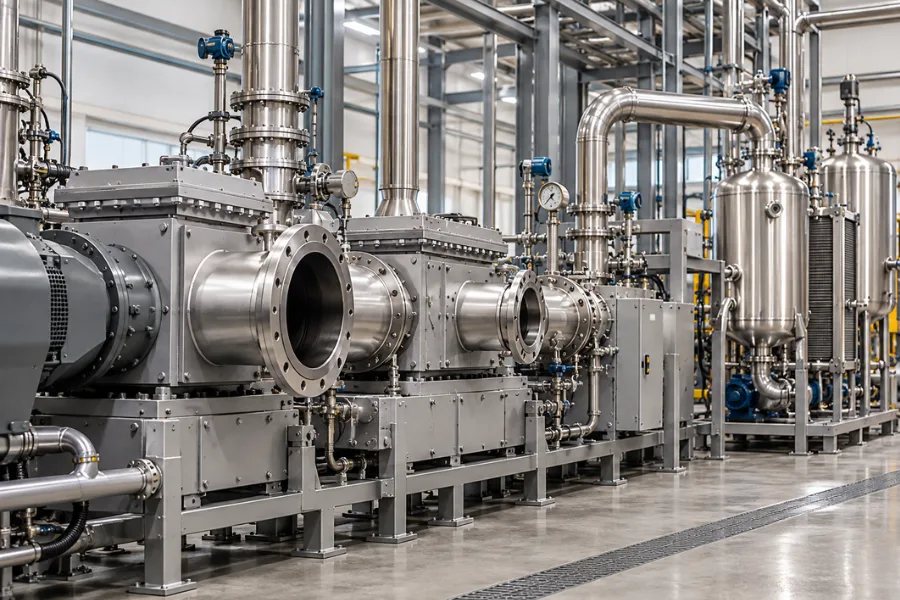
For processable polymer melts, vacuum devolatilization reduces the surrounding glycolide partial pressure and promotes volatile removal. Separation performance depends on temperature, exposed surface area, surface renewal and the rate at which glycolide migrates through the polymer phase.
Highly viscous materials may require mechanically renewed surfaces to reduce mass-transfer limitations. However, increasing temperature or residence time to improve removal can increase thermal exposure.
Slurry-based routes may use solid–liquid separation followed by route-specific purification and drying. Solvent recovery and residual monomer recovery should be evaluated separately because they involve different separation targets and material balances. Washing may be appropriate for a particular process, but it should not be assumed to be mandatory for every slurry route.
Balancing Removal Efficiency and Polymer Quality
The operating objective is to meet the residual glycolide specification without unacceptable molecular weight loss. A higher removal rate is not necessarily an improvement if it requires conditions that promote degradation.
Process development should measure residual glycolide together with molecular weight and melt viscosity. This helps distinguish inadequate separation from changes in the polymer that occurred during reaction or downstream processing.
PGA Resin Drying and Moisture Control
PGA contains hydrolyzable ester bonds, so moisture exposure can cause chain scission, particularly during high-temperature processing. Drying reduces the water available for hydrolysis but cannot restore molecular weight already lost through degradation.
Drying Temperature, Dew Point and Residence Time
Drying performance depends on gas dew point, resin temperature, residence time, pellet dimensions and internal moisture diffusion.
Patent US20090131602A1 describes a multistage treatment sequence. In one example, PGA powder was first dried at 120°C for 12 hours using air with a dew point of −50°C, reaching a reported moisture content of 42 ppm. After stabilization and melt extrusion, the resulting pellets underwent a further 17-hour heat treatment at 170°C under the same dew-point condition, yielding a reported moisture content of 27 ppm and melt viscosity of 710 Pa·s [2].
These results describe a combined formulation and thermal-processing sequence, not a universal drying specification. The final moisture and melt viscosity cannot be attributed to any single step without additional comparative evidence.
Continuous Drying and Moisture Reabsorption Control
Moisture control must continue after the dryer outlet. Dried pellets can reabsorb water during conveying, intermediate storage, packaging or transfer to extrusion equipment, undermining the benefit of the drying stage.
A continuous production line should evaluate:
- Closed conveying using appropriately dried gas.
- Controlled-moisture intermediate storage.
- Maximum holding times between drying and melt processing.
- Moisture sampling at the dryer outlet and before downstream processing.
The required controls depend on resin characteristics, ambient conditions and the time between drying and use. Final moisture content and melt viscosity should be monitored separately because low moisture does not prove that the polymer avoided earlier hydrolytic damage.
PGA Resin Stabilization and Thermal Degradation Control
Moisture removal addresses one degradation pathway, but thermal and catalyst-associated reactions may still affect PGA during subsequent processing. Stabilization must match the polymerization chemistry, residual catalyst species and downstream thermal conditions.
Catalyst Deactivation and Thermal Stabilizers
Residual catalyst species may contribute to unwanted reactions during downstream processing. Catalyst deactivation or compatible additives can reduce selected degradation pathways, but their effectiveness depends on the actual catalyst system and formulation.
US20090131602A1 describes a specific formulation using 300 ppm, based on PGA mass, of a nearly equimolar mixture of mono- and di-stearyl acid phosphate as a thermal stabilizer, together with 0.5 wt.%, based on PGA mass, of N,N-2,6-diisopropylphenylcarbodiimide as a carboxyl end-capping agent. The disclosed sequence includes melt extrusion followed by heat treatment of the pellets [2].
These values belong to that patent’s formulation and processing conditions. They should not be transferred to other PGA grades without compatibility and performance testing.
Stabilizer Addition Point and Mixing
The addition point affects additive dispersion and thermal history. Adding stabilizers too early may interfere with polymerization or expose them to unnecessary reaction conditions, while adding them too late may leave insufficient time or mixing capacity for uniform distribution.
The selected location should provide adequate mixing, compatibility with residual catalyst and polymer end groups, reliable dosing, and limited unnecessary high-temperature residence time. Depending on the process, additives may be introduced after the main polymerization stage or during a validated downstream melt-compounding step.
Matching Stabilization Methods to Degradation Mechanisms
| Stabilization strategy | Primary objective | Engineering consideration |
|---|---|---|
| Catalyst deactivation | Reduce residual catalytic activity | Must match catalyst chemistry and residual concentration |
| Carboxyl end-capping | Reduce end-group-associated hydrolysis | Requires compatible chemistry and adequate mixing |
| Thermal stabilizers | Improve stability during melt processing | Performance depends on formulation and thermal history |
| Metal deactivators | Limit selected metal-promoted degradation pathways | Relevant metal species must be identified |
Stabilizer selection should follow identification of the dominant degradation mechanism rather than serve as a substitute for moisture control or appropriate polymerization conditions.
PGA Polymerization Scale-Up and Quality Control
Higher throughput can change heat removal, residence time distribution, mechanical loading and downstream separation capacity. Pilot validation must therefore include sustained operation rather than short steady-state runs alone.
Critical Process Parameters and Quality Attributes
| Critical process parameter | Quality attribute to monitor |
|---|---|
| Glycolide purity and moisture | Conversion and molecular weight |
| Catalyst and initiator dosage | 분자량 분포 |
| Polymerization temperature and residence time | Conversion and degradation indicators |
| Mixing and heat removal | Temperature uniformity and product consistency |
| Devolatilization or monomer separation | Residual glycolide concentration |
| Drying temperature and gas dew point | Final resin moisture |
| Stabilizer dosage and dispersion | Melt-processing stability |
These relationships should be established experimentally because their sensitivities depend on the selected polymerization route and resin specification.
Long-Duration Continuous Operation
Short pilot trials may not reveal gradual deposition, fouling, feed fluctuations or additive-dosing instability. Long-duration validation should track pressure drop, torque, heat-transfer performance and product quality over successive operating periods.
Molecular weight, residual glycolide and moisture should be trended alongside operating data. Startup, shutdown, feed interruptions and temperature disturbances also require evaluation because transient conditions may produce material with a different thermal history from steady-state production.
Residence time distribution is particularly important. A fraction of material retained longer than expected may undergo disproportionate degradation even when average residence time remains within the intended range.
Diagnosing Process Instability
| 신호 처리 | Possible mechanism | What to verify | 기술 대응 |
|---|---|---|---|
| Increasing reactor pressure drop | Deposition, crystallization or viscosity growth | Temperature profile, conversion and flow rate | Review phase behavior and transport conditions |
| Declining melt viscosity | Hydrolysis, thermal degradation or altered chain growth | Moisture, GPC results and thermal history | Identify the affected process stage |
| Elevated residual glycolide | Incomplete conversion or insufficient removal | Conversion, separation conditions and residence time | Evaluate reaction and separation independently |
| Increasing discoloration | Oxidation or secondary thermal reactions | Oxygen exposure, temperature and catalyst residues | Review thermal exposure and stabilization |
| Variable molecular weight | Feed quality or residence time fluctuations | Monomer purity, dosing and process trends | Improve feed and operating consistency |
These signals support diagnosis but do not independently establish a root cause. Corrective action should follow operating-data review and appropriate laboratory testing.
Evaluating an Integrated PGA Production Process
A suitable PGA production process must meet the target resin specification at the intended throughput while accommodating the physical behavior of the selected polymerization route. The key decision is whether reaction, separation, drying and stabilization can operate together without compromising molecular weight or product consistency during prolonged production.
Process route evaluation should connect reactor design with monomer recovery, solids handling, moisture protection and quality assurance before the equipment configuration is finalized.
도겐 supports continuous chemical manufacturing through process route evaluation, separation engineering, process integration and pilot-to-commercial scale-up assessment. These capabilities provide an engineering framework for evaluating integrated PGA production processes and their industrialization requirements.
Technical References
- Yamane, K., Sato, H., Ichikawa, Y., Sunagawa, K., and Shigaki, Y. “Development of an Industrial Production Technology for High-Molecular-Weight Polyglycolic Acid.” Polymer Journal, 46, 769–775 (2014).
- US20090131602A1. Polyglycolic Acid Resin Particle Composition and Process for Production Thereof.
- US9657147B2. Continuous glycolide polymerization involving a solvent-based system.