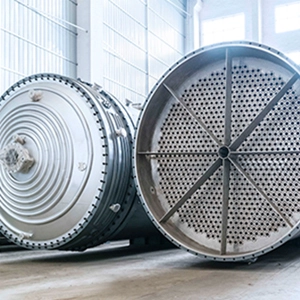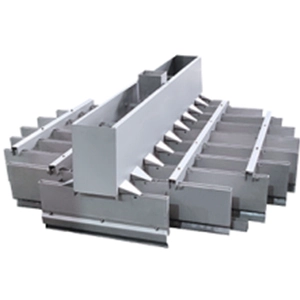
Converting aqueous 시안화나트륨(NaCN) into a controlled solid product requires coordinated crystallization, solid-liquid separation, and drying. Solution composition affects crystal growth, crystal properties influence centrifuge dewatering, and residual cake moisture and particle behavior determine dryer duty and downstream forming performance.
Equipment selection should therefore follow the changing material condition from NaCN solution to crystals, wet cake, dry powder, and final formed product.
Why NaCN Properties Shape the Solid-Product Process
NaCN is highly soluble in water. Reference data reports water solubility of approximately 48 g/100 mL at 10°C and 63.7 g/100 mL at 25°C, making water removal a central requirement in solid-product production.
Dry NaCN is relatively stable under appropriate dry storage conditions. Moisture, acidic species, and other incompatible conditions increase the importance of HCN control, so moisture management affects containment, air ingress, off-gas handling, and enclosed solids transfer as well as final product condition.
These requirements extend across crystallization, centrifugation, NaCN drying, powder recovery, forming, and packaging rather than ending at any single equipment boundary.
NaCN Evaporative Crystallization: From Solution to Controlled Crystals
For aqueous NaCN, crystallizer performance must be evaluated by both solids recovery and the physical characteristics of the crystals sent to downstream separation.
증발 결정화
Evaporative crystallization generates supersaturation by removing water. Published sodium cyanide crystallization processes use this route to produce crystal slurry for subsequent classification, dewatering, and drying.
Water-removal rate cannot be evaluated independently of crystal growth, impurity concentration, and heat transfer. Greater evaporation may increase supersaturation while also changing nucleation, fines generation, liquor composition, and the heat-transfer duty required to maintain production.
Impurities become more significant as the mother liquor concentrates. Sodium carbonate can precipitate during evaporation and contribute to heating-surface fouling, reducing heat-transfer performance and potentially constraining sustained evaporator operation.
Cooling crystallization provides an alternative method of generating supersaturation but shifts utility demand toward cooling and creates different hydrate and dehydration considerations. Route selection should therefore consider feed condition, energy integration, crystal properties, impurity behavior, and downstream solids processing rather than crystallization yield alone.
Crystal Quality Determines More Than Product Purity
Yield and chemical purity do not fully describe the performance of a NaCN crystallizer. Particle size distribution, morphology, and fines content influence how the resulting slurry behaves during separation.
Small particles and excessive fines can reduce cake permeability and increase retained mother liquor. A wetter or less consistent centrifuge cake then increases drying duty even when crystallizer solids yield is satisfactory.
Dryer load begins in the crystallizer.
A crystallizer that increases solids production while producing difficult-to-dewater crystals may transfer the limiting step from crystallization to centrifugation or drying.
When Crystal Classification Adds Value
A classifying crystallizer separates crystal populations rather than withdrawing all solids under the same conditions.
Published NaCN process work describes configurations in which smaller crystals are separated from the larger product fraction. Larger crystals were associated with improved dewatering and compaction characteristics, while fine crystal streams could be returned to the process.
Classification can therefore influence separator loading, retained mother liquor, solids recovery, and downstream forming in addition to product particle size. Its value depends on the actual PSD, recycle strategy, impurity behavior, and required final product properties rather than on crystal size alone.
Mother Liquor and Impurities Can Reshape the Process
Mother-liquor recycle recovers residual NaCN but also returns dissolved impurities to the crystallization loop. Relevant circulating species can include sodium carbonate, sodium formate, and residual alkalinity.
This creates a process trade-off:
Higher recycle → greater material recovery → greater impurity recirculation → possible accumulation → altered crystallization and fouling behavior
Sodium carbonate precipitation is particularly relevant because published NaCN process work identifies it as a potential contributor to evaporator heating-surface fouling. The recycle strategy should therefore be evaluated against impurity concentration trends, deposition behavior, product purity, and material recovery rather than recovery percentage alone.
A high recycle ratio can be attractive from a material-balance perspective while still creating an unfavorable long-term operating condition if poorly rejected impurities progressively accumulate.
Solid-Liquid Separation Sets the Dryer Load
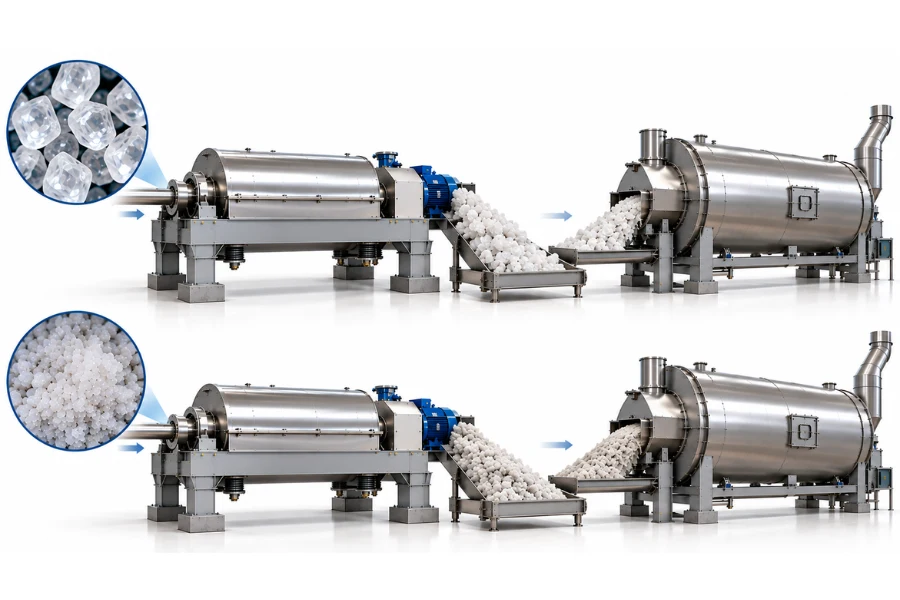
The centrifuge must produce more than recovered NaCN crystals. It must provide a wet solid with moisture content and physical consistency compatible with the selected dryer.
Slurry solids concentration, PSD, morphology, fines content, cake permeability, and retained mother liquor all influence dewatering. Variation in any of these parameters can appear downstream as changing cake moisture or unstable dryer feed.
Published NaCN crystallization tests illustrate this interaction. One laboratory case reported a median crystal size of about 243 μm with approximately 17% cake moisture after dewatering, while another case near 272 μm also produced approximately 17% cake moisture.
Crystals sampled from an operating plant were reported at an average particle size of approximately 109 μm and about 21% cake moisture. Because these observations came from different process conditions, they do not establish a universal particle-size-to-moisture relationship.
They do demonstrate why PSD and dewatering should be validated together. Residual cake moisture becomes downstream dryer duty, so reducing or stabilizing moisture at the centrifuge can improve drying capacity and energy use without increasing installed dryer size.
Selecting a Dryer for Wet NaCN Crystals and Filter Cake
Dryer selection should begin with representative centrifuge cake rather than a preferred dryer technology.
The main screening variables are:
- Wet-cake moisture and moisture variability
- Particle-size distribution and fines fraction
- Cake cohesiveness, agglomeration, and dispersion behavior
- Required final moisture and moisture uniformity
- Throughput and feed-rate variability
- Permissible product temperature
- Process-gas demand
- Particle entrainment and dust recovery
- Containment and off-gas requirements
- Powder properties required for downstream forming
These variables determine whether direct gas-solid drying or an indirect heat-transfer architecture is more compatible with the process.
Rotary or Spin Flash Drying
Rotary flash drying has relatively strong NaCN-specific process evidence. Published process descriptions use rapid dispersion and gas-solid contact to dry wet NaCN solids, followed by entrainment and downstream powder recovery.
The route is most relevant when the wet cake can be dispersed reliably and short drying exposure is advantageous. Cake cohesiveness and feed consistency matter because poor dispersion can undermine the heat- and mass-transfer conditions on which flash drying depends.
Particle entrainment also couples the dryer to its gas-handling system. Gas volume, fines generation, cyclone or other powder recovery, off-gas treatment, and containment must therefore be evaluated with the drying chamber rather than sized as unrelated downstream accessories.
Fluidized-Bed Drying
Fluidized beds provide intensive gas-solid contact when the particle population can maintain stable fluidization.
For wet NaCN solids, suitability depends on particle-size distribution, feed preparation, agglomeration, fines, and bed behavior. Historical NaCN process literature describes fluidized-bed drying, while other NaCN-specific process development reports feed preparation, plugging, process complexity, and high gas load as limitations in particular configurations.
These observations are configuration-specific rather than evidence that fluidized-bed drying is inherently unsuitable. Representative testing should establish whether the actual feed can enter and remain in a stable fluidized state without excessive agglomeration, attrition, or fines carryover.
A granular, free-flowing NaCN feed and a cohesive centrifuge cake may therefore justify different drying architectures despite having the same chemical composition.
Indirect Paddle Drying
An indirect paddle dryer transfers heat through heated surfaces such as the vessel, shafts, and paddles while mechanical mixing renews solids contact with those surfaces.
This architecture may be considered when reducing process-gas demand is important or when the wet cake can be mixed and heated effectively without depending on stable gas-solid fluidization. Lower gas throughput can also change, rather than eliminate, the requirements for vapor handling and containment.
The evidence level differs from flash drying. Publicly available NaCN-specific evidence for paddle drying is comparatively limited, so its inclusion here is based primarily on general indirect-drying principles and wet-cake handling logic rather than equivalent NaCN operating evidence.
Representative-material testing should therefore verify mixing behavior, heat transfer, discharge characteristics, achievable moisture, and product condition before this route is selected.
Rotary Flash vs. Fluidized Bed vs. Paddle Drying
The three architectures impose different requirements on the wet feed and surrounding process system.
| Selection Factor | Rotary Flash | Fluidized Bed | Indirect Paddle |
|---|---|---|---|
| Wet-cake handling | Strong candidate if dispersible | Feed-dependent | Strong candidate if mixable |
| Main heat transfer | Direct convective | Direct convective | Indirect conductive |
| Process-gas demand | Relatively high | Relatively high | 아래 |
| Fine entrainment | Important consideration | Feed-dependent | Lower gas-side burden |
| Key solids requirement | Reliable dispersion | Stable fluidization | Effective mixing and surface renewal |
| Residence behavior | Short | Bed-dependent | Mixing and surface-contact dependent |
| Dust recovery | Critical | Important | Different/lower gas-side load |
| NaCN-specific published evidence | Relatively strong | Historical evidence | More limited |
The table should be used for technology screening, not final selection. Representative drying tests are needed when feed behavior, final moisture, powder characteristics, or scale-up performance cannot be predicted reliably from existing operating data.
Drying Must Match the Final Solid Product
Solid NaCN production can continue from drying into compaction or briquetting, screening, fines recycle, and packaging. Dryer performance therefore cannot be judged by outlet moisture alone.
Particle attrition and excessive fines can impair forming behavior, while variable residual moisture can change powder flow and compaction consistency. Dryer operating conditions should therefore be assessed against the physical requirements of the downstream forming step.
A higher instantaneous drying rate has limited value if the resulting powder increases fines recycle or destabilizes compaction.
Integrating Crystallization, Separation, and Drying at Industrial Scale
Scale-up can alter heat transfer, slurry circulation, crystal residence behavior, PSD, separator loading, cake consistency, gas demand, and dust load. These variables do not necessarily increase in proportion to nominal plant throughput.
For example, a commercial crystallizer can achieve the required solids production while generating a broader PSD than expected. If that change reduces cake permeability, the centrifuge can discharge wetter solids and move the effective capacity constraint to the dryer even when its nominal throughput remains adequate.
도겐‘s published NaCN process technology treats evaporation and concentration, crystallization, centrifuge separation, wet-solid drying, and compression/forming as a connected solid-production train. Its published process description also identifies continuous, stable operation as an overall process objective.
Pilot or representative-material testing should focus on the interfaces most likely to change during scale-up:
- Crystal growth, PSD, and classification behavior
- Slurry concentration and solids handling
- Centrifuge dewatering and cake-moisture variability
- Dryer feedability and achievable moisture uniformity
- Powder attrition and fines generation
- Gas, vapor, dust, and recovery-system loads
- Downstream forming behavior
Equipment capacity alone does not demonstrate scalability. Commercial performance depends on whether material properties remain within the operating window required by the next unit operation.
Engineering Decision Framework
When a problem appears in the drying section, the location of the symptom should not be assumed to be the location of the cause.
| 공정 신호 | 추정되는 작용 기전 | 확인해야 할 사항 | 엔지니어링 방향 |
|---|---|---|---|
| Excess fines | Limited crystal growth, attrition, or classification imbalance | PSD before and after key solids-handling steps, crystal morphology, residence behavior | Identify whether fines originate in crystallization or mechanical handling before changing dryer capacity |
| High cake moisture | Poor cake permeability, excessive fines, or inconsistent centrifugation | PSD, cake structure, slurry solids, centrifuge performance | Correct crystallization or separation limitations before increasing dryer duty |
| Variable dryer feed | Changing slurry solids or inconsistent dewatering | Slurry concentration, centrifuge discharge, cake-moisture distribution | Stabilize wet-solids feed before retuning dryer conditions |
| High process-gas load | High incoming moisture or dependence on convective heat transfer | Cake moisture, water load, gas-to-solids requirement | Compare improved dewatering with alternative heat-transfer architecture |
| High dust burden | Fine crystals, particle attrition, or gas entrainment | PSD across crystallizer, centrifuge, dryer, and recovery system | Locate the fines-generation step before modifying dust collection alone |
| Poor compaction | Unsuitable dry-powder PSD, residual moisture, or particle condition | Powder PSD, moisture, fines recycle, forming behavior | Adjust the unit operation responsible for the unsuitable powder property |
| Variable final moisture | Uneven wet-cake condition, feed rate, or residence behavior | Cake-moisture distribution, feed stability, dryer residence behavior | Stabilize feed variability before increasing drying severity |
| Evaporator fouling | Impurity precipitation or accumulation through recycle | Mother-liquor composition trend, deposition location, recycle behavior | Address impurity management before compensating with greater heat input |
This sequence separates symptom correction from root-cause correction. Increasing dryer capacity will not resolve a moisture bottleneck created by poor cake permeability, just as larger dust collection equipment will not eliminate fines generated by unstable crystallization or excessive particle attrition.
From NaCN Solution to a Controlled Solid Product
NaCN equipment selection should be based on the material properties transferred between unit operations. Crystal PSD and morphology affect dewatering, cake condition establishes dryer load, and drying determines whether the powder is suitable for forming and recycle.
The practical design objective is therefore a stable operating window across crystallization, centrifugation, drying, and forming rather than maximum performance from any individual unit.
도겐 evaluates these interfaces through process integration, validation, and industrial scale-up, with the objective of identifying the actual process constraint before equipment is selected or expanded.