What Is Conductivity in Chemical Engineering?

목차

정의

Conductivity, also known as specific conductance, refers to the ability of a material or solution to conduct electric current. It is the reciprocal of resistivity and is commonly represented by the symbol κ (kappa).

In chemical and process engineering, conductivity is used as a key parameter to characterize the electrical transport behavior of materials, especially electrolytic solutions.

Its standard unit is S/cm (siemens per centimeter).

Conductivity in Chemical Engineering

Fundamental Concept

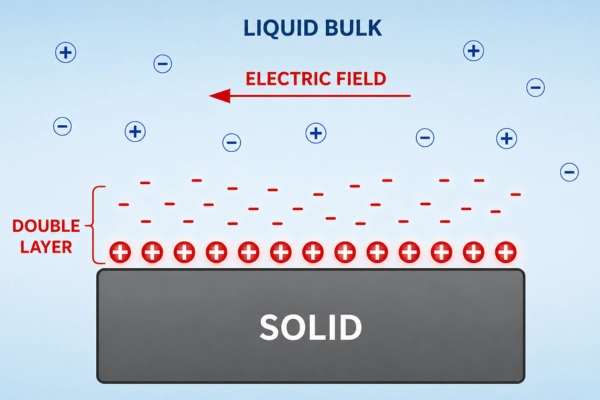
Conductivity describes how easily electric charges (typically ions in solution or electrons in solids) can move through a medium.

For different types of materials:

Conductors (metals, carbon materials)

Conductivity represents electron transport along a solid structure.

Electrolyte solutions

Conductivity represents ion mobility in a liquid phase, strongly influenced by:

  • ion concentration
  • ion charge
  • temperature
  • solvent properties

Mathematical Expression

Conductivity is related to resistance and resistivity as follows:

  • It is the inverse of resistivity
  • It is linked to the conductance of a unit volume system

For a standard reference system:

  • length: 1 cm
  • cross-sectional area: 1 cm²

The conductivity represents the conductance of this defined unit geometry.

산업 분야 적용

Conductivity is widely used in chemical and process industries as a real-time measurement parameter.

일반적인 애플리케이션은 다음과 같습니다:

  • Electrochemical process monitoring
  • Water treatment systems
  • Industrial wastewater analysis
  • Chemical reaction progress tracking
  • Battery electrolyte characterization
  • High-purity water (UPW) systems in semiconductor industry

In many industrial plants, conductivity is used as a fast and continuous online indicator of solution composition.

Process Engineering Considerations

From a chemical engineering perspective, conductivity is influenced by several key factors:

Ion Concentration

Higher ionic concentration leads to higher conductivity.

Temperature Dependence

Conductivity generally increases with temperature due to enhanced ion mobility.

Ion Mobility

Smaller or less hydrated ions move more easily, increasing conductivity.

Solution Composition

Presence of impurities, additives, or mixed electrolytes significantly affects conductivity behavior.

Industrial Measurement Systems

Conductivity is typically measured using conductivity meters equipped with electrodes immersed in the solution.

In industrial systems, it is integrated into:

  • inline process monitoring systems
  • automatic control loops
  • quality assurance systems
  • real-time reaction monitoring platforms (PAT systems)

It is especially important in continuous production environments where rapid feedback is required.

산업적 의의

Conductivity is a fundamental parameter in chemical engineering because it directly reflects:

  • solution purity
  • ionic strength
  • reaction progress
  • system stability

It is widely used as a low-cost, high-speed diagnostic signal in industrial process control systems.

In high-end industries such as semiconductor manufacturing, even small conductivity changes can indicate contamination or process deviation.

Industrial Misconception

A common misunderstanding is that conductivity only reflects “electrical behavior.”

In reality, in chemical engineering systems, conductivity is often used as a proxy variable for chemical composition.

It does not directly measure specific compounds but reflects overall ionic environment changes.

관련 용어

  • Resistivity
  • Ionic Strength
  • Electrolyte Solutions
  • pH Measurement
  • Process Analytical Technology (PAT)
  • Electrochemical Impedance

관련 라이선스 기술 및 장비

화학 공정 솔루션

애플리케이션

지속 가능성

메시지 보내기

반응 및 분리 전문, 저탄소 기술 파트너

도겐-화학-공정-회사

문의하기

고객의 요구 사항을 충족하기 위해 최선을 다합니다.