Definición
La evaluación del ciclo de vida (LCA), también denominada análisis del ciclo de vida, es un método sistemático para evaluar los posibles impactos medioambientales asociados a un producto, proceso o servicio a lo largo de todo su ciclo de vida.
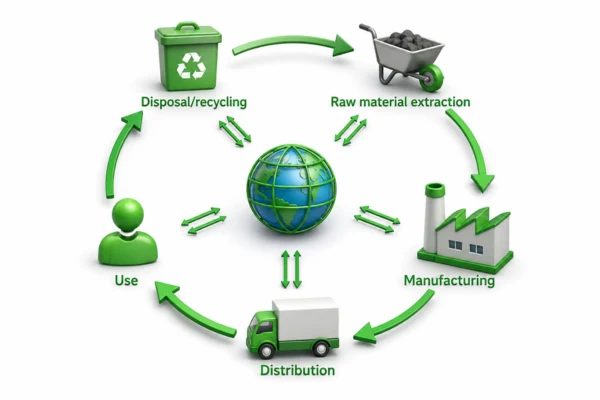
La evaluación puede abarcar la extracción de materias primas, la producción, el transporte, la distribución, el uso, el mantenimiento, el reciclaje y la eliminación final. Esta perspectiva integral se suele describir como un enfoque “de la cuna a la tumba”.
En lugar de evaluar únicamente las emisiones de una planta de fabricación o de una sola unidad de proceso, el ACV analiza los insumos de materiales y energía, las emisiones, los residuos, el consumo de recursos y otras cargas medioambientales en todo el sistema definido. Se utiliza ampliamente para identificar puntos críticos desde el punto de vista medioambiental, comparar alternativas de proceso y respaldar las decisiones de mejora en ingeniería.
¿Cómo funciona el análisis del ciclo de vida?
En el marco de la norma ISO 14040, un análisis del ciclo de vida (ACV) se estructura, por lo general, en cuatro fases interrelacionadas: definición de los objetivos y el alcance, análisis del inventario del ciclo de vida (LCI), evaluación del impacto del ciclo de vida (LCIA) e interpretación.
La norma ISO 14040 describe los principios y el marco de la evaluación del ciclo de vida (ACV), mientras que la norma ISO 14044 especifica los requisitos y las directrices para la realización de estudios de evaluación del ciclo de vida.
Durante la definición de los objetivos y el alcance, se establecen el objetivo del estudio, la unidad funcional, los límites del sistema, los supuestos y la base de comparación. Estas decisiones determinan qué procesos y qué flujos de material o energía se incluyen.
El inventario del ciclo de vida cuantifica los insumos y los productos, tales como las materias primas, la energía, el agua, las emisiones, los residuos y los materiales recuperados. Durante el análisis del ciclo de vida (LCIA), estos flujos del inventario se evalúan según categorías de impacto como el cambio climático, la acidificación, la eutrofización, el agotamiento de los recursos, el consumo de agua, la toxicidad para el ser humano y la ecotoxicidad.
La interpretación relaciona los resultados con el objetivo original del estudio mediante la identificación de puntos críticos del entorno, la evaluación de las compensaciones, el análisis de la incertidumbre y la determinación de aquellos ámbitos en los que las mejoras en los procesos pueden aportar beneficios significativos.
Evaluación del ciclo de vida en el diseño de procesos químicos
En ingeniería química, el análisis del ciclo de vida (ACV) puede utilizarse para comparar materias primas, vías de reacción, tecnologías de separación, sistemas energéticos, estrategias de recuperación y opciones de tratamiento de residuos.
Una modificación del proceso puede reducir el consumo de disolventes, pero requerir más energía para la purificación. El procesamiento en flujo continuo puede mejorar el rendimiento y reducir los residuos, al tiempo que modifica los requisitos de servicios públicos o la demanda de equipos. Una tecnología de separación avanzada puede reducir el consumo energético durante el funcionamiento, pero generar impactos medioambientales en otras fases del ciclo de vida de los equipos o los materiales.
El análisis del ciclo de vida (ACV) ayuda a los ingenieros a identificar estas compensaciones en todo el sistema de proceso, en lugar de evaluar el rendimiento medioambiental a partir de un único indicador.
Una secuencia de decisiones típica podría ser:
Definir alternativas de proceso → Establecer los límites de las unidades funcionales y del sistema → Cuantificar los flujos de materiales y energía → Evaluar los impactos medioambientales → Identificar los puntos críticos → Mejorar el diseño del proceso
Consideraciones y limitaciones técnicas
La fiabilidad de un análisis del ciclo de vida (ACV) depende en gran medida de los límites del sistema, las unidades funcionales, la calidad de los datos, los métodos de asignación, los modelos de evaluación del impacto y las hipótesis sobre las fuentes de energía, el reciclaje y el tratamiento al final de la vida útil.
Cuando se comparan dos tecnologías de proceso, estas deben ofrecer el mismo resultado funcional y evaluarse utilizando unos límites del sistema coherentes. De lo contrario, las ventajas medioambientales aparentes podrían deberse a diferencias en el diseño del estudio y no al rendimiento real del proceso.
Los ingenieros de procesos también deben tener en cuenta el «desplazamiento de la carga». La reducción de las emisiones, el consumo de energía o el uso de recursos en una fase de la producción puede aumentar el impacto medioambiental en otros puntos de la cadena de suministro o del ciclo de vida del producto.
Por este motivo, el análisis del ciclo de vida (ACV) no debe considerarse como una única puntuación medioambiental universal. Para que una evaluación resulte útil, es necesario que se base en supuestos transparentes, datos industriales representativos, métodos de comparación coherentes y un análisis de sensibilidad respecto a las incertidumbres importantes.
Términos relacionados
- Definición del objetivo y el alcance
- Inventario del ciclo de vida (LCI)
- Evaluación del impacto a lo largo del ciclo de vida (LCIA)
- Interpretación
- Límites del sistema
- Unidad funcional
- De la cuna a la tumba
- Huella de carbono
- Tecnología verde