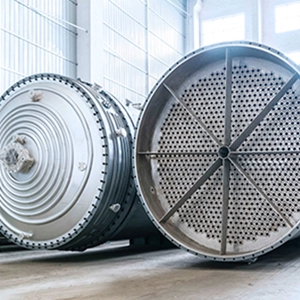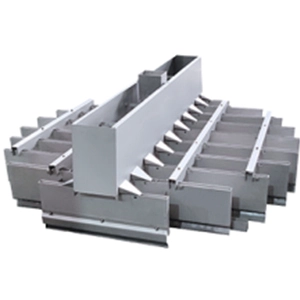
Choosing between random packing and structured packing requires balancing separation efficiency, pressure drop, hydraulic capacity, fouling risk, and lifecycle cost. Structured packing is often favored when column height or pressure drop is constrained, while random packing may be more practical when installation flexibility, maintenance access, or solids handling influences the design.
Neither type is universally superior. The preferred option depends on packing geometry, vapor and liquid loads, fluid properties, liquid distribution, and the column’s operating envelope. Engineers should identify the limiting condition and compare specific packing designs under equivalent process requirements before committing to a selection.
Random Packing vs. Structured Packing: Key Differences
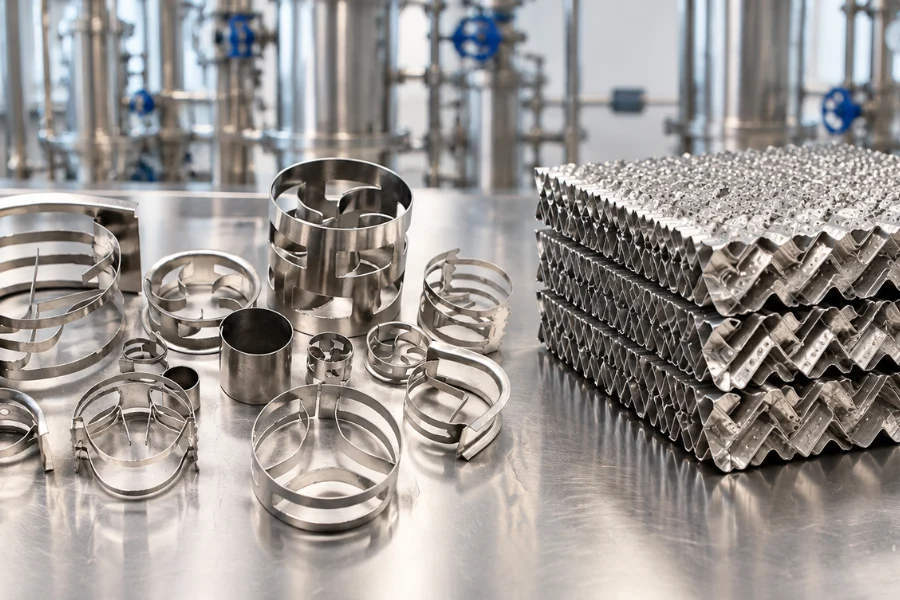
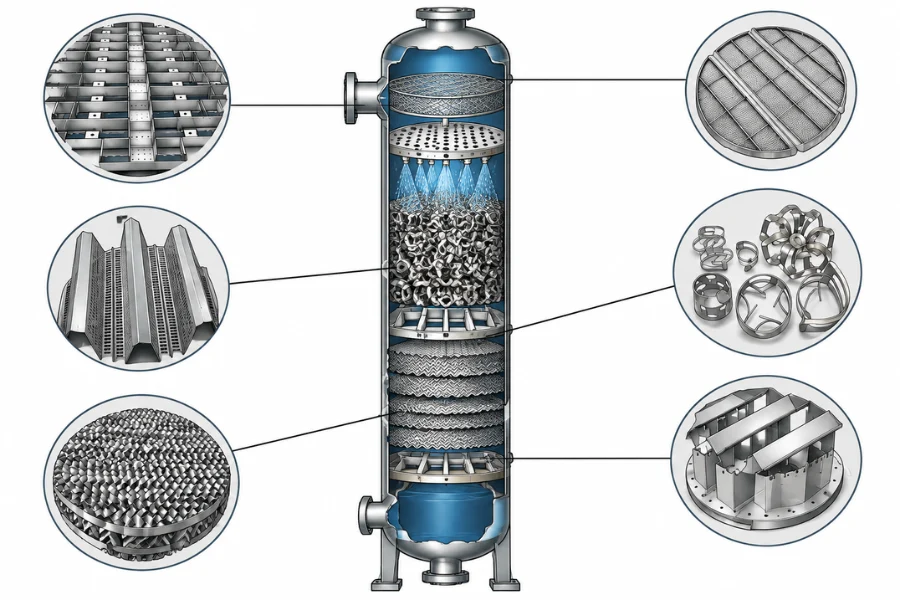
Random packing consists of individual elements loaded into a column to form a disordered bed. Common examples include Pall Rings, saddles, and IMTP-type metal packings. Structured packing uses organized layers of corrugated sheets, wire gauze, or other engineered geometries to create defined flow channels.
These geometries influence gas-liquid contact, pressure drop, liquid distribution, and hydraulic capacity.
| Factor de selección | Embalaje aleatorio | Embalaje estructurado |
|---|---|---|
| Eficiencia de separación | Depends on element geometry, wetting, and operating conditions | Often provides higher efficiency per unit bed height in suitable service |
| Caída de presión | Depends on packing design and hydraulic loading | Often lower for a comparable separation duty |
| Hydraulic capacity | Depends on element geometry, free-flow area, and gas-liquid interaction | Depends on channel geometry, open area, and gas-liquid loading |
| Liquid distribution | Some redistribution may occur, but maldistribution can persist | Initial distribution and redistribution between beds can be critical |
| Fouling and solids | Open designs may suit selected solids-bearing or fouling-prone services | Fine mesh and narrow passages may be vulnerable; open grid designs may be alternatives |
| Installation | Individual elements are often easier to load and remove | Requires controlled assembly, orientation, support, and handling |
| Initial investment | Often lower for comparable general-purpose duties | May require higher packing and installation costs |
| Mantenimiento | Individual elements may be removed for cleaning, subject to access | Removal and reinstallation may require more controlled handling |
These are general tendencies, not guaranteed performance rankings. Modern random packing can provide high capacity and low pressure drop, while structured packing designs differ in surface area, geometry, material, and intended service.
For industrial separation applications, DODGEN’s structured packing solutions provide a relevant starting point for evaluating packing configurations against the required separation duty.
Cómo influye la geometría del relleno en el rendimiento de la columna
Effective Surface Area and Mass Transfer
Packing provides the interface across which components transfer between vapor and liquid phases. Nominal specific surface area, however, is not the same as effective mass-transfer area.
Actual performance depends on liquid wetting, film formation, flow distribution, fluid properties, and gas-liquid interaction. Structured packing uses organized channels and textured surfaces to spread liquid across the packing. Random packing relies on the contact surfaces and flow paths created by individual elements and their orientation.
Increasing nominal surface area does not automatically improve separation. Poor wetting can leave part of the surface ineffective, while maldistribution creates regions with different liquid loads and mass-transfer performance. Near a hydraulic limit, additional surface area may not compensate for deteriorating flow conditions.
Engineers should evaluate effective mass transfer alongside pressure drop and capacity rather than select packing solely by nominal surface area.
Pressure Drop, HETP, and Required Packing Height
Pressure drop measures the pressure loss as vapor passes through the packing. HETP, or height equivalent to a theoretical plate, represents the packing height associated with one theoretical equilibrium stage under specified operating conditions.
For preliminary sizing, the required packing height can be estimated as:
[Z=N_{\mathrm{theoretical}}\times HETP]
Dónde:
- (Z) is the required packing height.
- (N_{\mathrm{theoretical}}) is the required number of theoretical stages.
- (HETP) is the applicable height equivalent to a theoretical plate.
This relationship assumes that the selected HETP is representative of the packed section. If fluid properties, operating loads, or separation behavior vary substantially along the column, a single HETP may not adequately represent the entire bed.
Structured packing is often attractive when column height is limited or pressure drop per theoretical stage is a major constraint. However, the result depends on packing geometry, liquid distribution, and operating load.
HETP is not an intrinsic material property. It varies with packing geometry, fluid properties, pressure, and vapor and liquid loading. Engineers should compare HETP data obtained under similar conditions rather than transfer a value from one fluid system or column configuration to another without validation.
A sound comparison evaluates HETP and pressure drop together. A packing with favorable mass-transfer performance may still be unsuitable if it cannot meet the required capacity, turndown, or hydraulic margin.
Capacity, Flooding, and Operating Range
Packing capacity is governed by vapor velocity, liquid loading, fluid properties, and packing geometry.
As vapor velocity increases, pressure drop generally rises. At high loading, vapor flow increasingly restricts liquid drainage, liquid holdup rises, and the column approaches flooding. High liquid throughput can also alter drainage behavior and reduce the available flow area.
Operating range matters as much as performance at the design point. A packing bed may meet the separation target at normal throughput but lose efficiency or approach hydraulic limits when production rates change.
Neither random nor structured packing has a universal turndown ratio. The usable range must be established from hydraulic and mass-transfer data for the selected packing and liquid distribution system.
For a new column or debottlenecking project, verify performance at minimum, normal, and maximum expected loads. This establishes whether the design can accommodate production changes without sacrificing separation or approaching flooding.
Quantitative Performance Comparison: What Engineers Should Verify
A useful comparison should focus on measurable parameters obtained under comparable conditions. Nominal surface area and packing factor are screening inputs, not sufficient proof of actual column performance.
| Design parameter | What to compare | Why it matters |
|---|---|---|
| Specific surface area | Nominal area per unit packing volume | Indicates potential contact area but does not establish effective wetted area |
| HETP | Values measured or validated for the relevant fluid system and operating range | Estimates the packing height required for a given theoretical-stage duty |
| Caída de presión | Pressure-drop curves at the required vapor and liquid loads | Determines hydraulic performance and pressure-loss constraints |
| Capacity and flooding | Predicted or measured flooding point and design operating margin | Establishes whether the packing can handle peak throughput |
| Liquid distribution | Distributor turndown, irrigation coverage, and redistribution requirements | Determines whether available packing surface is used effectively |
| Fouling tolerance | Flow-passage geometry, deposit behavior, and cleaning requirements | Helps estimate blockage risk and maintenance burden |
| Mechanical compatibility | Material, support, installation clearance, and temperature limits | Establishes whether the design is feasible in the actual column |
How to Interpret Packing Factor Data
Packing factor is a useful hydraulic comparison parameter, but its meaning depends on the correlation, definition, units, and reference conditions used by the source. Values from different tables should not be combined without checking these details.
The original Perry’s Chemical Engineers’ Handbook data should be consulted before publishing a numerical comparison between Mellapak 250Y and IMTP #25. Secondary compilations do not always present the same definitions or units, so a reported packing factor should not be treated as a verified pressure-drop value without checking the original table and its context.
Even when packing factors are confirmed, they do not independently establish the pressure drop at a specific operating point. Engineers must also account for vapor and liquid loads, fluid properties, packing geometry, and the applicable hydraulic correlation.
The same rule applies to HETP. Values obtained from different mixtures, pressures, column diameters, or loading conditions are not automatically comparable.
Engineering decision: Use packing factor and nominal surface area to screen candidates, then verify pressure drop, mass-transfer performance, and flooding margin for the intended process conditions.
Where the Performance Boundary Changes
High Liquid Loads
A packing that performs well at moderate liquid loading may become less attractive as liquid throughput increases. High liquid loads affect drainage, liquid holdup, vapor-flow area, and pressure drop. The magnitude of these effects depends on packing geometry and gas-liquid interaction.
There is no verified universal liquid spray density at which structured packing becomes inferior to random packing. Such a crossover depends on the specific packing designs, fluid system, vapor load, and test conditions.
For high-liquid-load services, compare product-specific hydraulic curves, pressure-drop growth, liquid holdup, flooding behavior, and the required operating margin. The selected packing must satisfy both separation and hydraulic constraints at the actual design rates.
Nominal efficiency and specific surface area cannot determine capacity on their own.
Fouling, Solids, and Maintenance Risk
Suspended solids, precipitated salts, polymer deposits, coke, and viscous residues can accumulate on packing surfaces or obstruct flow passages. The resulting pressure-drop increase and loss of capacity depend on particle size, concentration, deposit adhesion, temperature, fluid viscosity, and the fouling mechanism.
Open random packing may be suitable when it provides sufficient clearance for the process stream or allows individual elements to be removed for cleaning. However, deposits can still bridge openings and accumulate in poorly drained regions.
Structured packing also varies by design. Fine wire gauze and high-area sheet packing may be vulnerable to blockage, while open grid packing can be worth evaluating when the service requires greater fouling tolerance.
Before selecting packing for a fouling-prone process, establish:
- Whether solids are suspended, precipitated, or generated during operation.
- How rapidly deposits form and where they accumulate.
- Whether the packing can be cleaned in place or must be removed.
- The expected maintenance interval and cost of downtime.
- Whether pretreatment or a different process configuration would reduce the fouling burden.
For polymerizing or heat-sensitive materials, consider residence time, local temperature, and the possibility of deposits developing during operation or shutdown.
Maintenance planning should address safe isolation, residual process material, cleaning procedures, and inspection requirements. Combustible deposits may create hazards during shutdown and maintenance, so risk assessment should be based on the actual material inventory and operating history rather than packing type alone.
Vacuum Distillation and Heat-Sensitive Products
Structured packing is often favored in vacuum distillation because low pressure drop can help limit the pressure gradient through the column while maintaining high separation efficiency per unit bed height.
However, vacuum operation alone does not determine the selection. Very low liquid loads can result in incomplete wetting, reducing effective interfacial area. Distributor performance, fluid properties, packing geometry, and operating stability must be checked alongside pressure drop.
For heat-sensitive products, lower pressure drop may support a more favorable operating pressure and temperature profile. The actual benefit depends on process thermodynamics and the complete column design. A packing change alone does not guarantee lower reboiler duty, lower product temperature, or improved product quality.
Compare the entire separation duty, including reboiler and condenser requirements, rather than treating pressure drop as a standalone measure of energy performance.
Small-Diameter Columns and Material Constraints
In small-diameter columns, random packing may be attractive because individual elements can be loaded without assembling structured layers. However, the ratio between column diameter and packing element size matters because wall effects can reduce effective separation performance.
Structured packing can provide high efficiency in compact equipment, but layer assembly, installation access, liquid distribution, and available cross-sectional area may limit its practical advantages.
Material selection introduces additional constraints. Metal, plastic, and ceramic packing differ in corrosion resistance, temperature capability, mechanical strength, and cost. Plastic may suit selected corrosive aqueous systems, while ceramic can be useful in certain corrosive services but requires careful handling because of its brittleness.
The final choice should account for chemical compatibility and mechanical performance under actual operating conditions.
How to Select Packing for a New Column or Revamp
A reliable selection process starts with the separation requirement and proceeds through operating conditions, candidate packing designs, hydraulic verification, and lifecycle cost.
Step 1: Define the Separation Objective
Establish the required product purity, recovery, removal efficiency, or number of theoretical stages.
Identify the primary constraint. It may be separation efficiency, available column height, allowable pressure drop, throughput, or operating cost. A packing change will not necessarily solve a bottleneck caused by another part of the process.
Step 2: Establish the Operating Envelope
Collect the process information needed for hydraulic and mass-transfer evaluation.
- Operating pressure and temperature.
- Minimum, normal, and maximum vapor and liquid flow rates.
- Fluid density, viscosity, surface tension, and relevant phase-equilibrium data.
- Presence of solids, salts, polymers, or other fouling components.
- Required turndown and expected process variability.
Use the full operating envelope rather than relying only on nominal production conditions.
Step 3: Screen Candidate Packing Designs
Compare specific packing products instead of relying solely on the categories of random and structured packing.
Review applicable HETP data, pressure-drop curves, capacity limits, material compatibility, and mechanical requirements. For difficult separations, validated process models, vendor data, or pilot testing may be needed.
Where data come from different fluid systems or operating conditions, identify the differences before using them to predict industrial performance.
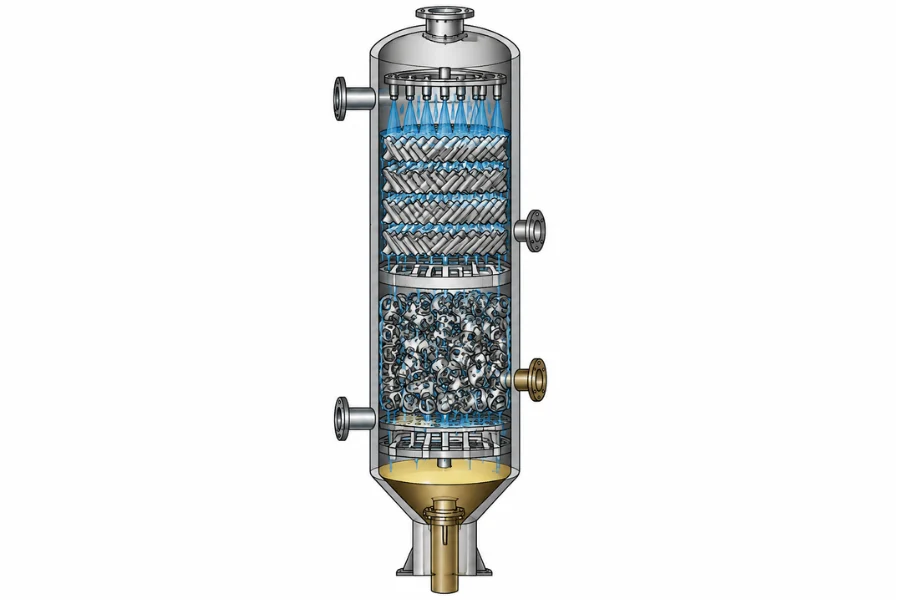
Step 4: Check Liquid Distribution and Tower Internals
Liquid distribution affects effective wetting and separation performance in both random and structured packing.
For structured packing, check distributor suitability and whether liquid collection and redistribution are required between beds. For random packing, verify that the distributor, support plate, and bed arrangement provide adequate liquid coverage and vapor flow.
Confirm that the distributor can operate across minimum, normal, and maximum liquid rates. Also consider wall flow, channeling, and the need for redistribution between packed sections.
Random packing may promote some internal redistribution, but it cannot reliably correct poor initial liquid distribution.
For projects that require a broader review of tower equipment, DODGEN’s column internals provide a relevant product category to evaluate alongside packing selection.
Step 5: Evaluate Fouling and Maintenance Requirements
Determine whether the process requires open flow passages, frequent cleaning, removable elements, or specialized materials.
Consider cleaning methods, inspection access, replacement procedures, and the cost of unplanned shutdowns. These factors can outweigh an initial advantage in mass-transfer efficiency when the service is difficult to maintain.
Step 6: Verify Hydraulic and Mechanical Feasibility
For a new column, establish the required diameter, packed height, support arrangement, and hydraulic margin.
For an existing column, review the internal diameter, available height, support capacity, distributor arrangement, and installation access. A packing replacement may require modifications to the internals and should not be treated as a direct material substitution without engineering review.
For a column revamp, identify the actual bottleneck first. If the limitation is an undersized distributor, insufficient column diameter, or a process constraint outside the packing bed, replacing the packing alone may not deliver the expected improvement.
Step 7: Compare Lifecycle Cost
Estimate the initial investment and expected operating costs over the intended service life.
Include packing purchase, installation, pressure-drop-related energy consumption, cleaning, maintenance, downtime, and production or quality losses attributable to the existing limitation.
A higher-cost packing may be justified if it delivers a measurable benefit under the actual operating conditions. A lower-cost random packing may be preferable when it already meets the separation requirement and the additional efficiency of structured packing has limited economic value.
Preliminary Packing Selection Matrix
Use the following matrix to screen candidate options before detailed hydraulic and mass-transfer calculations. It is a starting point, not a substitute for design validation.
| Process condition | Initial direction to evaluate | Critical checks |
|---|---|---|
| Vacuum distillation with a tight pressure-drop limit | Embalaje estructurado | Wetting, HETP, distributor performance, and pressure profile |
| High separation efficiency with limited bed height | High-efficiency structured packing or suitable high-efficiency random packing | Required stages, capacity, and hydraulic margin |
| Solids-bearing or fouling-prone service | Open random packing or grid packing | Particle characteristics, blockage risk, cleaning, and material compatibility |
| High liquid loading | Compare specific random, structured, and grid designs | Hydraulic curves, liquid holdup, pressure-drop growth, and flooding |
| Existing column revamp | Select based on the identified bottleneck | Tower diameter, supports, distributor, bed height, and shutdown constraints |
| Limited initial capital | Evaluate the least-cost design that meets the process duty | Lifecycle cost, maintenance, energy use, and production losses |
High liquid loading does not automatically favor random packing, and fouling does not make every random packing suitable. Specific geometry and operating data determine whether a candidate meets the process requirements.
Total Cost of Ownership: Beyond Packing Price
The economic comparison should cover three cost categories.
| Cost category | Evaluation questions |
|---|---|
| Initial capital | What are the costs of packing, installation, distributors, supports, and other required modifications? |
| Operating cost | How does pressure drop affect energy use? Will throughput, recovery, or product purity change? |
| Maintenance and downtime | How often will cleaning or replacement be required, and how much production could be lost? |
In vacuum service, pressure drop can influence the column pressure profile and achievable separation. Where gas-moving equipment is involved, pressure loss may affect equipment duty. The economic impact depends on the process configuration and the extent to which packing pressure drop controls energy consumption.
Maintenance costs depend on fouling behavior, access, cleaning method, and the consequences of downtime. A lifecycle comparison should use consistent assumptions for operating hours, energy prices, maintenance intervals, production value, and expected service life.
Without these inputs, a claimed payback period would be speculative.
Can Random and Structured Packing Be Combined in One Column?
Yes. A hybrid arrangement can be evaluated when different sections of a column have different separation, hydraulic, or fouling requirements.
For example, one section may prioritize separation efficiency while another requires more open passages for a fouling-prone stream. The design must account for liquid collection and redistribution, vapor-flow transitions, support requirements, and the hydraulic compatibility of adjacent beds.
A hybrid arrangement is most useful when each section addresses a distinct process constraint. It is unlikely to solve a bottleneck caused by an undersized distributor, inadequate column diameter, or an unsuitable operating envelope unless those issues are addressed as part of the overall design.
Conclusión
Random packing and structured packing should be selected according to the process duty and its controlling constraints. Structured packing is often a strong candidate when low pressure drop, high separation efficiency per unit height, or limited column space matters. Random packing may be more practical when installation flexibility, fouling tolerance, maintenance, or initial investment carries greater weight.
The final decision should be based on comparable mass-transfer and hydraulic data, verified liquid distribution, material compatibility, and lifecycle economics. For an existing column, identify the limiting condition before deciding whether a packing change, internal modification, or broader process adjustment is warranted.
En el caso de los proyectos de separación industrial, DODGEN offers process technology solutions and equipment options that can be evaluated against project requirements. A sound selection starts with reliable operating data, a clear understanding of the bottleneck, and a technical comparison of suitable packing configurations.
PREGUNTAS FRECUENTES
Random packing consists of individual elements loaded into a column, while structured packing uses organized layers with defined flow channels. Structured packing often provides higher separation efficiency per unit height and lower pressure drop, but actual performance depends on packing geometry, fluid properties, liquid distribution, and operating conditions.
Structured packing often has lower pressure drop for a comparable separation duty. The result depends on packing design, vapor and liquid loading, and fluid properties, so product-specific hydraulic data should be compared before selecting a design.
Structured packing is often preferred when vacuum distillation requires high separation efficiency and low pressure drop. The final choice depends on operating pressure, liquid loading, fluid properties, available column height, and liquid distribution quality.
Random packing may be preferable when solids or sticky deposits can obstruct narrow passages, provided the selected geometry offers suitable clearance and maintainability. Open grid packing may also be worth evaluating. Fouling behavior and cleaning requirements should be assessed for the specific process and packing design.
It may be possible, but the change requires an engineering review of column diameter, available height, distributor performance, support structure, hydraulic limits, and separation duty. Replacing packing without correcting a limiting distributor or other internal equipment may produce less improvement than expected.
Yes. A hybrid arrangement can be evaluated when different sections have different separation, hydraulic, or fouling requirements. The design must account for liquid redistribution, mechanical support, and the operating conditions of each section.
No. Structured packing may reduce pressure drop or required bed height in suitable applications, but the economic benefit depends on energy use, operating hours, maintenance requirements, installation costs, and the value of any capacity or purity improvement. A lifecycle cost analysis is needed to determine whether the higher initial investment is justified.