In direct MMA esterification, methacrylic acid (MAA) reacts reversibly with methanol (MeOH) to form methyl methacrylate (MMA) and water. Reactor conversion therefore changes the composition and load entering methanol recovery, water management, MMA purification, and recycle.
Optimizing the reactor alone can shift costs or operating constraints downstream. Catalyst performance, equilibrium, azeotropic separation, polymerization inhibition, recycle stability, and energy recovery must therefore be evaluated as an interacting process system.
Why MMA Esterification Cannot Be Optimized in Isolation
Reaction Rate and Equilibrium Are Different Constraints
Temperature, catalyst loading, reactant concentration, and transport conditions affect the observed esterification rate, but a faster reaction does not necessarily increase equilibrium conversion.
A catalyst lowers the kinetic barrier and accelerates both forward and reverse reactions without changing the equilibrium composition. Once MMA esterification approaches equilibrium, additional catalyst or residence time provides diminishing conversion benefit unless composition or product-removal conditions also change.
For the reversible reaction:
MAA + MeOH ⇌ MMA + H₂O
water formation progressively changes the reaction environment. This distinction helps determine whether limited conversion should be addressed through kinetics, feed composition, water management, or reaction-separation integration rather than simply increasing catalyst loading.
Conversion Changes the Downstream Separation Load
Lower single-pass conversion increases the amount of unreacted MAA and MeOH entering separation. More material must then be recovered and recycled, increasing column throughput, condenser and reboiler duties, and potentially hydraulic load and equipment size.
Recycle creates a second effect. Trace impurities and high-boiling species can accumulate when their net formation or introduction exceeds removal through product streams or purge. The resulting composition drift can affect purification duty, fouling, catalyst environment, and the material returned to the reactor.
Higher conversion can reduce recycle, but conditions used to obtain it may impose other penalties. The relevant target is therefore a conversion range that balances reaction performance against recycle load, separation duty, MMA stability, and operating cost.
Catalyst Selection Changes the Whole Reaction-Separation System
Homogeneous acid catalysts provide intimate contact with the liquid reaction mixture but can introduce corrosion, materials-of-construction, catalyst recovery, and downstream separation requirements. Heterogeneous acidic resins simplify catalyst retention and can support fixed-bed continuous processing, while introducing other scale-up variables such as intraparticle or external mass transfer, pressure drop, water exposure, fouling, and catalyst life.
Experimental studies of MAA esterification with MeOH have investigated sulfonated cation-exchange resins and evaluated variables including catalyst loading, reactant molar ratio, temperature, pressure, stirring, and particle size. Langmuir-Hinshelwood models have also been applied to represent adsorption, surface reaction, and desorption in heterogeneous catalytic systems.
Catalyst Activity vs. Operating Window
Higher catalyst activity can potentially support lower temperature or shorter residence time, but initial activity does not establish commercial suitability.
For continuous operation, catalyst validation should examine:
- conversion and selectivity over time
- activity decay and fouling
- pressure-drop development
- sensitivity to water and feed impurities
- heat- and mass-transfer limitations
- replacement or regeneration requirements
These variables determine whether catalyst performance remains reproducible over an operating campaign rather than only during short-duration testing.
Water Removal Connects Reaction and Distillation
Because water is a product of the reversible esterification reaction, its concentration affects both reaction equilibrium and downstream separation. Product removal can reduce equilibrium limitations, but the benefit depends on the vapor-liquid behavior of MAA, MMA, MeOH, water, and relevant impurities.
Water management is therefore not an isolated dehydration step. Its location and separation method can change conversion, recycle composition, vapor traffic, and the duty assigned to downstream columns.
Methanol Excess Is Not Free Conversion
Increasing the MeOH-to-MAA feed ratio can favor reaction-side performance, but additional MeOH must subsequently be recovered, recycled, or removed.
The plant-wide trade-off is:
More MeOH → potential reaction benefit → larger recovery and recycle load → additional separation duty
The optimum feed ratio therefore depends on both conversion response and the marginal cost of circulating and separating additional MeOH.
The same logic applies to more aggressive water removal. Its reaction benefit should be compared with the additional vaporization, separation, and recycle requirements created elsewhere in the flowsheet.
Reactive Distillation or Separate Reactor and Distillation?
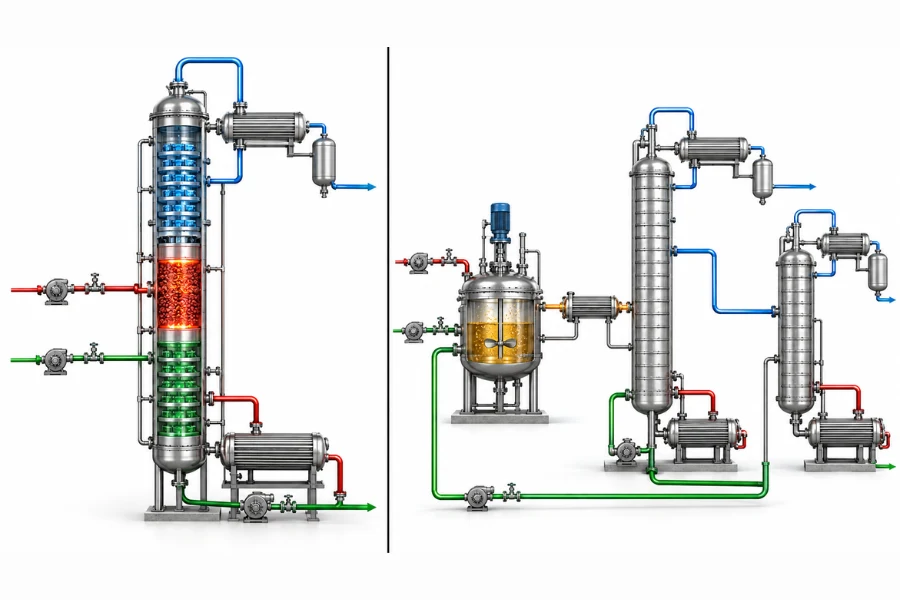
Reactive distillation combines reaction and vapor-liquid separation within one column. For equilibrium-limited esterification, selective product removal can change local composition while reaction proceeds and potentially increase conversion without relying only on excess reactant or longer residence time.
Research on MAA esterification has demonstrated catalytic reactive-distillation configurations containing rectifying, reactive, and stripping sections. Their practical value, however, depends on whether reaction kinetics, catalyst conditions, separation behavior, and MMA stability can share a compatible operating window.
Why Integration Is Not Automatically Better
| Process Factor | Destilación reactiva | Separate Reactor + Distillation |
|---|---|---|
| Equilibrium limitation | Product removal may support conversion | Separation and recycle recover unreacted feed |
| Catalyst conditions | Must match column environment | Reactor conditions can be optimized independently |
| Temperatura | Reaction and VLE requirements are coupled | Reaction and separation temperatures can differ |
| Tiempo de residencia | Linked to column internals and liquid holdup | Primarily set by reactor design |
| Separation | Must coexist with the reactive zone | Dedicated separation sequence can be optimized |
| Mantenimiento | Reaction and separation functions are coupled | More modular equipment |
| Control | Strong multivariable interaction | More independent control loops |
The MMA–MeOH–water system introduces azeotropic constraints that can limit how effectively reaction and separation are combined in one column. If the required component split conflicts with the temperature profile, catalyst operating window, or product-removal objective of the reactive zone, the equilibrium benefit of reactive distillation may not produce the best plant-wide configuration.
A separate reactor followed by dedicated separation and recycle provides greater freedom to set reaction and purification conditions independently, at the cost of additional equipment and recycle handling. Configuration selection should therefore be based on kinetics, VLE, catalyst constraints, inhibition requirements, hydraulics, recycle behavior, and control interactions rather than process integration alone.
MMA Distillation Is Also a Polymerization-Control Problem
MMA purification must separate the target product while limiting conditions that promote unwanted monomer polymerization. Risk depends on the combined thermal history created by temperature, residence time, local composition, inhibitor condition, and liquid holdup.
Reboilers, column bottoms, circulation loops, high-boiler handling sections, and low-flow regions deserve particular attention because extended liquid residence can increase exposure even when the nominal column temperature is acceptable. Polymer or oligomer deposits can then reduce heat transfer, alter hydraulics, increase pressure drop, and shorten stable operating campaigns.
Inhibition Must Follow the Process
Industrial MMA stabilization commonly uses inhibitors such as MEHQ, hydroquinone, or other systems selected for the applicable process conditions. Specifying an inhibitor concentration at the feed does not establish equivalent protection throughout the separation train.
Depending on inhibitor chemistry, volatility, liquid distribution, residence time, phase behavior, and process configuration can cause the local inhibition environment to differ across the column, reboiler loop, reflux system, and heavy-component purge.
Engineering evaluation should therefore verify:
- inhibitor concentration and distribution in critical liquid zones
- local temperature and residence time
- oxygen requirements where applicable to inhibitor chemistry
- inhibitor thermal stability
- high-boiler and polymer accumulation
- residual inhibitor in purified MMA
Vacuum operation can reduce boiling temperature and therefore one component of thermal exposure. The trade-off is increased vapor volume and changes in column hydraulics, condenser conditions, vacuum equipment, and utility demand, so pressure should be selected from both stability and separation requirements.
Design the Purification Train Around the Impurity Profile
The purification train should be based on reactor-outlet and recycle composition rather than a predefined number of columns. Depending on reaction conditions, the process may need to manage unreacted MeOH, water, MMA, residual MAA, light impurities, high-boiling byproducts, and oligomeric or polymeric material.
Light-component removal, reactant recovery, MMA purification, recycle conditioning, and high-boiler purge should then be assigned according to those impurity behaviors and required product specifications.
Recycle composition is particularly important in continuous operation. A low-concentration impurity can reach a much higher circulating concentration when its removal rate is small relative to its introduction or formation rate, affecting separation duty, fouling, catalyst environment, and product quality.
Additional polishing should therefore be justified by the impurity specification it resolves. Every extra thermal separation step adds equipment and utility demand while increasing MMA residence time and thermal exposure.
Energy Saving Starts Before the Reboiler
The energy demand of MMA esterification is partly created upstream of the distillation columns. Conversion, MeOH excess, water management, and recycle determine how much material must repeatedly be heated, vaporized, condensed, and circulated.
A practical optimization sequence is:
Reaction conversion → feed ratio → water management → recycle load → separation sequence → distillation conditions → heat recovery
Reducing unnecessary circulation before installing heat-recovery equipment can lower both utility demand and hydraulic load rather than recovering energy from an oversized material loop.
Optimize Pressure and Reflux Before Adding Complexity
Operating pressure, reflux ratio, feed thermal condition, feed location, condenser duty, and reboiler duty should be optimized around both MMA purity and thermal stability.
Lower pressure can reduce boiling temperature, but it also increases vapor volume and can affect column diameter, pressure drop, condenser temperature level, vacuum equipment, and utility selection. Reflux reduction similarly lowers internal circulation only until separation performance or product specification becomes limiting.
Pressure and reflux should therefore be optimized together with VLE, column hydraulics, and MMA stability rather than minimized independently.
Add Heat Recovery Only Where the Temperature Levels Work
Potential energy-integration options include:
- feed preheating
- condenser-to-process heat recovery
- reboiler integration
- dividing-wall configurations
- heat pumps
- vapor recompression
A large heat duty does not automatically represent a useful heat source. Heat recovery requires sufficient temperature driving force after exchanger approach temperatures, pressure effects, and process constraints are considered.
Heat-transfer area, pressure drop, fouling tendency, startup behavior, and operating flexibility can further determine whether calculated energy recovery is commercially practical. Heat integration also couples unit responses, so a disturbance in one column may propagate through the integrated thermal network.
The relevant target is minimum practical energy demand within a stable, controllable, and adequately inhibited MMA operating window, not minimum steam consumption alone.
What Must Be Validated Before Commercial Scale-Up?
Process simulation can establish mass and energy balances, but commercial MMA esterification also depends on catalyst aging, transport limitations, recycle accumulation, fouling, and dynamic behavior that short-duration equilibrium calculations cannot establish.
Reaction Performance
Verify:
- conversion and selectivity
- catalyst activity over time
- residence-time sensitivity
- temperature response
- heat- and mass-transfer effects
Observed kinetics can deviate from intrinsic kinetics when transport becomes limiting. Pilot data should therefore distinguish chemical-rate limitations from mixing, diffusion, or heat-transfer effects before commercial reactor sizing.
Separation and Recycle Performance
Validate:
- actual VLE behavior
- achievable MMA purity
- recycle composition
- impurity accumulation rate
- high-boiler behavior
- purge requirement
- column hydraulic performance
Long-term mass-balance closure is particularly important. A process can appear stable after reaching an initial steady state while slowly accumulating trace components over repeated recycle, eventually changing product quality or operating conditions.
MMA Stability
Monitor:
- inhibitor distribution
- polymer or oligomer formation
- high-boiler accumulation
- fouling tendency
- thermal exposure in high-risk zones
Validation should determine whether inhibition remains adequate as recycle composition, catalyst activity, fouling, and equipment heat-transfer performance evolve during sustained operation.
Integrated Operation
Evaluate:
- startup and shutdown behavior
- pressure-drop development
- heat-transfer performance
- disturbance response
- recycle stabilization
- control interactions
Commercial scale-up requires these variables to remain compatible simultaneously. Meeting conversion and purity targets at one steady-state operating point is insufficient if recycle composition, inhibition, or hydraulic behavior drifts during extended operation.
A Practical Decision Framework for MMA Process Integration
| Process Question | Qué hay que comprobar |
|---|---|
| Is conversion kinetically or equilibrium limited? | Kinetics, equilibrium, and transport |
| Is the catalyst commercially stable? | Activity decay, fouling, life, and pressure drop |
| Does excess MeOH improve the whole process? | Conversion gain vs. recovery and recycle duty |
| How should water be managed? | Equilibrium effect, VLE, and downstream load |
| Is reactive distillation appropriate? | Reaction-separation compatibility and azeotropic constraints |
| Can recycle composition remain stable? | Impurity accumulation and required purge |
| Is MMA adequately protected? | Local temperature, residence time, and inhibition condition |
| Where can heat be recovered? | Heat balance, temperature levels, and control impact |
| Is the flowsheet scalable? | Pilot reproducibility and long-term operating stability |
A higher single-pass conversion is not necessarily the best plant-wide result if obtaining it increases MeOH circulation, thermal exposure, or separation complexity. Similarly, lower calculated distillation duty has limited value if the configuration increases polymerization risk, fouling, or control coupling.
From Process Optimization to Industrial Deployment
Industrial MMA esterification requires reaction, separation, recycle, inhibition, and energy integration to remain compatible over sustained operation. The commercial design target is therefore not a single maximum conversion or minimum energy value, but a reproducible operating window that maintains product purity without progressive recycle drift, catalyst deterioration, or polymerization-related fouling.
DODGEN evaluates reaction-separation configuration, purification strategy, pilot performance, process intensification, and scale-up as connected parts of this industrialization problem. Pilot-scale validation can then establish whether the selected configuration maintains the required mass balance, catalyst performance, inhibition, hydraulics, and control response before commercial deployment