시안화수소(HCN) has a normal boiling point of approximately 26°C, making it highly toxic and extremely volatile. As a result, HCN production facilities are typically designed around the principles of closed operation, continuous processing, and minimal hazardous material inventory, with HCN transferred directly to downstream reactions whenever possible.
In methane or natural gas ammoxidation processes, ammonia, methane-containing feed gas, and air are mixed, reacted, cooled, and subjected to ammonia removal before the HCN stream is further converted into glycolonitrile, sodium cyanide, or other cyanide intermediates, depending on the product configuration.
A truly mature HCN process technology does not simply optimize individual equipment—it integrates mixing, reaction, heat transfer, absorption, separation, and process control into a single, highly coordinated engineering system.
공정 과제
Why Is Three-Gas Mixing Critical to Stable HCN Production?
Before entering the HCN reactor, large volumes of ammonia, methane-containing gas, and air must be mixed uniformly. If concentration or velocity distributions are uneven, local composition deviations can quickly develop into temperature gradients, uneven catalyst loading, and fluctuations in ammonia conversion.
Therefore, evaluating gas mixing performance requires much more than analyzing the average composition. Engineers must also consider radial concentration distribution, pressure drop, residence time, operating flexibility, and maintenance accessibility.
DODGEN’s Solution
Gas Static Mixer
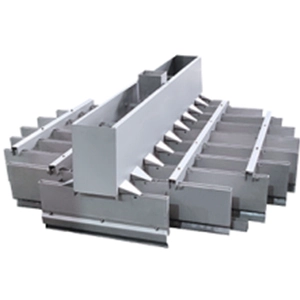
DODGEN employs specially engineered gas static mixers that enhance three-gas mixing through repeated fluid splitting, redirection, and recombination. Multi-stage mixing improves flow uniformity at the reactor inlet and helps establish stable operating conditions.
Although static mixers contain no rotating components, their internal geometry, installation location, and allowable pressure drop must be carefully engineered according to actual flow rate, pipe diameter, and feedstock fluctuations. Generic off-the-shelf designs cannot meet the demanding requirements of HCN production.
HCN Deammoniation
How Can Efficiency, Corrosion Control, and Carryover Be Balanced?
After catalytic synthesis, the HCN process gas still contains residual ammonia. This remaining ammonia not only affects downstream product quality but also alters absorption performance and overall material balance.
Under certain operating conditions, conventional acid absorption towers may encounter challenges such as large equipment size, complex corrosion management, liquid entrainment, and limited operating flexibility. Simply increasing acid dosage does not necessarily improve deammoniation stability.
The engineering objective is to optimize mass transfer driving force, reaction kinetics, and corrosion limits simultaneously.
DODGEN’s HCN deammoniation process utilizes multiple static mixing reaction absorbers arranged in series. Acid concentration increases progressively through each stage, while operating temperature decreases in a controlled manner. Acid is continuously introduced, and ammonium sulfate solution is continuously withdrawn. A high-efficiency gas-liquid separator at the final stage minimizes sulfuric acid and ammonium sulfate mist carryover into downstream processes.
The key advantage lies not in adding more equipment, but in maintaining optimal mass transfer conditions throughout every stage using precisely controlled process gradients.
Downstream HCN Derivatives
How Can Continuous Processing Be Achieved with Minimal HCN Inventory?
An HCN production facility should not be designed simply to produce hydrogen cyanide. Instead, downstream products should determine the design of absorption and reaction systems.
Different products require different combinations of gas-liquid distribution, heat removal capability, residence time, and side reaction control.
Glycolonitrile Production
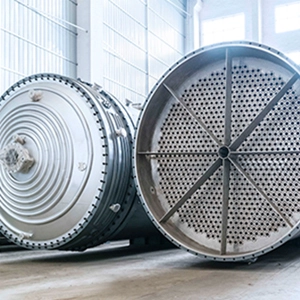
After ammonia removal, the HCN synthesis gas flows cocurrently with a uniformly distributed aqueous formaldehyde film inside a falling film reactor. The large heat and mass transfer area rapidly removes reaction heat before downstream conversion is completed in a static mixing reactor.
For other hydroxynitrile production processes, falling film reactors, DSV reactors, 및 DSR reactors may be combined according to reaction kinetics and required residence time.
Liquid Sodium Cyanide Production
For liquid sodium cyanide production, both gas-liquid contact time and mixing intensity are equally important.
Static mixing reactors connected in series promote rapid gas-liquid reactions within a short residence time while reducing side reactions such as carbonate formation caused by CO₂ absorption and formate generation from cyanide hydrolysis. This approach helps improve product purity while reducing alkali consumption.
What Should a Complete HCN Process Technology Package Deliver?
From an engineering perspective, an HCN technology package should provide far more than a process flow diagram and equipment list.
A comprehensive package integrates process design parameters, critical equipment specifications, safety limits, and automation strategies into a unified engineering solution.
It typically includes:
- Material and energy balances, together with process flow diagrams (PFDs)
- Process conditions and design data for critical equipment
- Instrumentation, control philosophy, and safety interlock logic
- Utility requirements together with startup and shutdown operating limits
- Operating envelopes and abnormal condition response strategies
- Closed handling systems for tail gas and cyanide-containing process streams
FAQ:Six Frequently Asked Questions About HCN Production
What are the major steps in an HCN production process?
모든 국민은 직업선택의 자유를 가진다. 정당은 법률이 정하는 바에 의하여 국가의 보호를 받으며, 국가는 법률이 정하는 바에 의하여 정당운영에 필요한 자금을 보조할 수 있다.
Why is three-gas mixing so important?
The mixing quality of ammonia, methane-containing gas, and air directly affects concentration and velocity distributions at the reactor inlet. Poor local mixing may lead to temperature gradients, uneven catalyst utilization, and fluctuations in ammonia conversion. Static mixer design should therefore consider flow rate, pipe diameter, allowable pressure drop, and operational flexibility.
Why must ammonia be removed from HCN process gas?
Residual ammonia influences downstream absorption performance, material balance, and product impurity levels. An effective deammoniation process must balance ammonia removal efficiency with acid consumption, corrosion control, mist carryover prevention, and continuous ammonium sulfate withdrawal.
How should HCN deammoniation equipment be selected?
Equipment selection should be based on synthesis gas flow rate, residual ammonia concentration, operating temperature and pressure, allowable pressure drop, absorption chemistry, and corrosion considerations. Packed absorption towers, static mixing absorbers, and multistage hybrid systems each have different application ranges and should be selected through comprehensive process evaluation rather than equipment size or single-performance metrics.
What does an HCN process technology package typically include?
A complete HCN technology package generally includes process descriptions, material and energy balances, process flow diagrams, critical equipment specifications, instrumentation and control philosophy, safety interlock logic, utility requirements, and startup/shutdown operating limits, all tailored to the specific plant capacity and product configuration.
How can continuous downstream HCN processing be achieved?
The downstream process should be designed according to the target product and reaction kinetics. Falling film reactors, DSV static mixing reactors, 및 DSR reactors can be combined to optimize gas-liquid distribution, heat removal, and residence time. The primary objective is to minimize hazardous HCN inventory while ensuring rapid and stable conversion into glycolonitrile, sodium cyanide, or other downstream products.