Propiedades del gas silano y riesgos de seguridad asociados
El silano (SiH₄) se clasifica como un gas de proceso pirofórico y tóxico que se utiliza en operaciones de deposición de semiconductores, entre ellas el CVD y el PECVD. Puede inflamarse espontáneamente al entrar en contacto con el aire en un rango de concentración de aproximadamente entre el 1,37 % y el 96 %.
Los límites de exposición se han fijado en 0,05 ppm (TWA) y 0,2 ppm (STEL). El gas tiene una densidad aproximada de 2,7 con respecto al aire, lo que aumenta el riesgo de acumulación en zonas con poca ventilación.
El diseño del sistema debe tener en cuenta el riesgo de ignición inmediata tras la liberación y debe impedir la entrada de oxígeno, el flujo incontrolado y la acumulación de gas en todas las condiciones de funcionamiento.
Normativas y normas de seguridad aplicables a los sistemas de silano
Los sistemas de manipulación de silanos en las instalaciones de semiconductores deben cumplir con múltiples normas internacionales y reglamentos locales. Estas normas definen los requisitos mínimos de seguridad y las restricciones de diseño.
Requisitos basados en el código
- Las normas NFPA 55 y NFPA 318 establecen los requisitos para el almacenamiento de gases comprimidos y la protección contra incendios en instalaciones de semiconductores.
- La norma SEMI S2 establece directrices de seguridad para los equipos de fabricación de semiconductores, incluidas la respuesta ante descargas electrostáticas (ESD) y la funcionalidad de purga.
- La norma CGA G-13 ofrece directrices específicas para el almacenamiento, la manipulación y la limitación del caudal de silano.
- El capítulo 64 de la IFC establece requisitos adicionales para los gases pirofóricos
Consideraciones sobre la práctica de la ingeniería
- Se requiere una conmutación automática entre dos cilindros para garantizar un suministro ininterrumpido.
- Se recomienda utilizar un sistema redundante de detección de fugas con lógica de votación.
- El diseño de la validación de la purga y de la limitación del caudal debe verificarse mediante ensayos.
Todos los sistemas deben distinguir entre los requisitos de cumplimiento obligatorios y las mejores prácticas de ingeniería durante el diseño y la validación.
Esquema típico de los sistemas de suministro de gas silano
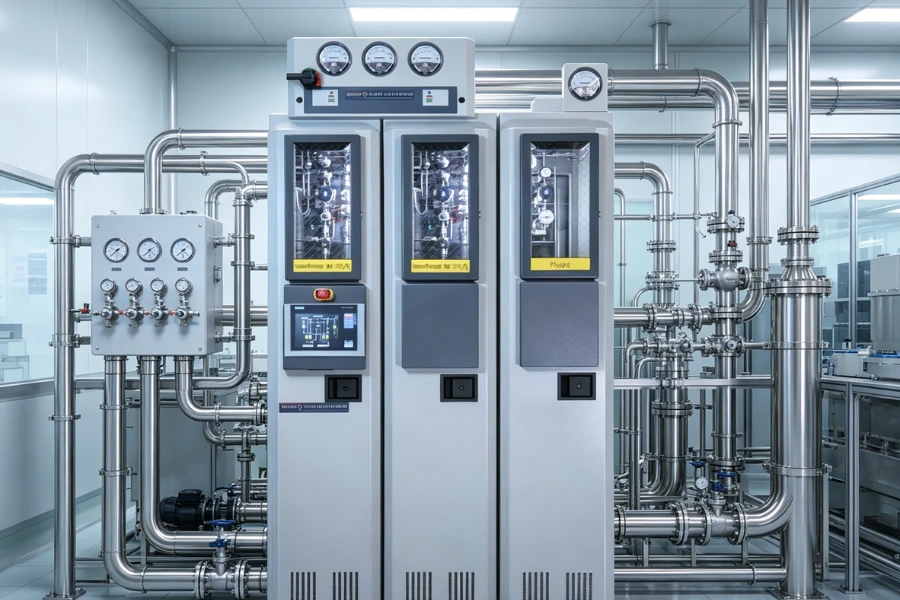
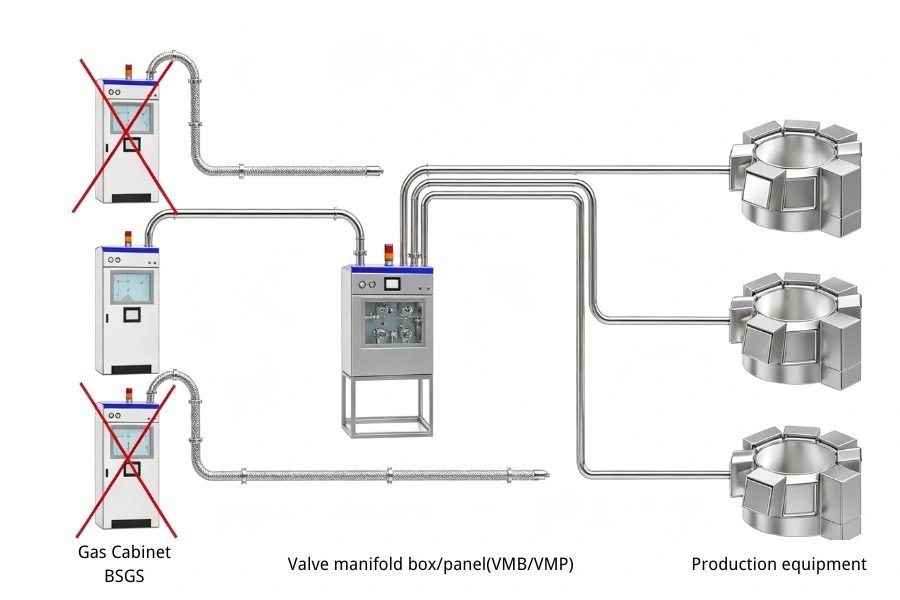
Un sistema de suministro de gas para SiH₄ consta de tres subsistemas principales que funcionan como una unidad integrada de seguridad y proceso.
- El armario para bombonas de gas actúa como principal barrera de contención y seguridad para las bombonas de gas
- La caja de distribución de válvulas (VMB) distribuye el gas a las herramientas de proceso y permite un control localizado
- Las tuberías de alta pureza conectan los componentes del sistema mediante racores soldados y de sellado frontal
Los sistemas de control basados en una arquitectura PLC o DCS gestionan los enclavamientos, las secuencias de purga y las funciones de parada de emergencia.
Cada subsistema debe diseñarse para funcionar de forma independiente en caso de fallo, manteniendo al mismo tiempo la integridad general del sistema.
Requisitos clave de diseño para las cabinas de gas silano
Requisitos de diseño y rendimiento del sistema de purga
El sistema de purga debe garantizar que los niveles de oxígeno y humedad se mantengan por debajo de los umbrales establecidos antes de la introducción de la corriente de gas pirofórico.
- La purga con gas inerte, ya sea nitrógeno o argón, debe lograr una concentración de oxígeno inferior a 1 ppm antes de la activación del sistema.
- Los ciclos de purga deben incluir un mínimo de tres secuencias de vacío y presurización para el cambio de cilindro.
- La velocidad del gas de purga debe mantenerse en 0,3 metros por segundo o más para garantizar un desplazamiento eficaz.
Los criterios de aceptación deben incluir una concentración de oxígeno en la salida verificada inferior al 0,5 % o una concentración de gas de proceso inferior al límite inferior de explosividad.
Requisitos relativos a la detección de fugas y a los dispositivos de enclavamiento
Los sistemas de detección de fugas deben supervisar de forma continua la concentración de gas y activar respuestas automáticas cuando se superen los umbrales definidos.
- Se deben instalar sensores electroquímicos en las cajas de gas, los conductos de extracción y los compartimentos de los VMB.
- Las alarmas de nivel bajo deben configurarse entre 0,1 ppm y 0,5 ppm
- Las alarmas de alto nivel deben activar medidas de enclavamiento por debajo del 50 % del STEL
Las medidas de interbloqueo deben incluir el cierre inmediato de las válvulas de aislamiento de los cilindros, la activación de los sistemas de escape y la puesta en marcha de la purga de emergencia.
Es necesario instalar sensores redundantes con lógica de votación para reducir los falsos eventos de parada.
Selección de materiales y requisitos de soldadura
Todos los materiales en contacto con el fluido deben ser compatibles con el uso de SiH₄ y permitir el suministro de gas de pureza ultraalta.
- Los tubos y los accesorios deben ser de acero inoxidable 316L con superficies internas electropulidas
- La rugosidad superficial no debe superar los 0,25 micrómetros Ra.
- Todas las conexiones deben realizarse mediante racores con junta metálica de sellado por presión
Las uniones soldadas deben cumplir los criterios de la prueba de fugas de helio, que son ≤ 1×10⁻⁹ atm·cc/s. Cada soldadura debe ir acompañada de la documentación correspondiente, que incluya los parámetros de soldadura y los registros de inspección.
Requisitos de diseño para las cajas de distribuidores de válvulas (VMB)
Requisitos de reducción de presión y control de caudal
El sistema de colectores debe reducir la presión del cilindro hasta la presión del proceso, manteniendo al mismo tiempo unas condiciones de caudal estables.
- Se deben utilizar reguladores de presión de dos etapas para reducir la presión desde un máximo de 2000 psi hasta niveles controlados aguas abajo.
- Los materiales utilizados para los diafragmas de los reguladores deben ser resistentes a la corrosión, como el Hastelloy o el Monel.
Para garantizar un suministro preciso, es necesario utilizar reguladores de caudal másico que compensen las variaciones de temperatura y presión.
Restricciones de flujo y requisitos de aislamiento
La limitación del caudal debe impedir la fuga incontrolada de gas en caso de fallo en la parte posterior del sistema.
- Los orificios de flujo restrictivo deben dimensionarse de manera que la descarga máxima se mantenga por debajo de los umbrales de liberación explosiva.
- Las válvulas de exceso de caudal deben cerrarse automáticamente cuando el caudal supere los límites establecidos.
Las válvulas de aislamiento deben permanecer cerradas de forma predeterminada en caso de corte de corriente o de suministro neumático.
Requisitos de redundancia y seguridad ante fallos
El sistema de colectores debe mantener la continuidad del funcionamiento al tiempo que aísla las averías.
- Deben instalarse dos conductos de suministro de gas con conmutación automática
- Para el aislamiento con fines de mantenimiento, deben utilizarse configuraciones de doble bloqueo y purga (DBB)
Las averías locales deben aislar únicamente la rama afectada sin interrumpir las líneas de proceso situadas aguas arriba ni las paralelas.
Requisitos relativos a los dispositivos de bloqueo de seguridad y a la parada de emergencia
Los sistemas de parada de emergencia deben reaccionar ante situaciones de peligro dentro de los plazos establecidos.
- El tiempo de respuesta ESD no debe superar los 50 milisegundos, tal y como se define en la norma SEMI S2.
- Los sistemas de enclavamiento deben incluir tanto lógica cableada como basada en PLC
Una vez activado, el sistema debe:
- Cierra todas las válvulas de aislamiento
- Trazar conductos de ventilación abiertos hacia los sistemas de extracción o de depuración
- Iniciar la purga de nitrógeno de alto caudal
- Activar las alarmas de las instalaciones y notificarlo a los sistemas de control central
La lógica del sistema debe incluir un filtrado de retardo para evitar activaciones erróneas, al tiempo que se mantiene la capacidad de respuesta rápida.
Requisitos de verificación y pruebas del sistema
Todos los sistemas deben someterse a una verificación antes de su puesta en servicio y tras su mantenimiento.
- Las pruebas de fugas con helio deben confirmar la integridad del sistema a un valor ≤ 1×10⁻⁹ atm·cc/seg.
- Las pruebas funcionales deben validar la respuesta del enclavamiento y la ejecución de la secuencia de purga.
- Las pruebas de presión deben confirmar la estabilidad del regulador y el funcionamiento del sistema de alivio de presión
La calibración periódica de los detectores de gas debe realizarse cada 6 a 12 meses utilizando gases de calibración certificados.
Consideraciones sobre la selección y el diseño de sistemas
El diseño del sistema debe ajustarse a los requisitos operativos, a la envergadura de las instalaciones y a los objetivos de seguridad.
- Para la producción de semiconductores a gran escala se requieren sistemas totalmente automatizados.
- En los sistemas críticos es imprescindible implementar una fuente de alimentación redundante y una configuración con dos sensores.
- Los conjuntos de válvulas modulares deben permitir el mantenimiento sin necesidad de paralizar el sistema
Una selección incorrecta de los componentes puede aumentar la exposición al riesgo.
- Los dispositivos limitadores de caudal deben dimensionarse con un margen de seguridad de al menos un 20 % por encima de la demanda del proceso.
- Se deben evitar los materiales de sellado no metálicos en aplicaciones a alta temperatura o de alta pureza.
- El personal de soldadura debe estar certificado según las normas aplicables, como la Sección IX de la ASME.
Asistencia técnica para el diseño de sistemas de gas silano
En entornos complejos de manipulación de SiH₄, el rendimiento del sistema depende de la integración del control de fluidos, la mitigación de riesgos y la lógica de automatización. Estos requisitos van más allá de las especificaciones de los equipos y exigen capacidades de ingeniería a nivel de proceso.
DODGEN aplica estas capacidades en sistemas de fluidos de alta pureza y entornos de proceso peligrosos, lo que permite una optimización a nivel de sistema en lugar de un diseño a nivel de componentes.
Puntos clave del diseño
El diseño del colector de gas y del armario para el servicio con SiH₄ debe cumplir con las normas internacionales e incorporar un control estricto de los sistemas de purga, la detección de fugas y la integridad de los materiales.
Los sistemas automatizados reducen la dependencia operativa y mejoran la coherencia. El diseño del sistema debe dar prioridad al comportamiento a prueba de fallos, a la redundancia y al rendimiento verificable.
Los enfoques basados en la ingeniería garantizan la estabilidad de las operaciones de fabricación de semiconductores en condiciones de proceso de alto riesgo.