Definición
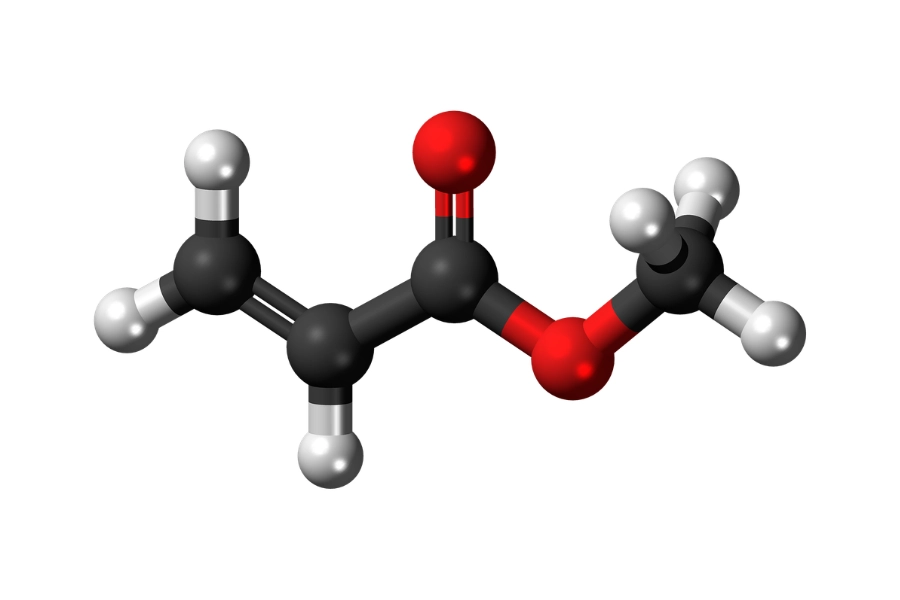
Methyl acrylate is a colorless, volatile organic compound with the molecular formula CH₂=CHCOOCH₃. It belongs to the acrylate ester family and is one of the simplest monomers used in industrial polymer chemistry.
It contains an activated vinyl group, which makes it highly reactive and suitable for polymerization and copolymerization reactions.
Propiedades físicas y químicas
Methyl acrylate is typically a flammable liquid with the following characteristics:
- Density: approximately 0.95 g/cm³ at 20°C
- Boiling point: around 80°C
- Good solubility in ethanol and ether
- High reactivity due to conjugated double bond structure
- Volatile and easily polymerizable under certain conditions
Because of its reactivity, methyl acrylate is usually stabilized with inhibitors during storage and transportation.
Aplicaciones industriales
Methyl acrylate is primarily used as a monomer in polymer manufacturing processes.
Key industrial applications include:
- Acrylic resin production
- Adhesives and coating systems
- Textile and fiber modification
- Paper and leather finishing agents
- Copolymer formulations for performance materials
In most industrial systems, methyl acrylate is not used alone but is copolymerized with other acrylates to adjust flexibility, adhesion, and durability of final materials.
Tecnología de producción
Industrial production of methyl acrylate is commonly based on esterification processes.
Typical production routes include:
- Esterification of acrylic acid with methanol under catalytic conditions
- Controlled reaction systems to manage heat and conversion
- Separation and purification via distillation columns
- Estabilización para evitar la polimerización prematura
Due to its high reactivity, process design must carefully control temperature, residence time, and impurity levels.
Consideraciones técnicas
From a chemical engineering perspective, methyl acrylate systems require careful process control.
Entre los aspectos clave a tener en cuenta se incluyen:
Control de reacción
The compound has a strong tendency toward undesired polymerization, making reaction stability a critical factor.
Purity Management
Impurities can significantly affect polymer quality and downstream performance.
Estabilidad del proceso
Temperature fluctuations must be strictly controlled to prevent side reactions and product degradation.
Operaciones y manipulación en planta
In industrial environments, methyl acrylate is typically stored with polymerization inhibitors under controlled conditions.
Entre los aspectos operativos destacan:
- Temperature-controlled storage systems
- Oxygen and moisture limitation
- Inhibitor concentration monitoring
- Closed transfer systems to reduce vapor exposure
- Safe handling of flammable vapor environments
Proper process design is essential to minimize risks associated with volatility and unintended polymerization.
Sustancias químicas relacionadas
- Ácido acrílico
- Acrilato de etilo
- Acrilato de butilo
- Metacrilato de metilo (MMA)
- Acrylate Copolymers