Características del sistema en aplicaciones con ácido cianhídrico
Ácido cianhídrico (HCN) es un ácido débil con un pKa ≈ 9,2 y una disociación limitada en sistemas acuosos. En condiciones de sequedad y alta pureza, a temperaturas cercanas a la ambiente, las velocidades de corrosión general en aleaciones comunes siguen siendo bajas.
En las operaciones industriales, el HCN rara vez se encuentra en estado puro. Es volátil a temperaturas cercanas a la ambiente, altamente tóxico en concentraciones bajas (del orden de las ppm) y sensible a las impurezas en trazas. Por ello, la integridad de los equipos depende más de la corrosión provocada por las impurezas y de la fiabilidad de los sistemas de contención que de la concentración nominal del ácido.
Comportamiento de corrosión inicial en condiciones controladas
En condiciones de sequedad y con niveles de impurezas por debajo de los límites de detección:
- Los aceros inoxidables austeníticos, como el 316L, suelen presentar velocidades de corrosión inferiores a 0,01 mm/año a temperaturas inferiores a 25 °C.
- La estabilidad de la película pasiva se mantiene en ausencia de especies oxidantes o halogenadas
- La corrosión uniforme sigue siendo el mecanismo predominante
Estas condiciones no son estables en la mayoría de los entornos de proceso y no deben utilizarse como base para la selección de materiales.
Corrosión provocada por impurezas: una limitación técnica determinante
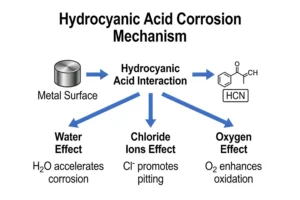
El comportamiento frente a la corrosión en los sistemas de HCN viene determinado por la presencia de agua, haluros, oxidantes y contaminantes ácidos. Estos factores alteran tanto las condiciones electroquímicas como la estabilidad de los materiales.
Contenido de agua
Las concentraciones en agua superiores a aproximadamente 0,5–1,0 wt% provocan hidrólisis y reacciones secundarias. Entre los efectos observados se incluyen:
- Formación de subproductos ácidos o básicos
- Variación del pH en todo el sistema
- Aumento de las velocidades de corrosión de los aceros inoxidables hasta 0,05-0,20 mm/año, dependiendo de la temperatura
Contaminación por haluros
Concentraciones de cloruro de tan solo 10-50 ppm son suficientes para provocar corrosión localizada en los aceros inoxidables austeníticos sometidos a tensión de tracción.
- El potencial de corrosión por picaduras disminuye significativamente en presencia de Cl⁻
- Se ha observado agrietamiento por corrosión bajo tensión en los grados 304 y 316 a temperaturas superiores a 20 °C.
- Puede producirse una penetración localizada sin que se observe una corrosión uniforme apreciable
Especies oxidantes
Las trazas de oxígeno o los ácidos oxidantes alteran las películas pasivas:
- El potencial de ruptura pasiva disminuye
- Se produce la transición de la corrosión pasiva a la activa
- Las tasas de corrosión localizada superan los 0,5 mm/año en las zonas afectadas
Contaminantes ácidos
La presencia de HCl o H₂SO₄ hace que el sistema pase de un comportamiento débilmente ácido a uno fuertemente ácido:
- Las velocidades de corrosión aumentan en un orden de magnitud con respecto al HCN puro
- La corrosión uniforme cobra importancia, además del ataque localizado
Modelo del mecanismo de corrosión
La corrosión en los sistemas HCN sigue un modelo de transición condicional:
- Estado basal: baja corrosión en condiciones secas y sin impurezas
- Estado de activación: introducción de agua, haluros u oxidantes
- Tipos de fallo: corrosión localizada, corrosión por picaduras, corrosión interlaminar y agrietamiento por corrosión bajo tensión
La selección de materiales debe basarse en los estados de activación y de fallo, y no en el estado de reposo.
Modos de fallo habituales en bombas y válvulas
| Modo de fallo | Condición de activación | Impacto observado |
|---|---|---|
| Agrietamiento por corrosión bajo tensión | Cl⁻ ≥ 20 ppm con tensión residual | Rápida propagación de la grieta y pérdida de contención |
| Corrosión por picaduras | Concentración local de cloruro | Penetración sin previo aviso |
| Corrosión intersticial | Interfaces de brida y junta | Ataque localizado acelerado |
| Degradación de los elastómeros | Incompatibilidad química | Pérdida de presión de sellado y fugas |
La progresión del fallo suele ser no lineal y puede dar lugar a una liberación repentina, en lugar de a una degradación gradual.
Marco de selección de materiales
Criterios de selección
La selección de materiales debe basarse en:
- Composición química completa, incluidas las impurezas en trazas
- Rango de temperatura y presión
- Velocidad del flujo y potencial de erosión
- Modo de funcionamiento, incluidas las condiciones de arranque y de anomalías
El coste del ciclo de vida debe incluir los intervalos de mantenimiento, la probabilidad de fallo y el impacto en la seguridad.
Materiales metálicos
Aceros inoxidables austeníticos
- 304 / 304L
Solo es adecuado para HCN seco y de alta pureza, con niveles de impurezas por debajo de los umbrales críticos
El riesgo de fallo aumenta considerablemente por encima de las 10 ppm de cloruro - 316 / 316L
Material de referencia para sistemas controlados
Las tasas de corrosión se mantienen por debajo de 0,05 mm/año en condiciones de baja impureza
El riesgo de corrosión localizada persiste en presencia de haluros - Calidades estabilizadas (321)
Mayor resistencia a la corrosión intergranular en ensamblajes soldados
Aceros inoxidables dúplex
Las aleaciones dúplex, como la 2205, presentan una mayor resistencia a la corrosión bajo tensión. Sin embargo:
- La resistencia a la corrosión por picaduras sigue dependiendo del valor del PREN
- El rendimiento no es estable en sistemas con impurezas mixtas sin validación
Aleaciones a base de níquel
- Hastelloy C-276
Mantiene las tasas de corrosión por debajo de 0,01 mm/año en sistemas con impurezas mixtas, incluidos los haluros
Resistente a la corrosión por picaduras, a la corrosión intersticial y a la corrosión bajo tensión
Se considera un material de primera elección para servicios de HCN de alto riesgo - Monel 400
Compatible con los sistemas HCN, aunque normalmente se elige en función de los requisitos específicos del proceso - Inconel 625
Ofrece un rendimiento estable en entornos con ácidos mixtos, pero su uso se limita debido a su coste
Aleaciones de titanio
El titanio de grado 2 y de grado 7 ofrecen un rendimiento estable en:
- Sistemas que contienen oxígeno
- Entornos con bajo contenido en haluros
Sin embargo:
- Las concentraciones de flúor superiores a los niveles traza provocan una rápida degradación
- La aplicación requiere un control de impurezas y pruebas de validación.
Materiales no metálicos y revestidos
Fluoropolímeros
- PTFE
Químicamente inerte frente a todas las composiciones típicas de HCN
No se observa corrosión apreciable en condiciones normales - PFA / FEP
Resistencia química similar con una mejor capacidad de fabricación - PVDF
Ventajas en cuanto a resistencia mecánica, con una resistencia química aceptable
Entre las limitaciones se incluyen:
- Menor resistencia a la abrasión
- Resistencia estructural limitada
- Sensibilidad a la deformación provocada por el vacío
Sistemas de sellado: riesgo de contención primaria
El fallo de las juntas es la causa que presenta mayor probabilidad de fuga en los sistemas de HCN.
| Material | Rendimiento | Notas |
|---|---|---|
| FKM (Viton) | Estable | Material de sellado estándar |
| Juntas a base de PTFE | Muy estable | Recomendado para sistemas de alta integridad |
| NBR | Condicional | Uso limitado en servicios no críticos |
| EPDM | Inestable | Inflado y degradación rápidos |
A la hora de seleccionar una junta, hay que tener en cuenta tanto la compatibilidad química como las propiedades mecánicas en función de la temperatura.
Configuración de la bomba y la válvula
Sistemas de bombeo
- Las bombas centrífugas requieren un control mínimo del caudal para evitar daños térmicos en las juntas.
- Las bombas de accionamiento magnético y de motor encapsulado eliminan los sellados dinámicos y reducen la probabilidad de fugas
- Las bombas de diafragma ofrecen una alta integridad de contención para aplicaciones de bajo caudal
Sistemas de válvulas
- Las válvulas con sellado de fuelle eliminan las vías de fuga del vástago
- Las válvulas revestidas garantizan el aislamiento químico en entornos agresivos
- Las válvulas de bola deben tener un diseño antiestático para reducir el riesgo de descargas electrostáticas
No se recomiendan las uniones roscadas debido a la formación de hendiduras y a una descontaminación incompleta.
Control de la envolvente operativa
- La temperatura se mantuvo por debajo de los 20 °C para limitar la volatilidad y la cinética de reacción.
- Velocidad de flujo controlada para reducir la erosión y la acumulación de electricidad estática
A temperaturas inferiores a −10 °C, la flexibilidad del elastómero disminuye y es necesario comprobar la fuerza de sellado.
Diseño y mantenimiento de la seguridad
Medidas de diseño
- Sistemas de sellado doble con fluidos de barrera con control de presión
- Sistemas de purga con gas inerte para el aislamiento y el mantenimiento
- Puesta a tierra de todos los componentes conductores
- Sistemas de juntas de alta integridad para uniones con bridas
Prácticas de mantenimiento
- Sustitución programada de las juntas en función de las horas de funcionamiento, en lugar de en función de las averías
- Descontaminación completa mediante gas inerte y neutralización química antes del mantenimiento
- Control del espesor en zonas de alto riesgo, como los codos y los asientos de válvulas
El incumplimiento de la integridad del sellado es la causa principal de las fugas peligrosas.
Análisis de escenarios de fallo
Entre los escenarios de fallo observados en los sistemas HCN se incluyen:
- El acero inoxidable austenítico, al estar expuesto a concentraciones de cloruro de entre 20 y 50 ppm, presenta fisuración por corrosión bajo tensión a los pocos meses de funcionamiento.
- Hinchamiento de la junta de elastómero que provoca una pérdida de la fuerza de estanqueidad y fugas
- Componentes revestidos que fallan en condiciones de vacío o en entornos abrasivos
Estos escenarios demuestran que el fallo viene determinado por condiciones localizadas, más que por la química media del sistema.
Enfoque de ingeniería integrado
El comportamiento de los materiales en aplicaciones con HCN viene determinado por la interacción entre la química del proceso, las condiciones de funcionamiento y el diseño de los equipos.
DODGEN aplica un enfoque integrado en el proceso para la síntesis de API y los sistemas de cristalización en los que interviene el HCN. La selección de los materiales se determina en función de la composición de la reacción, la generación de impurezas y las condiciones de separación, más que en función de la identidad química nominal.
Este enfoque reduce la dependencia de una selección conservadora de materiales y mejora la previsibilidad del rendimiento de los equipos a lo largo de su ciclo de vida operativo.
Conclusión
Sistemas de ácido cianhídrico se definen en función de la sensibilidad a las impurezas y del riesgo de fuga, más que por la fuerza ácida intrínseca. La selección de los materiales para las bombas y las válvulas debe basarse en las condiciones más desfavorables, incluyendo las trazas de impurezas y la variabilidad del proceso.
Para garantizar un funcionamiento fiable, es necesario que existan en armonía las características del material, el control del proceso y la integridad del sellado. Es imprescindible adoptar un enfoque estructurado y basado en datos para la selección y el diseño, con el fin de garantizar tanto la seguridad como el rendimiento a largo plazo.