Definición
El carbonato de etileno (EC), también conocido como 1,3-dioxolano-2-ona, es un compuesto orgánico cíclico de carbonato con la fórmula molecular C₃H₄O₃. Es un sólido cristalino incoloro a temperatura ambiente y se funde a una temperatura ligeramente superior a la ambiente, formando un líquido transparente.
Se utiliza ampliamente como disolvente de alta polaridad y como componente clave del electrolito en los sistemas de baterías de iones de litio y otras aplicaciones electroquímicas.
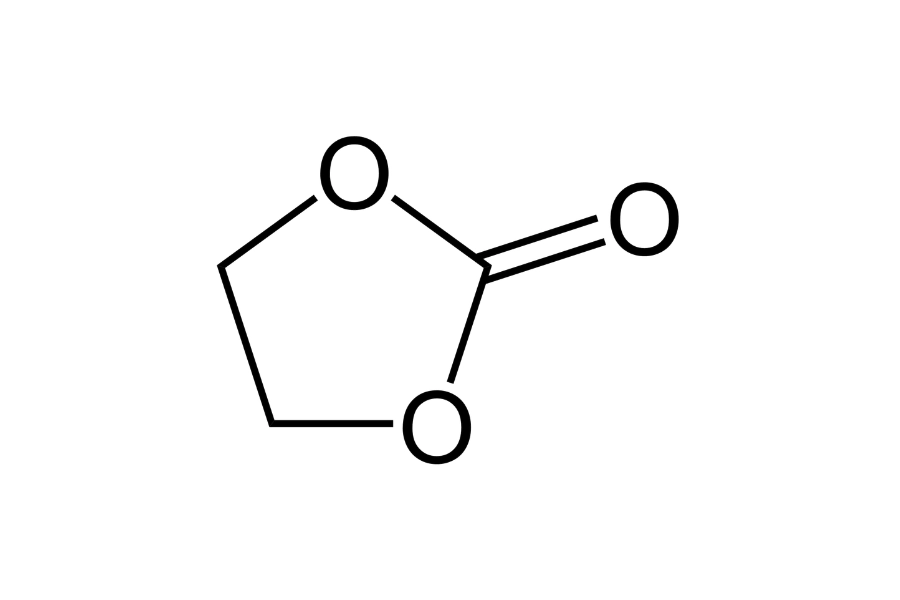
Propiedades físicas y químicas
El carbonato de etileno presenta una fuerte polaridad y una excelente capacidad de solvatación de sales inorgánicas.
Entre sus principales características se incluyen:
- Fórmula molecular: C₃H₄O₃
- Aspecto: sólido cristalino blanco (a temperatura ambiente)
- Punto de fusión: ~35–38 °C
- Punto de ebullición: ~243–248 °C
- Densidad: ~1,32 g/cm³ (en estado líquido)
- Alta constante dieléctrica
- Gran capacidad de solvatación de las sales de litio
Debido a su elevada polaridad, el EC desempeña un papel fundamental en la estabilización de la conducción iónica en los sistemas electrolíticos.
Aplicaciones industriales
El carbonato de etileno se utiliza principalmente como disolvente funcional y como producto intermedio en sistemas químicos de alto rendimiento.
Entre sus principales aplicaciones se incluyen:
- Electrolitos de baterías de iones de litio (componente disolvente principal)
- Sistemas de almacenamiento de energía electroquímica
- Plastificante para polímeros y resinas
- Intermedio en síntesis orgánica
- Aditivos para el procesamiento de textiles y fibras
- Procesos de purificación y separación de gases
En los sistemas de baterías, el EC suele mezclarse con carbonatos lineales para equilibrar la viscosidad, la conductividad y la formación de la SEI (interfaz del electrolito sólido).
Tecnología de producción
La producción industrial de carbonato de etileno se basa habitualmente en la reacción entre el óxido de etileno y el dióxido de carbono.
Proceso típico:
- Reacción catalítica del óxido de etileno con el CO₂
- Proceso de cicloadición a alta presión
- Condiciones de temperatura y presión controladas
- Purificación mediante destilación y cristalización
- Eliminación de los intermedios y subproductos que no han reaccionado
Este proceso se considera un ejemplo representativo de la química de la utilización del carbono en los sistemas industriales modernos.
Consideraciones técnicas
Desde el punto de vista de la ingeniería de procesos, la producción y la aplicación del EC implican varios factores críticos:
Control de reacción
Las reacciones de fijación de CO₂ requieren un control preciso de la temperatura, la presión y la actividad del catalizador para mantener la eficiencia de conversión.
Requisitos de pureza
Las impurezas pueden afectar de manera significativa al rendimiento de los electrolitos, especialmente en aplicaciones de baterías de iones de litio.
Comportamiento térmico
El EC tiene un punto de fusión relativamente alto, lo que requiere sistemas de calentamiento controlados para su manipulación y transporte.
Operaciones y manipulación en planta
En entornos industriales, el carbonato de etileno se maneja normalmente en estado líquido fundido, en condiciones de temperatura controladas.
Entre las consideraciones operativas se incluyen:
- Sistemas de almacenamiento con control de temperatura por encima del punto de fusión
- Prevención de la solidificación en las tuberías
- Control de la humedad para mantener la estabilidad del producto
- Integración de un sistema de purificación para EC apto para baterías
- Sistemas de transferencia cerrados en plantas de producción de electrolitos
En la producción de materiales para baterías, incluso una contaminación mínima puede afectar significativamente al rendimiento electroquímico.
Sustancias químicas relacionadas
- Óxido de etileno (EO)
- Carbonato de dimetilo (DMC)
- Carbonato de dietilo (DEC)
- Carbonato de propileno (PC)
- Sales de litio (LiPF₆, LiFSI)