Riesgos del proceso en la producción convencional de ISMN
El mononitrato de isosorbida se produce mediante procesos de nitración o de reducción selectiva en los que intervienen intermedios en forma de ésteres de nitrato. Estas reacciones son muy exotérmicas y requieren un control estricto de la temperatura para evitar la descomposición y situaciones de reacción descontrolada.
En los reactores discontinuos convencionales se observan las siguientes limitaciones:
- Un gran volumen de reacción, que suele oscilar entre cientos y miles de litros, aumenta la gravedad de las variaciones térmicas.
- Una superficie de transferencia de calor limitada provoca gradientes de temperatura y un sobrecalentamiento localizado
- El aumento de escala modifica las características de mezcla y disipación del calor, lo que introduce incertidumbre en el control de la reacción
Se han descrito procesos de hidrogenación selectiva con catalizadores de Pd/C en configuraciones discontinuas, con rendimientos superiores al 80 % en condiciones optimizadas. Sin embargo, estos enfoques siguen dependiendo del procesamiento discontinuo y no abordan la seguridad inherente a través del diseño del reactor.
La principal limitación no es la viabilidad de la reacción, sino la seguridad del proceso en condiciones a escala industrial. Los sistemas de ésteres de nitrato presentan riesgos de explosión durante la síntesis, la separación y el almacenamiento, lo que exige estrategias de intensificación del proceso que reduzcan tanto la probabilidad del riesgo como sus consecuencias.
Cómo mejora la seguridad de los procesos el flujo continuo
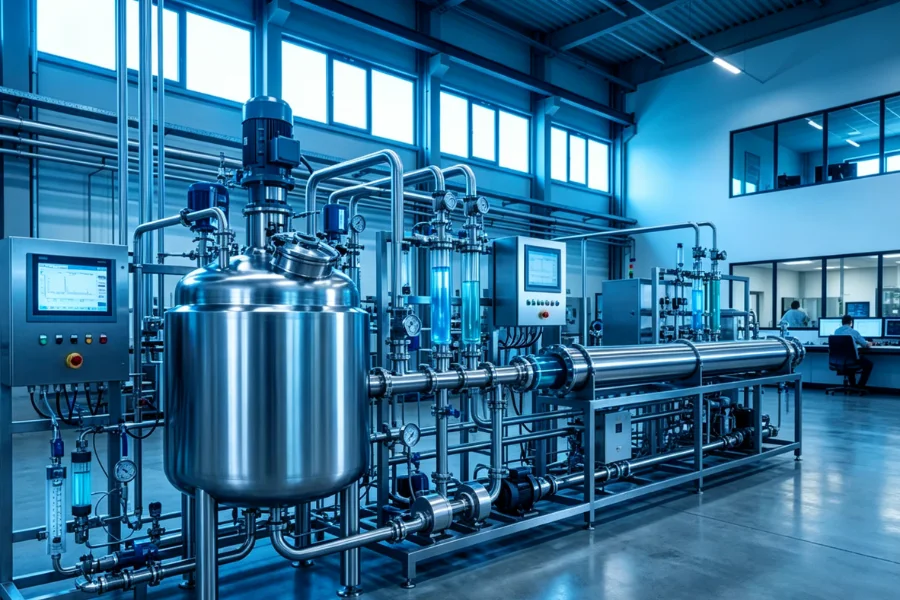
Los sistemas de procesamiento basados en el flujo modifican el perfil de riesgo al reducir el inventario de reacción y mejorar el control térmico.
Inventario de reacciones inferiores
- Los reactores de microcanales funcionan con volúmenes de retención a escala de mililitros
- Las etapas del reactor de flujo distribuyen el inventario entre varias unidades, en lugar de en un único recipiente
Esta configuración reduce la masa reactiva total presente en un momento dado y limita la liberación máxima de energía en caso de desviación.
Mejora de la disipación del calor
- Los coeficientes de transferencia de calor suelen ser entre uno y dos órdenes de magnitud superiores a los de los sistemas discontinuos.
- La temperatura puede mantenerse dentro de márgenes de funcionamiento muy estrechos, a menudo dentro de un intervalo de ±0,5 grados Celsius.
Una mejor gestión térmica reduce la probabilidad de que se produzcan puntos calientes locales y mitiga las vías de descomposición asociadas a la inestabilidad de los ésteres de nitrato.
Control preciso del tiempo de permanencia
- Una distribución estrecha del tiempo de permanencia mejora la uniformidad de la reacción
- La duración de la reacción viene determinada por el caudal, más que por el tiempo de reacción total.
Este control reduce la reducción excesiva y minimiza la formación de subproductos como el isosorbida y los isómeros de mononitrato no deseados.
Seguridad intrínseca por diseño
- Los intermedios reactivos se generan y se consumen in situ
- No se producirá acumulación de mezclas peligrosas en los depósitos de almacenamiento o en los recipientes intermedios.
La integración de medidas de seguridad adicionales suele incluir:
- Sistemas de alivio de presión y discos de ruptura
- Corte automático de la alimentación y enfriamiento de emergencia
- Purga con gas inerte en condiciones anómalas
Las implementaciones descritas de procesos de nitración continua indican una reducción sustancial de la gravedad de los incidentes en comparación con los sistemas por lotes, debido principalmente a la reducción de las existencias y a un mejor control térmico.
Aumento de la eficiencia en el procesamiento continuo
La configuración de procesamiento continuo mejora tanto el rendimiento de la reacción como la eficiencia operativa.
Menor tiempo de reacción
- Los tiempos de permanencia en los sistemas de flujo suelen oscilar entre segundos y minutos.
- Las reacciones por lotes similares pueden durar varias horas, dependiendo de las condiciones de reacción.
Unos tiempos de reacción más cortos reducen el consumo de energía y aumentan el rendimiento.
Mayor rendimiento y selectividad
- La selectividad hacia el producto objetivo, el mononitrato, puede superar el 80 % en condiciones controladas
- La formación de subproductos se reduce gracias a un control preciso de la temperatura y del tiempo de permanencia.
En lo que respecta a los procesos por lotes, las mejoras en el rendimiento suelen atribuirse a la reducción de las reacciones secundarias y a la uniformidad de las condiciones de reacción.
Menor riesgo de ampliación
- Los sistemas de flujo se amplían mediante un aumento del número de elementos, en lugar de mediante una ampliación geométrica.
- Las condiciones de proceso establecidas a escala de laboratorio pueden trasladarse directamente a las unidades de producción
Este enfoque reduce el tiempo de desarrollo y evita tener que volver a optimizar el sistema durante la transición a una escala superior.
Procesamiento continuo integrado
Los sistemas continuos permiten encadenar operaciones secuenciales sin manipulación intermedia:
- Hidrogenación
- Nitración o reducción
- Extracción y lavado
- Cristalización y secado
La integración reduce la manipulación de productos intermedios peligrosos y disminuye los costes de procesamiento posteriores.
Eficiencia del catalizador y del disolvente
- Las configuraciones de lecho fijo o con catalizador retenido permiten el uso continuo de Pd/C o sistemas similares
- La recuperación de disolventes es más eficiente gracias al funcionamiento en régimen estacionario
Estos factores contribuyen a reducir los costes operativos y las pérdidas de material.
Consideraciones de diseño para los procesos de gestión del ISMN
Elegir la vía de reacción adecuada
Se aplican dos vías principales:
- Nitración directa de la isosorbida
- Reducción selectiva del dinitrato de isosorbida
El procesamiento continuo resulta especialmente eficaz para la nitración directa, gracias a su capacidad para gestionar la rápida liberación de calor y limitar las existencias peligrosas.
Selección del tipo de reactor
Se utilizan diferentes configuraciones de reactor en función de las características de la reacción:
- Reactores de microcanales: adecuados para reacciones de nitración altamente exotérmicas que requieren un control térmico preciso
- Reactores tubulares: aptos para la hidrogenación a alta presión o para entornos corrosivos
- Reactores de tanque agitado continuo en serie — adecuados para sistemas multifásicos con catalizadores sólidos
La selección de materiales suele incluir aleaciones resistentes a la corrosión o revestimientos de fluoropolímeros para garantizar la compatibilidad con el ácido nítrico.
Condiciones clave de funcionamiento
Según los rangos óptimos indicados:
- Temperatura: normalmente entre -5 y 20 grados centígrados para la nitración o reducción controladas
- Presión: de 0,2 a 4 megapascales en condiciones de hidrogenación
- Concentración de ácido: controlada mediante mezcla en línea para evitar el sobrecalentamiento localizado
El funcionamiento estable depende de que se mantenga una distribución uniforme del caudal y de que se eviten los gradientes de concentración.
Procesamiento continuo en fase posterior
El procesamiento continuo va más allá de la fase de reacción:
- Las unidades de extracción y lavado en línea reducen la manipulación manual
- El secado continuo y la eliminación de disolventes mejoran la eficiencia
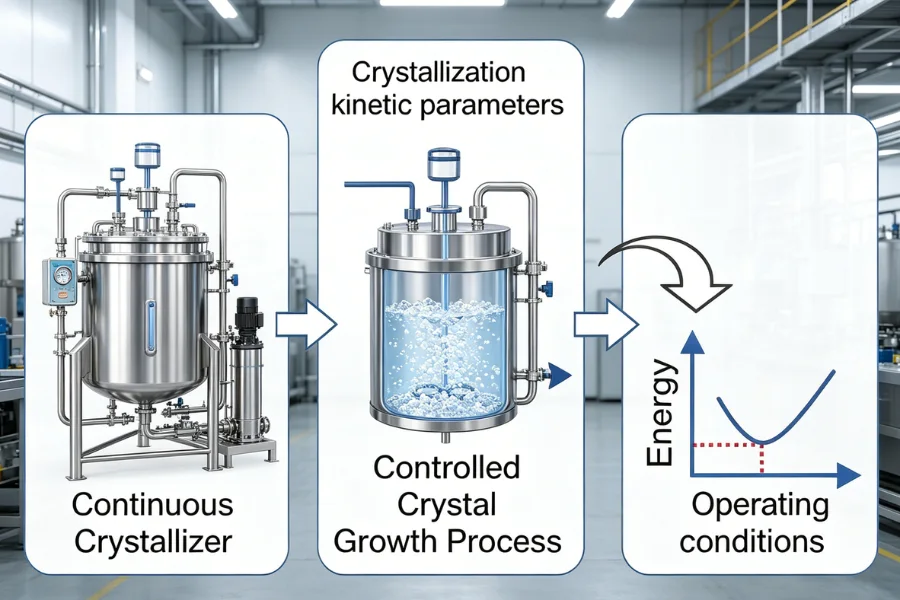
- La cristalización continua permite controlar la distribución del tamaño de las partículas
La integración reduce la variabilidad y mejora la uniformidad del producto.
Controles de seguridad de los procesos
Los sistemas de flujo suelen estar equipados con:
- Bloqueos por temperatura y presión
- Protocolos de apagado automático
- Sistemas de gas inerte para la estabilización de emergencia
Estas características permiten responder en tiempo real ante las desviaciones y mantener un funcionamiento controlado.
Del laboratorio a la producción: implementación del proceso
La transición del procesamiento por lotes al procesamiento continuo requiere un diseño coordinado del reactor, un análisis de seguridad y una integración con las fases posteriores del proceso.
DODGEN ofrece soluciones de ingeniería y desarrollo de procesos para productos intermedios farmacéuticos, incluidos los sistemas de ésteres de nitrato, como el mononitrato de isosorbida.
Entre las capacidades relevantes se incluyen:
- Diseño de sistemas de reactores de flujo, incluidas configuraciones de microcanales y tubulares
- Integración de unidades de hidrogenación y nitración en líneas de proceso unificadas
- Análisis de seguridad e implantación de sistemas de identificación y control de riesgos
- Desarrollo de sistemas de cristalización en continuo para la formación controlada de partículas
- Integración de procesos de principio a fin que abarca las fases de reacción, separación y purificación
Estas capacidades facilitan la implementación de estrategias de fabricación continua que se ajustan a las exigencias normativas en materia de uniformidad y seguridad de los procesos.
Principales conclusiones
El procesamiento basado en el flujo resuelve las principales limitaciones observadas en la fabricación de ésteres de nitrato al reducir el inventario de reacción, mejorar la transferencia de calor y permitir un control preciso de las condiciones de reacción.
Las mejoras en materia de seguridad y eficiencia se consiguen mediante los mismos mecanismos subyacentes: reducción del volumen, tiempo de permanencia controlado y diseño integrado del proceso.
La transición del procesamiento por lotes al procesamiento continuo supone un cambio estructural en la forma de gestionar las reacciones de los ésteres de nitrato, pasando de la mitigación de riesgos a la seguridad inherente por diseño.